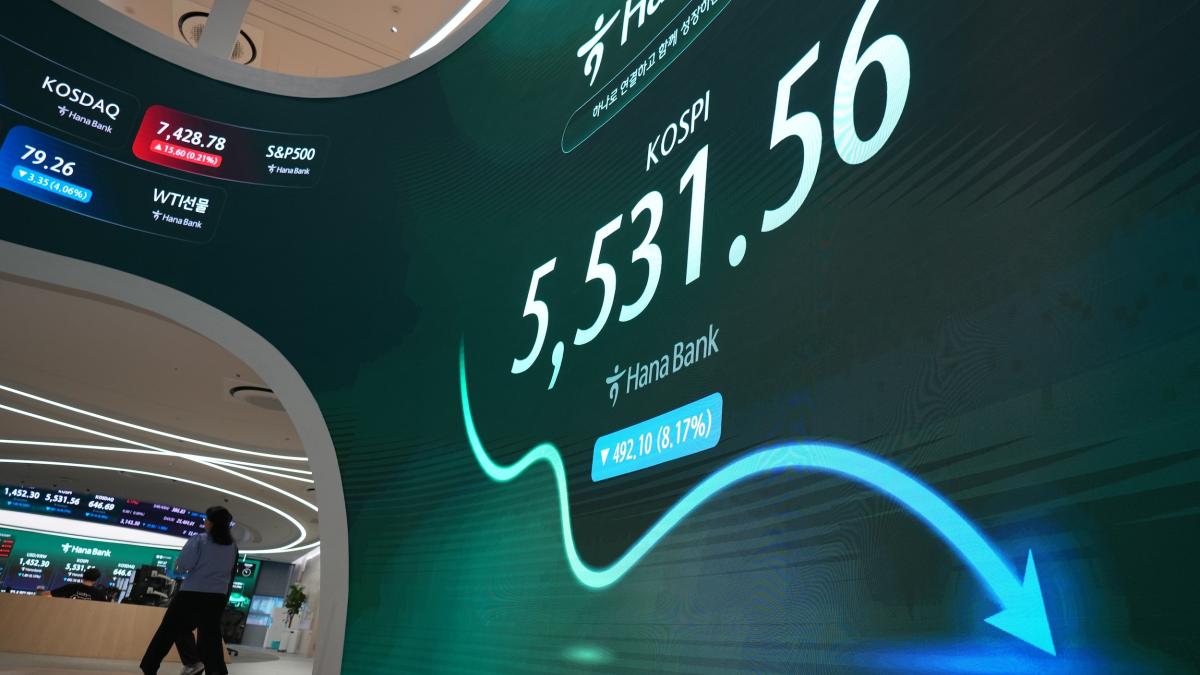
South Korea's stock market has suffered a historic crash. On the 29th, memory chip giant SK Hynix announced its second-quarter 2026 operating profit reached 60.5426 trillion KRW (approximately $43.8 billion), setting a new single-quarter record. Sales hit 79.3187 trillion KRW, a year-on-year surge of 557.2%. However, the market plunged into panic after the company failed to provide future outlook or shareholder return plans during its earnings call, triggering circuit breakers on both the Korea Composite Stock Price Index (KOSPI) and the KOSDAQ.
The circuit breaker mechanism halts trading for 20 minutes if an index drops more than 8% and remains below that level for over one minute. KOSPI briefly fell below 5,400 points, marking the first time in history that circuit breakers were triggered for two consecutive days. The previous day, on the 28th, KOSPI had already plunged 10.84% (732.09 points), closing at 6,023.66—the second-largest single-day drop in history.
SK Hynix's stock initially rose 2.39% to 1.587 million KRW after the earnings release but then collapsed 15.29% to 1.313 million KRW amid massive sell-offs. Samsung Electronics, South Korea's so-called 'national fortress,' also tumbled 9.80% in the afternoon, breaking below 200,000 KRW to 198,600 KRW.
South Korea's ChosunBiz expressed deep disappointment in SK Hynix's earnings call. While global tech giants often have their CEOs present clear future visions, SK Hynix Chairman Choi Tae-won did not attend, and the company gave vague answers on future guidance and shareholder returns. The publication called the call 'the biggest risk to the Korean stock market.' Industry insiders sarcastically noted, 'He used to publicly share photos of himself eating fried chicken, yet chose to vanish during a crucial investor call.'
KOSPI dropped 9.61% intraday to 5,444.74 points, while KOSDAQ fell 8.99% to 642.42 points. The Korea Exchange halted trading for 20 minutes at noon for both indices. This marked the 15th time in history—and the 9th time this year—that KOSPI triggered a circuit breaker, and the first time it happened for two consecutive days. For KOSDAQ, this was the third time in history—after the 2008 global financial crisis and the 2011 U.S. credit downgrade—that it experienced back-to-back circuit breakers.
Kiwoom Securities analysts noted, 'Historically, such massive sell-offs occur during financial crises, wars, or asset bubbles bursting. But no such systemic risk exists now. While concerns about memory market peaks, Chinese chipmakers' expansion, and Fed rate hikes persist, these remain potential risks. The current panic selling is clearly an overreaction.'
Meanwhile, the semiconductor sell-off in U.S. markets also impacted Korea. On the previous trading day, Micron dropped 8.85%, SanDisk plunged 14.25%, and SK Hynix's ADR fell 8.98%. The Wall Street Journal reported that capital is rapidly shifting from AI-related stocks to traditional defensive sectors—Coca-Cola rose 5%, pushing the Dow Jones up 1.03%—indicating 'investors are questioning AI's return on investment and actively seeking safe havens.'
CNBC further pointed out that South Korea's market has become a 'barometer' for U.S. tech stocks: 'The 60-day correlation coefficient between KOSPI and the Nasdaq 100 has risen to around 0.50, the highest since 2021. Global institutional investors now use Korean market movements to predict U.S. tech stock trends before New York opens, and vice versa.'
In response to the panic, Mirae Asset Securities downgraded its price targets on April 29. While maintaining 'Buy' ratings for both Samsung Electronics and SK Hynix, it slashed Samsung's target from 550,000 KRW to 370,000 KRW and SK Hynix's from 4.2 million KRW to 2.8 million KRW.
FACT BOX
- Source: PR Times
- Category: News
- Organizations: SanDisk / CNBC / The Wall Street Journal