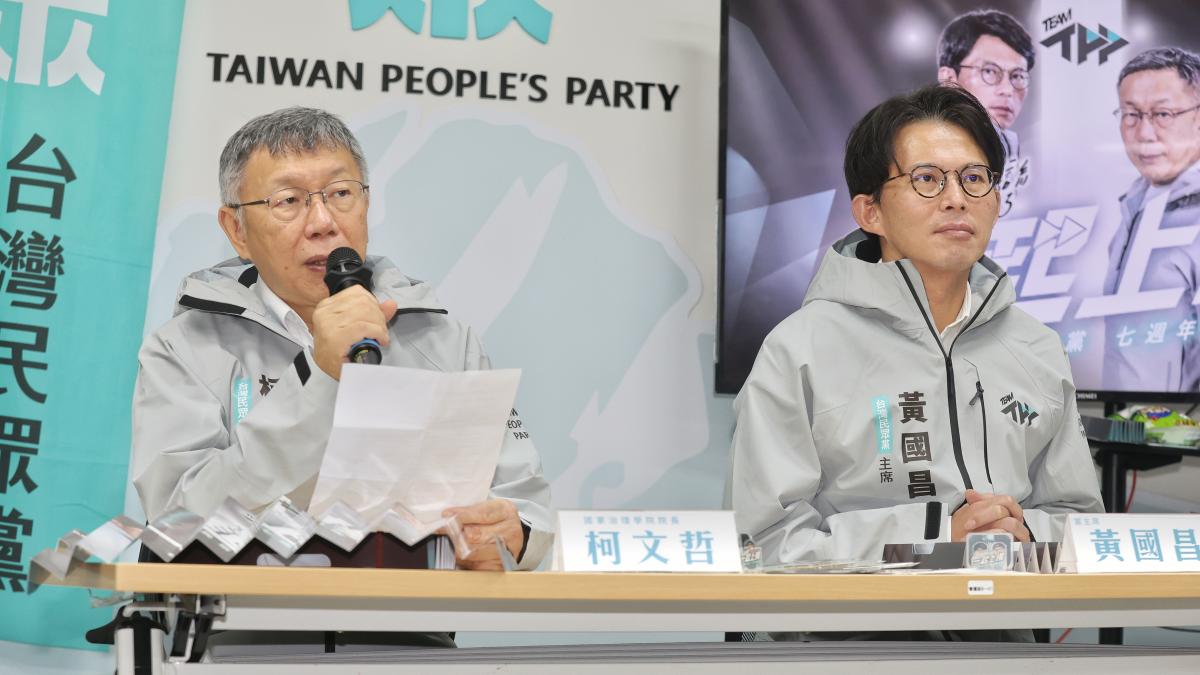
Taipei Mayor Chiang Wan-an has recently proposed a vote of no confidence against Executive Yuan Premier Cho Jung-tai, calling on the Legislative Yuan to initiate a no-confidence vote, sparking political debate. Ko Wen-je, former chairman of the Taiwan People's Party, stated on the 29th that the key issue is not toppling the cabinet but 'toppling Lai'—President Lai Qing-te must be replaced, as changing the premier without changing the president would yield little real difference. Huang Kuo-chang, current chairman of the Taiwan People's Party, added that after Chiang introduced the topic, several Kuomintang (KMT) legislators reached out to him, and all those who contacted him oppose the motion. A no-confidence motion requires one-third of legislators to file; according to Huang’s current information, the KMT caucus holds highly divergent views on the matter.
Ko Wen-je and Huang Kuo-chang attended a pre-party anniversary press conference for the Taiwan People's Party on the 29th. Regarding the no-confidence motion, Ko reiterated his rational, pragmatic, and scientific stance. First, he noted that over the past two years, the legislature has been chaotic, with little notable administrative achievement. 'Perhaps President Lai himself wants to replace Cho Jung-tai. By proposing a no-confidence vote now, Chiang Wan-an might be inadvertently helping Lai solve a problem he already wanted to address—making Chiang merely a stepping stone,' Ko said.
Second, Ko emphasized that the real issue is not toppling the cabinet but toppling Lai. 'As long as the president remains unchanged, replacing the premier will produce similar results. If a cabinet collapse doesn’t lead to a full legislative re-election, but only results in Lai appointing a new premier, it’s merely changing the soup, not the medicine.' Ko pointed out that Taiwan holds comprehensive elections every two years—alternating between central and local levels. If a full legislative re-election were triggered, new terms would reset, effectively consolidating all elections except the presidential one. This could significantly impact Taiwan’s political operations, especially since the president holds the most power, and separating presidential elections from others could reshape the political landscape.
Ko stressed that Chiang Wan-an must present a clear rationale when discussing a no-confidence motion. 'Just as surgery requires considering success, failure, and complications, so too must political actions be carefully assessed.' He warned that after the recent wave of recalls, society is already fatigued. 'Elections are a form of social mobilization and not easily executed, especially in Taiwan, where they often deepen partisan divides. We must consider whether society can endure another round of mobilization.' He emphasized cost-benefit analysis: 'Is Chiang helping Lai solve a problem, or just throwing out an idea? Does he advocate for a full legislative re-election? These are complex issues that require clear articulation so we can make accurate assessments. Without a clear diagnosis, sound decisions are impossible.'
Huang Kuo-chang stated that after Chiang raised the issue in the media, the KMT caucus remains deeply divided. The '725 People on Ketagalan Avenue' rally demanded the government properly address the carcinogenic cooking oil food safety scandal, which remains unexplained. Huang insisted that Premier Cho must be held to the same political accountability standards the DPP set 12 years ago—he should have already resigned. 'What angers the public is how poorly Lai’s administration has handled this crisis. What explanation will the Lai government give the people? Who will take political responsibility? These are the questions we must keep asking.' He stressed that it is the DPP government that must now face the public, not divert attention from the real issues.
FACT BOX
- Source: PR Times
- Category: News