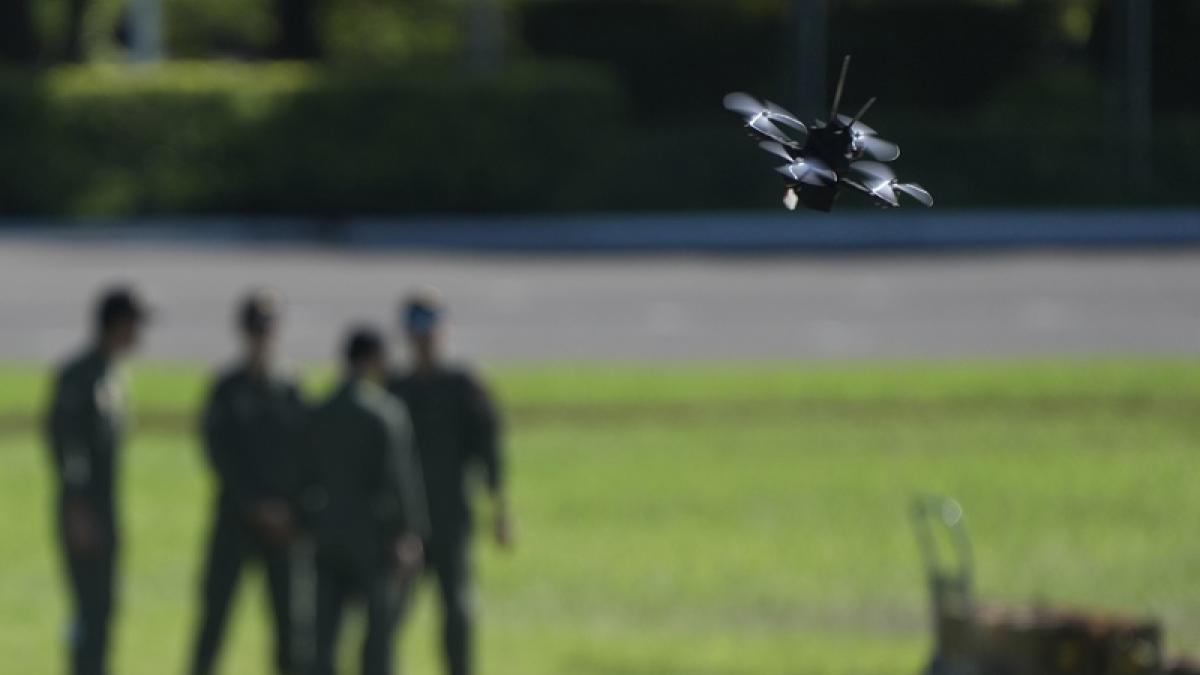
A special budget of 210 billion yuan has been allocated to procure over 210,000 unmanned aerial vehicles (UAVs), creating long-term demand and expansion opportunities for Taiwanese manufacturers. However, the true test for a genuine 'non-red supply chain' lies in decoupling from Chinese suppliers for key components.
By Lü Taide
For Taiwanese manufacturers, the drone industry has gradually secured international cooperation, prototype development, and mass production orders. Yet the real challenge lies in transitioning from small-scale development to mass-scale manufacturing. According to the Ministry of Economic Affairs, more than ten domestic companies have already received prototype or mass production orders from U.S. firm Anduril in areas such as airframe structures, payload equipment, and propulsion systems. If procurement scales expand from dozens of prototype units to tens of thousands of mass-produced units, manufacturers must simultaneously meet requirements for delivery timelines, yield rates, cost control, consistent quality, and cybersecurity. They must also establish component traceability, testing and verification, and continuous iteration capabilities to convert policy-driven demand into stable production capacity.
The Executive Yuan has passed the draft 'Special Act on Indigenous Unmanned Vehicle Procurement for National Defense,' planning to allocate budgets annually from August 2026 to December 2031. The total budget cap is 210 billion yuan, with procurement items including coastal surveillance drones, coastal attack drones, and small suicide unmanned boats.
A procurement demand of 210,000 units emerges, offering expansion opportunities for Taiwanese manufacturers
According to public statements by the Ministry of National Defense, the planned quantities are 1,446 units, 208,200 units, and 1,320 vessels, totaling 210,966 units. Among these, coastal attack drones account for approximately 98.7% of the total, reflecting the policy focus on mass deployment, rapid replenishment, and continuous iteration of small unmanned vehicles. If we project this over the 65-month period from August 2026 to December 2031, an average of about 3,246 units per month would need to be delivered.
Currently, Taiwan's monthly production capacity for complete drone units is about 15,000. The government aims to increase this to 100,000 units by 2030, raising the export ratio from the current 20% to 50%. The export value in the first quarter of 2026 has already surpassed the full-year 2025 total, and the first half of 2026 saw drone exports reach $212 million. If the 210 billion yuan procurement plan proceeds smoothly, the benefits will extend beyond just drone integrators, potentially reaching aerospace quality management, electronics manufacturing, optical sensing, communication equipment, and logistics maintenance supply chains.
To strengthen the industrial foundation, the Executive Yuan has also approved a comprehensive unmanned vehicle industry development plan from 2025 to 2030, investing 44.2 billion yuan to promote demand-driven development, technology R&D, testing and verification, industrial clusters, regulatory systems, and international market linkages. Lei Hu and Chungwha Telecom have already invested in drone platforms and system integration. Aerospace firms like AIDC possess experience in aircraft manufacturing, quality assurance, reliability, and maintenance systems. Electronics conglomerates such as Foxconn, Pegatron, and Qisda have large-scale procurement, automated production, and global delivery capabilities.
The non-red supply chain is key—core components remain the biggest challenge
Drones are highly integrated electromechanical and electronic systems, including not only frames, propellers, and casings but also battery cells, motors, flight controllers, satellite positioning, communication chips, image sensors, data storage, and firmware. Even if final assembly occurs in Taiwan, if core components rely on restricted Chinese suppliers, or if firmware updates, data transmission, or sub-supplier sources cannot be traced, it may affect government procurement eligibility, cybersecurity reviews, and international market certifications.
Section 5949 of the U.S. 'National Defense Authorization Act for Fiscal Year 2023' states that, effective December 23, 2027, federal executive agencies are generally prohibited from procuring electronic products containing certain restricted semiconductor products or services. For electronics used in critical systems, these regulations may also extend to subordinate electronic products. On February 17, 2026, the FAR Council proposed a draft of implementing rules requiring prime contractors to conduct reasonable due diligence to confirm the origin of restricted semiconductors and to pass these requirements down to applicable subcontractors.
FACT BOX
- Source: PR Times
- Category: News
- Organizations: Anduril