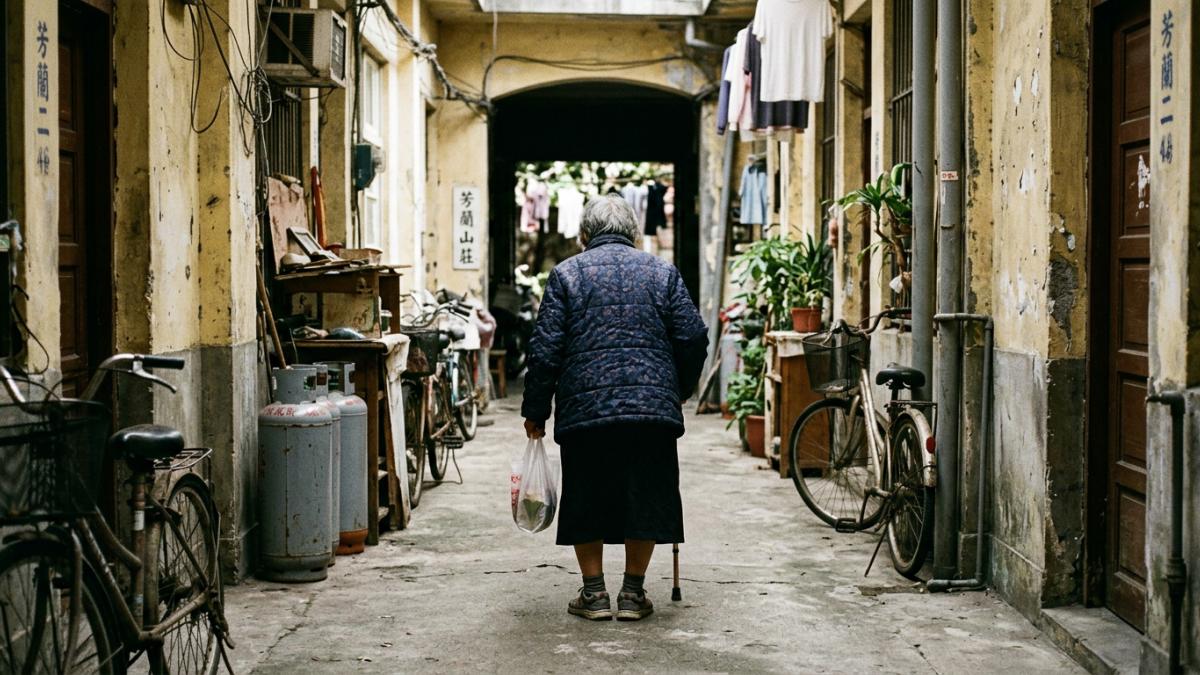
In the half-mountain area of Fanglan Mountain in Taipei's Da'an District, there is a veterans' village that seems to have been forgotten by time, called Fanglan Mountain Villa. Among the old, low-cost housing units, several tall Blue Sky, White Sun, and Red Earth flags stand out, flapping in the wind. It is like an awkward patch sewn onto the new brocade of Taipei that is constantly expanding outward. Inside Fanglan Mountain Villa, there are two four- to five-story Air Force Veterans' Retreats. Upon closer inspection, the history of the place is evident: single-person dormitories with an age of over half a century, with peeling walls and grayish surfaces. One floor, dozens of doors, shared toilets and showers at the end of the hall. It is hard to imagine that a group of elderly people are still living there, most of whom are mainland spouses. Currently, there are still 16 old soldiers living in this retreat. The youngest is 98 years old. His eyes are cloudy, and when he sees strangers, the corners of his mouth twitch occasionally, as if he has just woken up from a very long dream. He is the chairman of the "Veterans' Self-Government Association" here. Self-government, this word has no echo in this hallway. The one managing this building is time itself. The other half of the residents are the women left behind by the old soldiers after they passed away. They have a collective name—the veterans' widows. They came from the other side of the strait. Now, the ones hanging on the wall, smiling in the glass frame, and no longer speaking are their husbands. They have become the "widows" in this building. Now, they are in their twilight years, but a catastrophic disaster is hanging over their heads, waiting to strike at any moment. To understand why they are huddled here, we must first dispel a thicker layer of historical fog. In 1949, 1.2 million people of the Kuomintang government crossed the strait, among whom 600,000 were soldiers. They were mostly rural youths, conscripted, and in a daze, they put on military uniforms, retreated south, and boarded ships in a daze. Looking at the gradually distant coastline, when they turned back, it was already their twilight years. To "strengthen combat will," in 1952, the "Marriage Regulations for Land, Sea, and Air Forces during the Period of Bandit Suppression" was issued: combat units, military school students, and those who had not completed their service were not allowed to marry. The ban was slightly relaxed in 1959 and was narrowed down to direct combatants, those executing emergency defense, and military school students by 1974. It was not until 1987, when martial law was lifted and visits to mainland China were allowed, that the first to rush to the docks and airports were these elderly people. They saw that the fields of their hometowns remained the same, but their parents had already turned white-haired, or were buried under green mountains. They had become old soldiers from new recruits, but they were still alone. Whether it was for the continuation of the lineage or emotional companionship, in any case, although most of them were already over sixty, they finally had the opportunity to marry in mainland China while they still had the ability. For a time, it became fashionable to bring young mainland compatriots back to Taiwan to live. They were in their thirties or forties, divorced or widowed, with weathered faces and hesitant eyes. Life on the other side of the strait was bitter, and the promises on this side were thin—a dormitory and a half-pay (after death)—but it was a stable hope. In 1991, the "Regulations on Relations Between People Across the Taiwan Strait" were promulgated; in 1992, mainland spouses were legally allowed to reside in Taiwan. The tide of cross-strait marriages officially rose. According to the public statistics of the Taiwan Immigration Agency, by the end of 2011, there were 302,700 veterans with spouses in Taiwan, accounting for 67.2% of the total number of veterans. Among them, 32,656 mainland spouses of veterans had come to Taiwan, accounting for more than 10% of the total number of mainland spouses in the country. Behind these numbers is a generation of elderly people who were delayed in their youth by the marriage ban and hastily made up for their marriage after the lifting of martial law, as well as a group of women who gambled their later half of life for a stable old age. Huang Da Jie from Fanglan Mountain Villa is one of them. She is 78 years old, from Zhejiang, and her back is still quite straight. When she came to Taiwan in 2000, she was just 53 years old. She is very clear about her role: "I just came to be a nanny." After her veteran husband passed away at the age of 97, she stayed in this dormitory that does not require rent. She has nowhere to go and cannot afford the cost of finding another place to live. The refrigerator is broken and cannot be repaired. Even if it is repaired, she does not dare to use electricity. Therefore, she rarely buys groceries and lives on a half-pay of 13,000 New Taiwan dollars per month. I asked her the question that Taiwanese people often ask mainland spouses: "It's so hard, why don't you go back to mainland China?" She smiled bitterly: "How can I live if I go back? There is no medical insurance or social security. Going back would only burden my children." Those are the children she had with her ex-husband in mainland China. Now, her children are also about to turn 60. They have never paid for social security or medical insurance in mainland China. At the age when they need to spend money on medical treatment, going back would mean having nothing. Here, there is national health insurance and preferential treatment for veterans' dependents at the Veterans General Hospital. This is the biggest reason they cannot leave. Yang Da Jie, 88 years old, is another case. She came to Taiwan in 2000 at the age of 63. Her husband passed away at the age of 98. She was born in Shanghai, went to support Guizhou in her youth, and now speaks Guiyang dialect, which makes me, a Sichuanese, feel strangely familiar. She has children in Guiyang. A few years ago, when she was seriously ill and could not take care of herself, they came to take care of her and then went back. But she cannot go back, nor can she go back. She has a half-pay of 17,000 and an elderly pension of more than 8,000, which is considered "affluent" among the widows. But this affluence is only the money to "wait for death" in the small house on the fourth floor. She has lost her sight in one eye, cannot stand for long, and has to sit down after saying a few words to someone. Thus, when chatting, she often apologizes, "I'm sorry, I can only sit." With such legs, she has to carry a walker every day, trembling, step by step, from the fourth floor down to the supermarket, to buy a bunch of vegetables and a few eggs. Xiang Da Jie is 73 years old, from Zhejiang, and looks younger than her actual age. She came in 1992 and was part of the first batch to land legally. It is hard for her to say whether she is lucky or not—on the first day of her marriage to the old soldier, she saw him taking medicine. However, after being in a medicine jar for decades, he suddenly became a centenarian. Longevity does not necessarily mean happiness. He has had Alzheimer's disease for many years and cannot walk, but he is "full of energy." When alone at home or in the dead of night, he likes to bang on the door with his body. When he is in a bad mood, he refuses to eat and shouts to anyone, "She is poisoning me!" Xiang Da Jie once took him back to his hometown in mainland China for "falling leaves returning to the root," but returning to the root is not that easy. The old man's midnight door-banging noise disturbed the neighbors so much that they could not stand it. Hiring a caregiver costs 8,000 yuan per month, while his retirement pay is less than 6,000 yuan. Without health insurance, he cannot be treated in mainland China. So he was brought back to Taiwan and confined in this three-ping house, continuing to listen to the "bang bang" of the door being knocked, day after day. The most unforgettable is Lin Da Jie. She is 78 years old and comes from Zhoushan, Zhejiang. However, after living in Taiwan for more than 20 years, she is as thin as a withered branch, visually weighing less than 40 kilograms. She only receives a low-income subsidy of more than 8,000 yuan per month. She divides a bunch of vegetables into four portions based on their degree of wilting: "This one is wilted, we'll eat it today; these two are a bit better, we'll eat them tomorrow." Four days, relying on this bunch of vegetables to cook porridge, with no oil or meat. She eats four eggs a month, one egg a week. When she is really hungry, she buys the cheapest dragon bones, 60 yuan for four small pieces, and only "indulges" once a month. At other times, she comforts herself: "I believe in Buddhism and eat vegetarian." The refrigerator is broken, and the bones cannot be refrigerated, so she soaks them in water in a bowl. She believes that this way they will spoil more slowly. Such a quality of life would even make people in the poorest villages in China exclaim, "Poor thing." She is full of diseases, even has a disability certificate, but when she went to the district office to ask if there was any subsidy to improve her life, the answer was: "None." Why didn't she receive the half-pay of the deceased old soldier? Speaking of it is like a needle piercing her heart. After the old soldier passed away, she had a half-pay of 15,000 yuan. But the old soldier had always thought of "falling leaves returning to the root," but his hometown was already without relatives. In the end, she decided to take the old soldier's ashes back to her hometown in Zhoushan for burial. The funeral across the sea was very expensive. She took out the half-pay all at once and used it all to fulfill the old soldier's last wish. The money was spent, and she could only apply for an elderly pension of more than 8,000 yuan. In this way, she is still saving money. Because the old soldier's 100th anniversary is approaching, she wants to hold a memorial service for him. "He respected me very much in his life, and we had a good relationship," she said, "People should be loyal to their emotions." She eats two vegetables cooked in porridge every day but saves money to hold a memorial service for her late husband. In this absurd contrast, there is a heartbreaking human dignity. The words "emotion" and "loyalty" bloom the heaviest flowers in such a corner. However, they all face the same fate: being forcibly evicted. Even such an old single-person dormitory cannot accommodate their twilight years. Because these single-person dormitories are nominally owned by the veteran soldiers. According to custom, after the last soldier leaves, all the widows must move out and vacate the old building. As for where the widows will go? The official answer is: they can apply for a veterans' home for free. But they went to ask, and the waiting list for the Taipei veterans' home has reached number 790. It is likely that they will not be able to wait in their lifetime. The newly built elderly apartments are deeper in the mountains of Muzha, require payment, and are extremely inconvenient for living and transportation. Elderly people in their 70s and 80s cannot endure another migration. However, they are still "lucky"—at least they do not have to pay rent for now. But in Zhongken San Zhuang, just a five-minute drive away, the situation is even worse. Zhongken San Zhuang seems remote but has quite good location conditions: it is adjacent to Wenshan Forest Park, only 5 minutes' walk from the MRT station, and there are convenience stores nearby. Here, next to a shiny youth social housing area, even this building of Zhongken San Zhuang is divided into two. The fourth and fifth floors are freshly painted and are modern youth apartments; the first to third floors, however, are dilapidated and look like Indian slums.
FACT BOX
- Source: PR Times
- Category: News