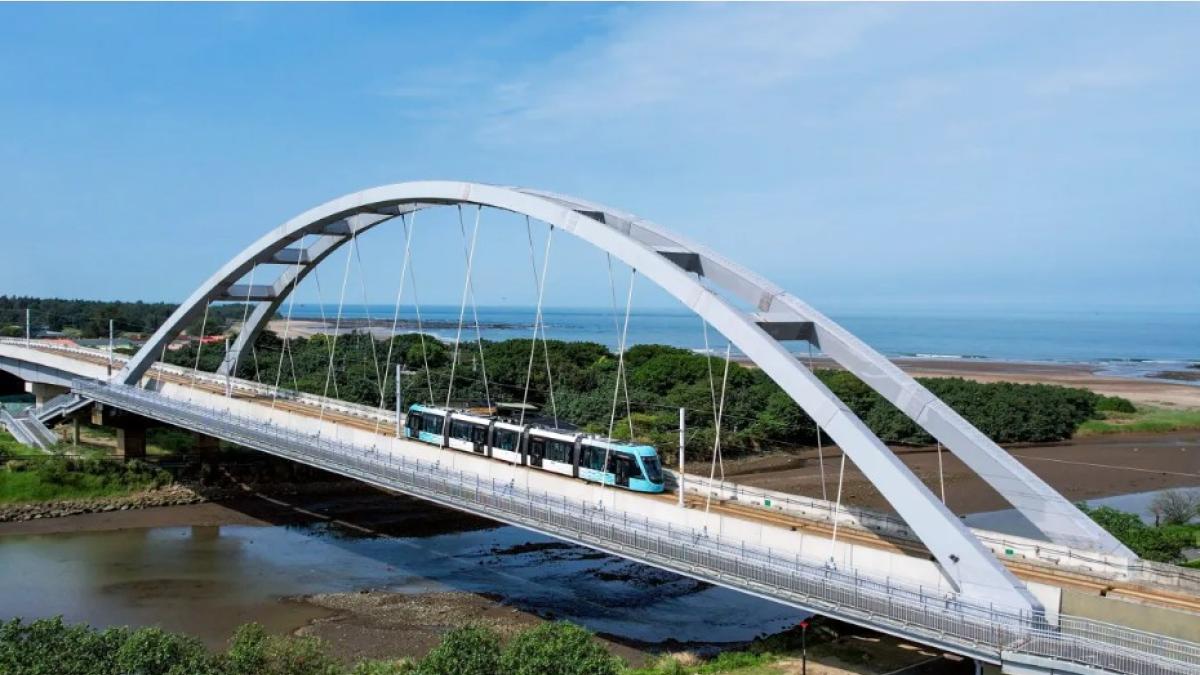
New Taipei City Mayor Hou You-ih delivered his fourth-term, eighth-regular-session policy report at the New Taipei City Council on the 30th, marking his final comprehensive presentation of eight years of governance achievements. Focusing on the theme of "安居樂業" (peaceful living and prosperous livelihoods), Hou reviewed progress in metro construction, major transportation projects, all-age care, healthcare capacity, and industrial investment. He also announced that the Sanying Line will extend its operating hours from August 1, running from 8:00 AM to 10:00 PM daily, offering residents along the route greater flexibility.
Hou stated that New Taipei has actively advanced major infrastructure projects in recent years. The city recently ranked 44th globally and first in Taiwan in the Global Happiness Cities Index, reflecting international recognition of its urban governance and quality of life, and laying a stronger foundation for future development.
Sanying Line to Extend Operations from August; Four Rings, Eight Lines Taking Shape
Hou emphasized that the "Four Rings, Eight Lines" plan is a key blueprint for New Taipei’s transportation development. Following the completion of Danhai Light Rail Phase I, the Circular Line, and Ankeng Light Rail, the opening of the Sanying Line on June 30 marks another significant step forward in expanding the city’s rail network. Currently, New Taipei has 108 kilometers of metro lines and 90 stations. Seven lines are under construction and seven more are in planning. Upon full completion, the network will span 189 kilometers with 182 stations, averaging 4.5 stations per 100,000 residents.
To meet growing ridership demand, Hou announced that starting August 1, the Sanying Line will extend its service from 8:00 AM to 10:00 PM daily. The extension aims to encourage more residents to use the metro for commuting, tourism, and leisure, thereby increasing public transportation usage.
Beyond rail infrastructure, Hou noted that the Danjiang Bridge, opened in May, has reduced travel distance by approximately 15 kilometers and saved commuters 25 minutes. The city has simultaneously launched four new bus routes to connect logistics, technology, tourism, and commercial development around the Tamsui River estuary. Since 2019, New Taipei has completed 14 new road constructions and 13 bridge constructions or renovations. The city continues to collaborate with the central government on improving national highway interchanges to strengthen the overall transportation network.
New Taipei Dome to Be Built in Shulin, Creating a Fourth Urban Center
Regarding urban development, Hou announced that after professional evaluation, the New Taipei Dome will be located on the Shulin Ji-5 site. It will become a multifunctional complex integrating sports events, cultural performances, tourism, and commercial activities, driving comprehensive development in Shulin and surrounding areas and forming a "Fourth Urban Center of New Taipei."
He emphasized that major projects are not just about building facilities but aim to stimulate surrounding industries, transportation, and urban renewal, injecting long-term development momentum into local communities.
All-Age Care Upgraded: Expanded Childcare and Elderly Welfare
Addressing challenges of low birth rates and aging population, Hou stated that New Taipei continues to enhance its all-age care policies. This year, childbirth incentives were increased: NT$40,000 for the first child, NT$45,000 for the second, and NT$50,000 for the third and beyond. The city has established 130 public childcare centers, 324 public kindergartens, and 314 quasi-public kindergartens, providing affordable childcare services for over 57,000 people—the highest rate of non-family childcare in Taiwan.
For elderly care, New Taipei has achieved its goal of "a senior club in every village." There are now 1,198 senior clubs and 1,045 community dining sites. Starting July, the senior citizen love card monthly points increased from 480 to 600, and the first 30 minutes of YouBike 2.0E electric-assist bikes are now free. Over one million people benefit from these measures.
In healthcare, the city continues advancing the Ruifang Medical and Long-Term Care Tower and the Banqiao Medical Park, with bed capacity expected to reach 2,076 by year-end. Telemedicine now covers 14 remote administrative districts. New Taipei has established the nation’s most extensive network of mental health centers (7 locations) and smart clinics (19 locations). Additionally, the city pioneered the "Triple AED Protection Network," integrating pre-hospital physician response teams and pre-hospital ECMO activation, raising the OHCA (out-of-hospital cardiac arrest) recovery discharge rate to 12.13% and saving over 3,000 families.
Over NT$770 Billion in Investment Attraction; ASML and Baogao Park as Industry Highlights
Hou stated that through the "one-stop investment attraction" mechanism, the city has facilitated 324 investment projects over eight years, attracting over NT$775.5 billion in investment and creating 122,000 jobs. Notably, global semiconductor equipment giant ASML has established operations in Linkou, and the first phase of the Baogao Smart Industry Park has attracted flagship enterprises like Foxconn. Phase II is being accelerated, continuously expanding New Taipei’s technology industry cluster.
Regarding concerns from councilors about the capacity of the Tamsui-Xinyi Line, Hou stated that Taipei Metro’s 10 new trains are expected to enter service by May next year, increasing hourly capacity by approximately 12,000 passengers, helping alleviate peak-hour congestion. The city will establish a task force to coordinate adjustments to Danhai Light Rail headways and add YouBike stations to improve transfer efficiency.
Additionally, regarding the Gancheng Bridge connection to the industrial park’s Zhongshan Road, Hou stated that he has instructed Deputy Mayor Zhu Ti-zhi to continue coordinating with the Ministry of Economic Affairs, prioritizing motorcycle access and road improvements on both sides of the Da’an Canal. Once the central government confirms the plan, the city will promptly conduct local briefings and construction to resolve traffic bottlenecks in the park.
Hou concluded that over eight years, the city administration has consistently advanced governance through three pillars—construction, care, and industry—aiming to steadily transform New Taipei into a safer, more convenient, and livable international city through continuous upgrades in transportation infrastructure, smart governance, and public services.
FACT BOX
- Source: PR Times
- Category: News
- Organizations: ASML