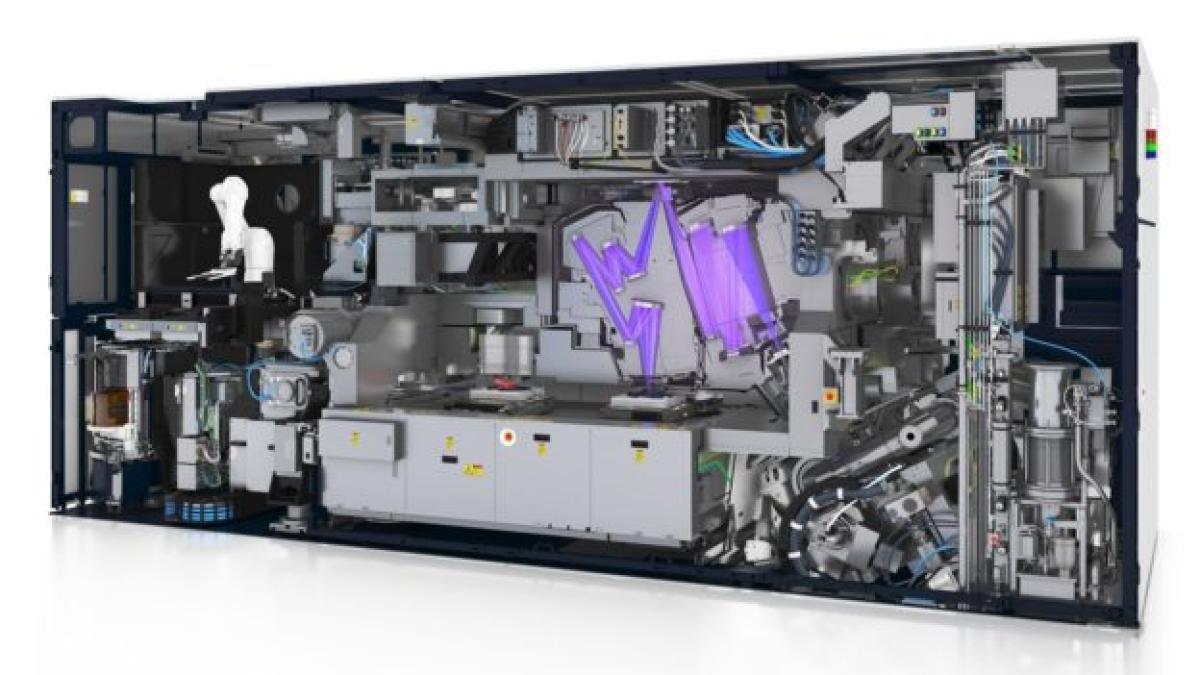
China has started mass production of its self-developed immersion (Immersion) DUV (Deep Ultraviolet, deep ultraviolet) lithography machines, with plans to deliver approximately five units this year. The first batch of customers includes SMIC (Semiconductor Manufacturing International Corporation), Hua Hong Semiconductor, and CXMT (ChangXin Memory Technologies). This is the first time China has entered the mass production stage of immersion DUV lithography machines, seen as a significant milestone in Beijing's push for a self-sufficient semiconductor supply chain.
According to reports, this project is led by the Shanghai Aishengna Electronic Technology Group, with plans to deliver approximately five units this year. Customers include SMIC, Hua Hong Semiconductor, and CXMT, with a production target of approximately twenty units next year.
The Shanghai company currently leading production was established in August 2023, with registered capital exceeding 700 million yuan. It is held by state-owned enterprises under Shanghai Electric Holdings and Shanghai International Trust, with almost no publicly available official website or operational information. Even using a Chinese IP address on 'Enterprise Query' and 'Tianyancha' makes it difficult to find relevant information.
It is reported that the company integrates multiple lithography start-up teams, including Shanghai Yu Liangsheng (or Yu Liangsheng, Yu Liangsheng) Technology, which has a state-owned background, and resources from Shanghai Microelectronics Equipment. Yu Liangsheng has already delivered prototype machines to some wafer fabs last year, and SMIC has been testing them since September 2025.
As domestic DUV is still in the testing and verification stage, although DUV can produce more advanced chips through multi-patterning (Multi-patterning), its cost, yield, and production efficiency are not as good as EUV.
Some Chinese technology bloggers have expressed on social media that 'there is still a significant gap in performance and manufacturing quality compared to ASML's mature models, and long-term adjustment is needed in terms of overlay accuracy, production capacity, yield, and reliability.' These bloggers also mentioned that 'most parts have been domesticated, but some key components still rely on Japanese suppliers, and domestic supply delays are also slowing progress. The verification process before the equipment is formally introduced into the production line may take several months or even longer.'
In contrast, ASML delivered approximately 131 immersion DUV systems last year. The production volume of domestic equipment is limited, and it is difficult to pose a substantial commercial threat in the short term.
After the related news broke, ASML's stock price once plummeted by more than 8%, and European and Asian related chip stocks also fell in sync. The market interpreted this as another step in China's semiconductor equipment self-sufficiency, which may erode ASML's revenue in the Chinese market in the long term (estimated to account for about 20% of its net sales this year). The U.S. Congress is currently reviewing a bill to further expand export restrictions on immersion DUV, which instead strengthens China's incentive to accelerate self-development.
Under the background of 'pan-national security,' what China really wants to solve is 'supply security.'
In recent years, the United States has continued to expand export restrictions on semiconductor equipment to China, not only banning ASML from exporting EUV lithography machines but also gradually restricting the export of some high-end immersion DUV equipment, making Chinese wafer fabs face uncertainty in obtaining equipment and subsequent maintenance.
Against this background, Beijing is promoting domestically produced lithography equipment, with the core goal not necessarily to immediately surpass ASML, but to reduce dependence on overseas supply chains.
Even if domestically produced equipment is less efficient and slower in production speed, as long as it can be stably obtained and continuously maintained, it may still be of greater strategic value to Chinese wafer fabs than imported equipment subject to export controls.
Therefore, it is not surprising that SMIC, Hua Hong Semiconductor, and CXMT are seen as the first batch of customers to adopt domestically produced equipment. For these companies, establishing a sustainable domestically produced equipment system is an important step in reducing geopolitical risks.
The original intention of U.S. export controls is to restrict China from obtaining advanced semiconductor technology, but at the same time, it forces China to invest more national resources to build a complete semiconductor equipment system.
Against the backdrop of escalating geopolitical tensions and increasingly stringent export restrictions, the speed at which China establishes an independent lithography equipment industrial chain will become one of the most worth-watching variables in the global semiconductor industry in the coming years.
FACT BOX
- Source: PR Times
- Category: New Product
- Organizations: ASML