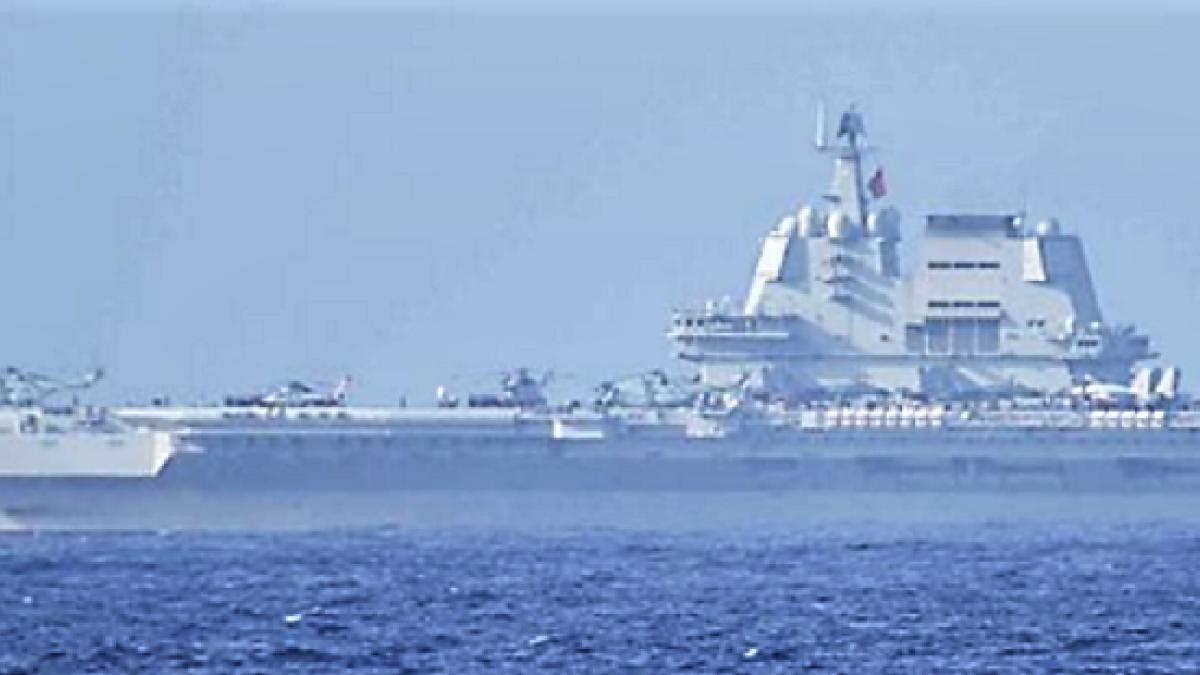
In recent years, whenever the Chinese People's Liberation Army (PLA) conducts large-scale military exercises around the Taiwan Strait, military experts and mainstream media—both domestic and international—almost uniformly conclude: 'The PLA is preparing to force Taiwan’s surrender through a maritime blockade.' In many people’s imagination, a blockade appears to be Beijing’s lowest-cost, most effective way to cut off Taiwan’s energy and food supply lines—a panacea. However, if we remove the lens of panic and rationally analyze the situation from the perspectives of international law, great-power strategic timelines, and the PLA’s consistent tactical logic, we uncover a harsh truth: a 'blockade' is strategically the worst and least likely option Beijing would adopt as its primary strategy. Indeed, this widespread 'blockade show' is nothing more than a meticulously designed cognitive warfare operation of 'feinting east while attacking west,' aimed at misleading Taiwan and Western powers into preparing in the wrong direction.
Time is Beijing’s greatest enemy: a blockade only invites U.S. and Japanese fleets
Advocates of the 'blockade theory' often commit a fatal strategic oversight: they ignore the critical role of 'time' in a Taiwan Strait conflict. A blockade is, by nature, a protracted war of attrition. Taiwan, though an isolated island heavily dependent on energy imports, would require several weeks or even months of complete encirclement before reaching the tipping point of societal collapse and unconditional government surrender.
The problem is that this extended timeframe effectively hands the United States, Japan, and their allies an open-ended invitation to mobilize. Once the U.S. and Japan decide to dispatch naval fleets to escort international merchant ships or oil tankers bound for Taiwan, Beijing faces an extremely awkward dilemma: if it opens fire on U.S.-Japan escort fleets, the blockade instantly escalates into a full-scale war between China and major powers; if it refrains from firing and allows the escorted convoys to pass, the blockade collapses publicly before the world’s eyes, resulting in a humiliating tactical failure for the Chinese regime. For Beijing, which deeply fears losing control of the conflict, choosing a strategy that 'inevitably grants the U.S. and Japan time to mobilize and intervene' makes no strategic sense.
Taiwan must stop fantasizing about the 'gray zone': forcibly cutting lifelines is an act of war
Another commonly exaggerated claim is that China could use quasi-military forces such as the China Coast Guard and maritime authorities to impose a non-military blockade on Taiwan under the guise of 'customs inspections' or 'health quarantines,' thereby blurring the boundaries of international law. But this is a fundamental misunderstanding of both international law and realpolitik.
According to United Nations General Assembly Resolution 3314, 'Definition of Aggression,' a blockade of another nation’s ports or coastline constitutes a standard act of aggression. No matter how Beijing phrases it as 'domestic law enforcement,' if its objective behavior amounts to 'forcibly cutting off external communications of another political entity through the use of force,' it is unequivocally an 'act of war' under international law and from the perspective of the blockaded party.
Since China’s fake law enforcement cannot conceal the reality of starting a war, and will inevitably trigger Taiwan’s right to self-defense and strong international backlash, why would Beijing waste months conducting half-hearted maritime interceptions, freely handing the entire world a legitimate reason to condemn and sanction China?
The PLA is not a Roman legion: speed and decisiveness are the core of its military doctrine
Historically, ancient Rome’s siege tactics were designed to minimize troop casualties when facing strong fortifications with limited forces. But the strategic context of modern cross-strait warfare is entirely different.
The PLA holds an absolute advantage in troop size, and the Chinese Communist Party’s authoritarian system has a far higher tolerance for frontline casualties than Western democracies. For Beijing’s decision-makers, minimizing frontline casualties is the least of their concerns in a Taiwan invasion; the only priority is regime survival. And what threatens the Chinese regime is not battlefield losses, but international sanctions, U.S.-Japan intervention, and domestic economic collapse triggered by prolonged conflict.
Therefore, the core goal of the PLA’s modernization has never been 'siege warfare' but 'swift and decisive victory.' Their ideal tactic is to establish a fait accompli before external forces like the U.S. and Japan can react. A slow, chronic war of attrition like a blockade is completely at odds with the PLA’s strategic vision.
The real threat: blockade drills are a cover for decapitation and surprise attacks
If a blockade has such massive strategic, legal, and operational flaws, why does China continue to conduct large-scale 'ring-the-island blockade drills' around Taiwan? The answer is simple: it is a precisely calculated strategic deception.
As Sun Tzu said, 'War is based on deception.' By extensively showcasing its blockade capabilities, the PLA aims to mislead Taiwan and Western powers into misallocating limited defense resources, training, and supplies toward preparing for a 'long-term sea and air blockade'—such as over-focusing on protecting long-range maritime routes, stockpiling excessive energy, or deploying slow patrol vessels and building more large but vulnerable surface warships through 'indigenous defense shipbuilding' policies to counter coast guard harassment.
Through this 'feint east, attack west' tactic, Beijing successfully draws global attention, thereby concealing its true strategic intent. While everyone watches the maritime blockade lines, the PLA secretly prepares for high-intensity surprise attacks. When all eyes are on the sea, the real method of attack could very well combine long-term internal infiltration, cyber and electromagnetic decapitation strikes, massive missile saturation attacks, and rapid amphibious and vertical insertion assaults, aiming to directly destroy Taiwan’s command center within days—or even hours.
In conclusion, the idea that 'China will seize Taiwan through a blockade' is merely a strategic myth that appears plausible but cannot withstand real-world combat scrutiny. Taiwan must not fall into Beijing’s 'blockade trap.' Recognizing the 'feint east, attack west' nature behind the blockade drills and precisely allocating defense resources to counter first-wave concentrated assaults, eliminate internal infiltration threats, and strengthen real-time intelligence coordination with allies like the U.S. and Japan is the only correct strategic path to thwart Xi Jinping’s ambitions of military aggression against Taiwan.
*Author: 35 years of service in the U.S. aerospace and defense industry; former honorary lecturer at Taiwan War College; founder of Taiwan Advocacy
FACT BOX
- Source: PR Times
- Category: News