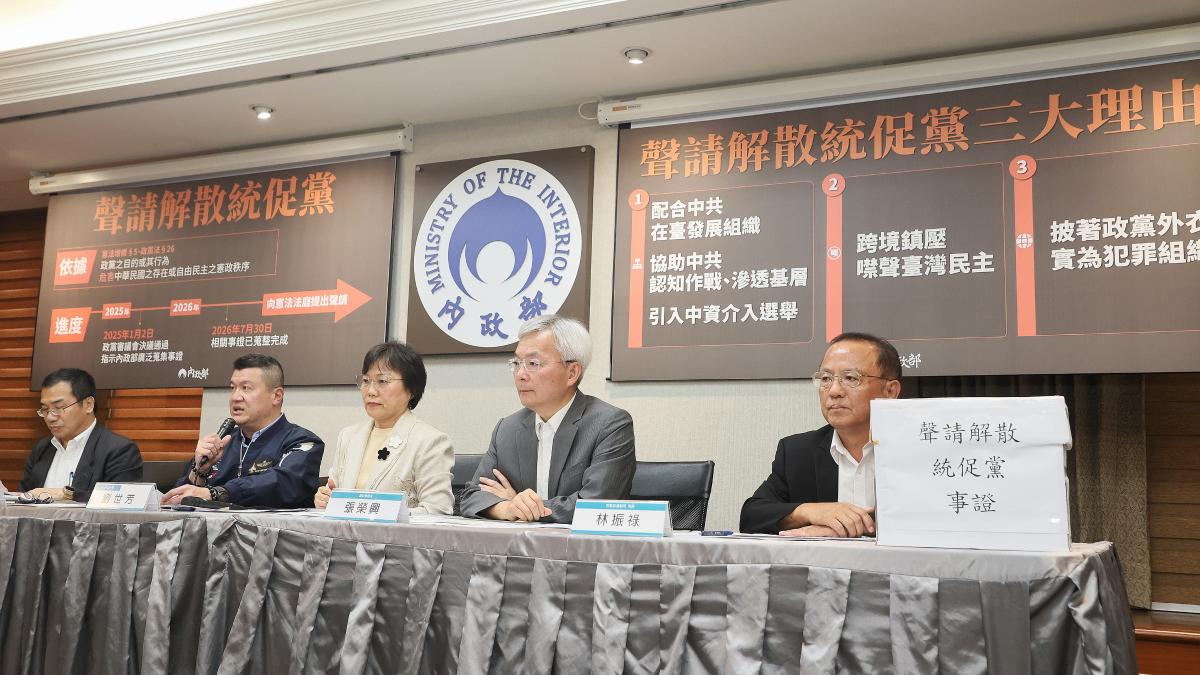
The Ministry of the Interior held a press conference today (30) titled 'Petitioning for the Unconstitutional Dissolution of the Unification Promotion Party of China.' Minister Liu Shih-fang stated that multiple core members of the Unification Promotion Party have been implicated in violations of the National Security Act, Anti-Infiltration Act, Taiwan Area and Mainland Area People Relations Act, Presidential and Vice-Presidential Election and Recall Act, Public Officials Election and Recall Act, Organized Crime Prevention and Control Act, and the Criminal Code, all of which have severely threatened national security, social stability, and electoral fairness.
The Ministry has completed the collection of relevant evidence and will formally petition the Constitutional Court for the dissolution of the UFP in early August.
### Why Petition for the Dissolution of the UFP? Ministry: It Endangers the Existence of the Republic of China and Its Free Democratic Constitutional Order
The Ministry pointed out that Article 5 of the Additional Articles of the Constitution of the Republic of China clearly stipulates that no political party's purpose or actions may endanger the existence of the ROC or its free democratic constitutional order. Any violation constitutes unconstitutionality. According to Article 26 of the Political Parties Act, the competent authority—the Ministry of the Interior—must submit evidence to the Judicial Yuan's Constitutional Court to petition for the dissolution of such parties.
The Ministry explained that the Party Affairs Review Committee approved the case for the unconstitutional dissolution of the UFP on January 2, 2025, and instructed further comprehensive evidence collection. After reviewing the evidence, the Ministry concluded that the UFP's purposes and actions have indeed endangered the existence of the ROC and its free democratic constitutional order.
### Three Pieces of Evidence Showing the UFP’s Unconstitutionality: Building Organizations in Taiwan for the CCP and Cross-Border Suppression
First, the party is accused of accepting directives from the CCP to build organizations in Taiwan, recruiting Chinese spouses into its activities, facilitating the travel of active and retired military personnel to China, and establishing espionage networks. It has also introduced Chinese capital to interfere in elections—supporting candidates, engaging in vote-buying, organizing trips to China for voters as bribes, and staging protests to disrupt opponents’ campaigns. Additionally, it has assisted the CCP in operating radio stations to spread cognitive warfare messages and infiltrated civic groups and temples to support united front operations.
Second, the party has been involved in cross-border suppression activities aimed at creating a climate of silence in Taiwan’s democracy, including the red paint attack on Denise Ho, the bloodshed incident at National Taiwan University’s 'China’s New Voice' event, and the violent assault on Joshua Wong at the airport.
Third, numerous party members have long been involved in organized crime and have been prosecuted under the Taiwan Area and Mainland Area People Relations Act, National Security Act, and Anti-Infiltration Act. Founder Chang An-lo is formally designated as the party’s spiritual leader and chairman, and has publicly declared himself a 'fellow traveler of the CCP,' claiming to have formed a 'Red Team' to promote CCP ideology.
The Ministry emphasized that while the Constitution guarantees the people's right to form political parties, such parties must operate within constitutional boundaries and uphold the free democratic constitutional order. As the supervisory authority, the Ministry has a duty to implement necessary democratic defense mechanisms against parties that threaten this order, in order to safeguard the existence of the Republic of China.
### Can the UFP Still Nominate Candidates Before Dissolution? The Ministry’s Position
When asked whether members could form a new organization if the UFP is dissolved, Director Cheng Ying-hung of the Civil Affairs Division explained that according to Article 30 of the Political Parties Act, a party declared unconstitutional and dissolved by the Constitutional Court must cease all activities immediately upon the ruling’s effectiveness. It is prohibited from forming a replacement organization with the same purpose or re-establishing a party under the same name or abbreviation. In other words, no substitute organization may be created after dissolution.
Regarding whether the UFP can still recruit members, raise funds, or nominate candidates before the Constitutional Court’s ruling—especially with year-end elections approaching—and whether the Ministry will apply for a provisional order during the court proceedings, Cheng stated that since the petition has already been submitted to the Constitutional Court, the Ministry will follow the court’s procedures and will not file any additional applications.
FACT BOX
- Source: PR Times
- Category: News