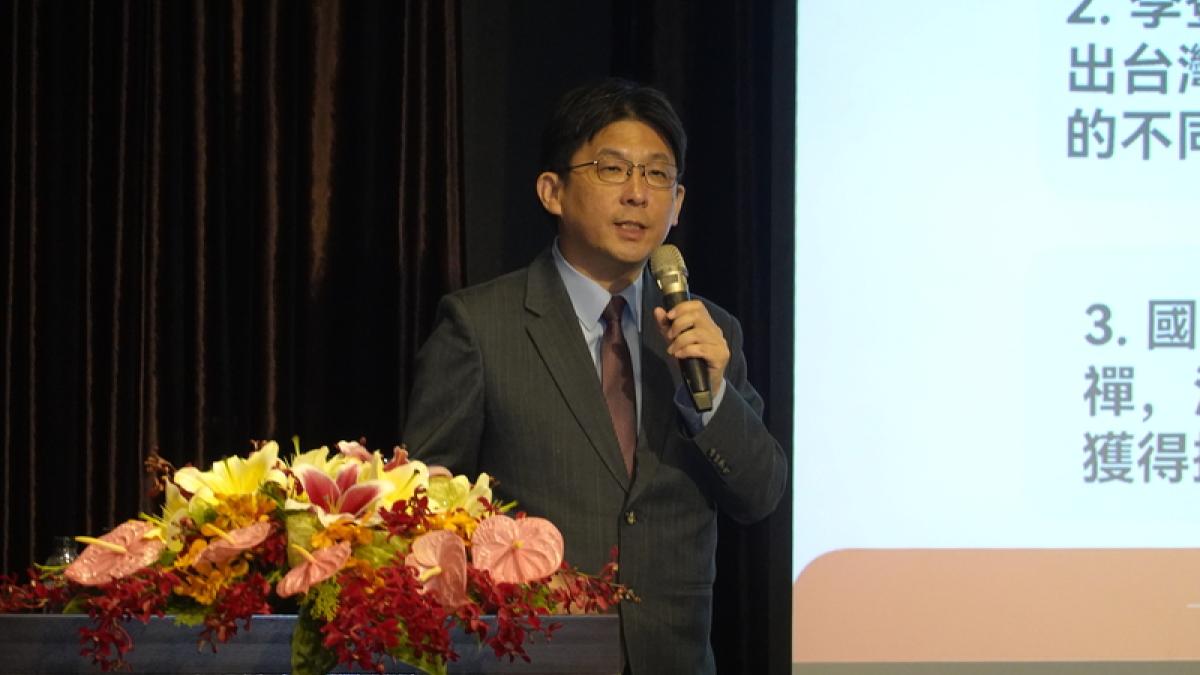
In 1999, Lee Teng-hui, in an interview with DW, proposed the 'Two Chinas' theory, which shocked the international community. During his 12-year tenure, he promoted democratization reforms, earning him the title of 'Quiet Revolution.' 2026 marks the 30th anniversary of Taiwan's direct presidential elections, and it has been six years since Lee's passing. Lin Hsiou-ting, in his new book, re-examines Lee's political legacy by analyzing declassified documents and historical records from multiple countries. Born in Japanese-occupied Taiwan, Lee received a Japanese education, was briefly influenced by left-wing ideologies, and even joined the Communist Party. As an agricultural scholar, he was favored by Chiang Ching-kuo, joined the KMT, and entered politics. After Chiang Ching-kuo's death in 1988, Lee, then Vice President, took over and promoted a series of democratization reforms. In 1999, as President, Lee was interviewed by DW, where he described the cross-strait relationship as a 'special state-to-state relationship,' known internationally as the 'Two Chinas' theory, which had a profound impact on cross-strait relations. The following is an excerpt from Lin Hsiou-ting's interview with DW, edited and condensed: DW: Why is your new book titled 'The Lee Teng-hui Era in Taiwan: Reshaping an Unexpected Country'? Lin Hsiou-ting: This is the continuation of my previous two books. The first one, published ten years ago, was 'An Unexpected Country: Chiang Kai-shek, the United States, and the Shaping of Modern Taiwan.' The second book is 'The Chiang Ching-kuo Era in Taiwan.' This book is the third and final part of the trilogy on post-war Taiwanese history. In the first book, I mentioned that the KMT government, which retreated to Taiwan after losing the Chinese Civil War around 1949, survived in this 'unexpected country' of Taiwan, Penghu, Kinmen, and Matsu. It might have been destroyed during the civil war, and the name 'Republic of China' would have disappeared. However, it survived and continued through the entire Cold War authoritarian era. It was not until the 1990s, during Lee Teng-hui's presidency, that this unexpected country underwent a qualitative change, at least a reshaping, redefining what the Republic of China is. This is a core important question and proposition of mine, so this book revolves around this unexpected country of Taiwan, Penghu, Kinmen, and Matsu, from the two Chiangs to Lee Teng-hui, exploring how it transformed. What happened to this piece of land in Taiwan as it transitioned from authoritarianism to democracy? I believe this is the main focus of my book. DW: How did Lee Teng-hui's cross-strait discourse reshape Taiwan/the Republic of China? Lin Hsiou-ting: I must emphasize that many people think Lee Teng-hui, after becoming an elected president in 1996, gradually developed a strong local consciousness, even so-called 'Taiwan independence' or 'independent Taiwan.' However, in the book, I found a lot of evidence that as early as the early 1990s, when his power was not yet fully consolidated, he already had the concept of 'the Republic of China in Taiwan.' I remember it was July or August 1990 when he wrote a letter to then-U.S. President George H.W. Bush, congratulating him on his victory in the Gulf War. In the English letter, he wrote 'Republic of China on Taiwan.' This was the first time he mentioned this concept in an official letter, from president to president. Of course, this concept continued to evolve, and by 1999, it became the concept of 'mutual non-subordination,' known as the 'Two Chinas' theory, 'special state-to-state (relationship).' Think about it, the implication of 'the Republic of China in Taiwan' is not 'the People's Republic of China on the mainland'? It's hard to say that there is no such implication of two countries, between the Republic of China and the People's Republic of China. So, it's not that in his late years, in the late 1990s, he emphasized this. I think it's interesting that he was emphasizing this as early as the early 1990s. DW: When Lee Teng-hui, as president, was interviewed by DW in 1999, he proposed the concept of a 'special state-to-state relationship.' You mentioned that he already had the concept of 'the Republic of China in Taiwan' before that. What historical context led to the birth of this concept or discourse? What historical impact did it have on cross-strait relations? Lin Hsiou-ting: There was indeed a process of evolution. In the early years after Lee came to power, I believe he genuinely believed that improving cross-strait relations and expanding Taiwan's diplomatic survival space could go hand in hand and should go hand in hand, just like internationally divided countries such as North and South Korea and East and West Germany. They simultaneously joined the United Nations and did not rule out the option of future unification. Because he carried a very strong 'Chinese color,' he took over the presidency from Chiang Ching-kuo, and because he promoted democratization, he had to remove the mobilization-to-suppress-rebellion system. After removing it, he had to realistically acknowledge the Communist Party's rule over all of mainland China. In this situation, for the past 40 years, the so-called 'bandit rebel group' was shouted loudly, but suddenly overnight, you realistically acknowledged it, you had to deal with it, you had to have three links, you had to prepare for cross-strait exchanges, so what is the definition of the other shore? All this had to be redefined. The old rhetoric was no longer applicable in Taiwan after democratization in the 1990s, so how to redefine cross-strait relations and redefine the four characters 'Republic of China'? I think Lee, from the time he was vice president, was constantly thinking about this question. Why did it eventually become a 'special state-to-state' relationship? I think there is a specific historical context and background, that is, in 1997, the second term of U.S. President Clinton began, and he wanted to establish a strategic partnership with mainland China. In this situation, the U.S. and China wanted to join hands, hoping to establish a partnership, and he did not want a democratized Taiwan and the Republic of China represented by Lee Teng-hui after the election to become a stumbling block in the development of U.S.-China relations. So, it was as if a 'one-China framework' was put back on Taiwan's head, specifically manifested in 1998 when U.S. President Clinton visited China and publicly stated the 'new three nos' in Shanghai regarding Taiwan: not supporting Taiwan's independence, not supporting Taiwan's joining the United Nations, and not supporting Taiwan's joining international organizations with sovereign state status. At that time, it was a huge blow to Taiwan. So, in the last two years of Lee's term, everything he did was to try to break the 'one-China' framework. He believed that Taiwan had already achieved democratization today, and this government has complete and full representativeness and legitimacy and should not be ignored by the international community. Under this situation, my book mentions that the proposal of the 'Two Chinas' 'special state-to-state' is one of the countermeasures he took to counter the U.S.-China joint effort to put the 'one-China' framework on Taiwan. This is my biggest point. DW: Can I understand your point as that while the U.S. and China were strengthening the 'one-China' framework, Lee Teng-hui was pragmatically seeking survival space for the Republic of China? Lin Hsiou-ting: Yes. In his cognition, when the entire international community and the situation were increasingly unfavorable to Taiwan, he hoped that in the gradually closing strategic gap, he could try to open up the gap that had not yet been closed for Taiwan. Of course, later, under the strong pressure of the U.S. and China, he indeed gradually withdrew the 'Two Chinas' theory, for example, he originally hoped that the 'Two Chinas' theory could be included in the constitution, but under the pressure of the U.S. and mainland China, he quietly withdrew it. But since the words were spoken, he accepted the interview with Deutsche Welle and spoke them, which means he quietly opened a range that could be spoken. Perhaps in his heart, he thought this was a good thing, although it caused a big stir, and the reaction from the other shore was very intense, but he would think: I have opened up a range that can be spoken for my future successors, no matter who becomes president in the future, it may be easier to do things. Because something that should not have been spoken has been spoken. DW: As a historian, how would you interpret or evaluate whether this discourse has had a decisive change on the history of cross-strait relations? Lin Hsiou-ting: Yes. Since Lee Teng-hui stepped down in 2000 until today, it has been 26 years. Many of his measures and actions during his term still continue to influence cross-strait relations today, influencing the political interaction within Taiwan, including the actual political operations and operations of different political parties. I believe that the so-called historical legacy he left during his term still deeply influences various aspects of our Taiwan today. In terms of the 'special state-to-state relationship,' because he proposed the concept of 'mutual non-subordination,' it has been continuously interpreted and evolved to this day, and today it has become the concept of 'the Republic of China, Taiwan,' which is probably a more mainstream consensus within Taiwan's society. This thing is definitely
FACT BOX
- Source: PR Times
- Category: 政治