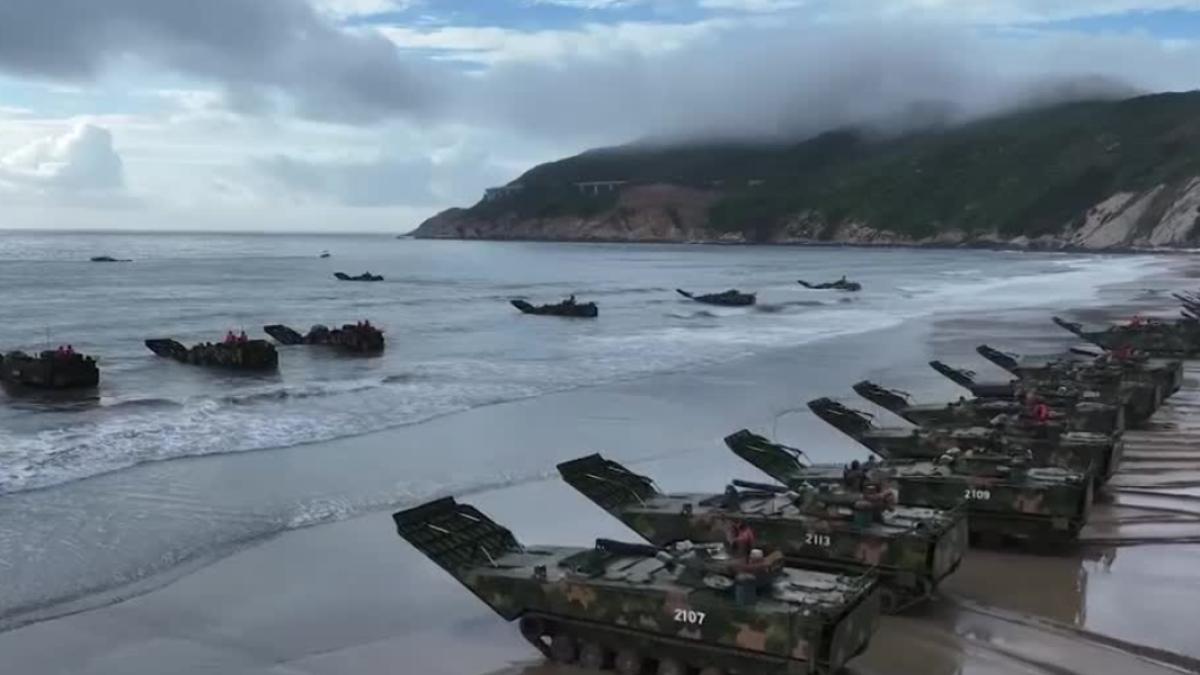
Recently, some officials and scholars claimed in a seminar that China's military drills against Taiwan are costly, ineffective, and unlikely to occur in the second half of the year due to Taiwan's upcoming elections. However, National Security Council (NSC) Secretary General Joseph Wu recently revealed on social media that the People's Liberation Army (PLA) has conducted live-fire shooting and military training near Dongshan Island, the East China Sea, and the South China Sea—activities that threaten Taiwan, Japan, and the Philippines. These conflicting statements may confuse the public and create information chaos.
The author applies academic research methods to analyze PLA activities from July 14 to 24 across five sea areas: the Bohai Sea, Yellow Sea, East China Sea, Taiwan Strait, and South China Sea. He identifies 16 military activities and drills not disclosed by Wu, and conducts a comparative analysis of PLA exercises in the Zhejiang East Sea, Dongshan Island, and the waters from Hainan to the Xisha Islands, both historically and recently, to determine their strategic purposes (see attached figures).
Additionally, the author compiles data on PLA activities following Taiwan’s past “Nine-in-One” elections into a statistical table to assess whether large-scale military drills against Taiwan are likely by year-end, providing a solid analytical foundation.
Recently, an official claimed in a seminar that large-scale Chinese military exercises are less effective than before due to high costs and low returns, and that conducting drills during Taiwan’s election period could heighten political tensions. Some scholars argue that the effectiveness of China’s “surround Taiwan” military drills has diminished, making large-scale exercises in the second half of the year unlikely. Such overly optimistic and simplistic analyses could dangerously lower public vigilance.
However, readers must not forget: in late December 2025 (December 29–30), the PLA conducted the "Righteous Mission-2025" military exercise against Taiwan. This year’s “Nine-in-One” election is scheduled for November 28 (Saturday), leaving nearly a full month in December. We must not be complacent.
China’s soft and hard strategies toward Taiwan are not simplistic and must be understood within their historical context.
The author uses research methodology to compile a statistical table of significant PLA activities during and after Taiwan’s “Nine-in-One” elections on November 24, 2018, and November 26, 2022 (see Table 1).
From this table, it is evident that the PLA’s Eastern Theater Command tends to avoid direct interference during Taiwan’s election period. However, on the day of the November 26, 2022 election, although only four aircraft sorties were recorded, two of them were PLA H-6 bombers—an important detail.
Especially after former U.S. House Speaker Pelosi’s visit to Taiwan in early August 2022, the PLA has shown increasing disregard for how its military actions might influence Taiwan’s electoral outcomes. In recent years, China has deliberately separated political and military strategies, consistently claiming that “PLA military actions are aimed solely at countering Taiwan independence and external forces.”
After the November 26, 2022 election, from November 30 to December 25, PLA aircraft and naval vessels intensified activities around Taiwan, conducting targeted military training and operations.
More recently, at the end of last year, the PLA conducted the "Righteous Mission-2025" military exercise against Taiwan. Taken together, these patterns suggest a high probability of another large-scale annual military drill by the end of this year (2026). This exercise would test how effectively the Northern and Southern Theater Commands can support the Eastern Theater Command in joint operations—beyond mere cost-benefit calculations.
Conversely, China likely already fully understands the extent of Taiwan’s response capabilities through recent military drills. It may be deliberately preserving surplus and combat-ready forces to counter the U.S.-Japan-Philippines-Australia-New Zealand military alliance’s containment strategy along the First Island Chain.
Recently, the Central News Agency reported: "The PLA conducted unannounced live-fire drills in multiple sea areas, and Joseph Wu criticized it as simultaneously threatening Japan, Taiwan, and the Philippines."
NSC Secretary General Joseph Wu revealed on social media at 12:33 PM on July 24 that the PLA was conducting military training in the Zhejiang East Sea, east of Fujian’s Dongshan Island, and from the southeast of Hainan Island to the Xisha Islands (Figure 1).
Out of curiosity, the author questions: were these drills truly unannounced? And do they genuinely threaten Taiwan, the Philippines, and Japan?
First, regarding the three PLA training zones disclosed by Joseph Wu: did China officially announce them, and where are they geographically located? Second, the author compiles PLA military activities from July 14 to 24 based on Chinese media reports, revealing 16 additional undisclosed training zones. Finally, a comparative analysis is conducted between these three zones and similar past exercises.
The three sea areas disclosed by Joseph Wu are:
(1) East China Sea
On July 23, China announced military training from 0400 on July 24 to 1800 on July 25 within an 11-point polygon: (1) 28-59.00N 121-56.00E, (2) 29-08.00N 122-16.00E, (3) 29-08.00N 122-55.00E, (4) 28-19.00N 122-55.00E, (5) 27-35.30N 122-29.72E, (6) 27-27.00N 122-10.70E, (7) 27-27.00N 121-28.00E, (8) 27-47.50N 121-08.00E, (9) 27-52.00N 121-08.00E, (10) 28-03.00N 121-30.00E, (11) 28-26.00N 121-56.00E. Vessels prohibited from entering. This area is located approximately 153 km northeast of Taizhou and 185 km southeast of Wenzhou in Zhejiang Province, covering 20,402 km² (Figure 2).
(2) Taiwan Strait (Facing Taiwan)
On July 22, China announced live-fire drills from 0600 to 1800 on July 23, 2026, within a five-point polygon: 1) 23-41.31N, 117-31.49E, 2) 23-36.23N, 117-28.73E, 3) 23-35.10N, 117-30.10E, 4) 23-38.60N, 117-36.21E, 5) 23-41.30N, 117-34.58E. Located southeast of Jixin Islet, Dongshan Island, covering approximately 82.0 km². Additionally, from 0600 to 1800 on July 24, live-fire drills were conducted within a four-point polygon: 1) 23-37.00N, 117-26.50E, 2) 23-37.00N, 117-29.50E, 3) 23-33.00N, 117-29.50E, 4) 23-33.00N, 117-26.50E. Entry prohibited. Located east of Ao Jiao (Village) Bay, Dongshan Island, covering approximately 37.9 km² (Figure 3).
(3) South China Sea
On July 23, China announced military training from 0800 on July 24 to 1800 on July 27 within a polygon defined by: 19-11.35N 111-57.00E, 17-03.90N 114-04.60E, 16-01.52N 112-56.37E, 18-10.22N 110-48.0E. Vessels prohibited. Located southeast of Hainan Island to north of the Xisha Islands, covering approximately 54,766 km² (Figure 4).
According to media reports, the U.S. Navy’s littoral combat ship USS Santa Barbara (LCS 32), MH-60S helicopters, P-8A anti-submarine patrol aircraft, Japan’s Maritime Self-Defense Force destroyer Yukikaze (DD-103), the Philippine Navy frigate BRP Laguna (FFG-15), AW109 helicopters, Philippine Air Force FA-50 fighters, TC-90 patrol aircraft, A-29B attack aircraft, C-208B reconnaissance aircraft, W-3A utility helicopters, and the Philippine Coast Guard’s large multi-role vessels BRP Aquino (MRRV-9702) and BRP Malapascua (MRRV-4002) conducted the 17th Multilateral Maritime Cooperation Activity (MMCA) joint patrol exercise in the “West Philippine Sea” (WPS) from July 21 to 25, carrying out multiple maritime drills to deter China’s expansionist ambitions.
Meanwhile, the PLA Southern Theater Command conducted joint air-sea combat training from 0800 on July 24 to 1800 on July 27 across 54,766 km² from southeast of Hainan Island to the Xisha Islands, responding to the U.S.-Japan-Philippines naval exercises in the South China Sea. It also signaled military strength to the U.S. Navy’s USS Washington aircraft carrier, USS Robert Smalls (CG-62), USS Benfold (DDG-65), USS Shoup (DDG-86), and USS Santa Barbara (LCS-32), which transited from the Western Pacific through the Luzon Strait into the South China Sea on July 22. The analysis of PLA military training in this region will not be further discussed at the end of this article.
FACT BOX
- Source: PR Times
- Category: News