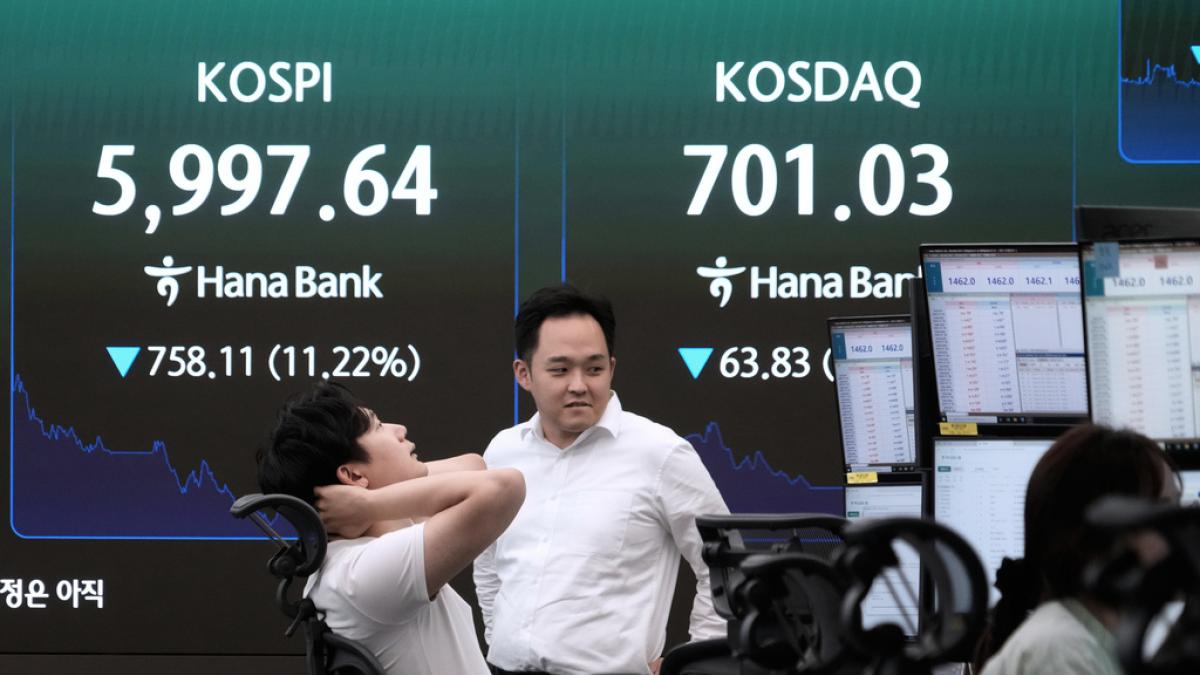
Fueled by the artificial intelligence (AI) boom, South Korea's stock market surged, enabling Song Mi-kyung (60), a Seoul resident, to earn approximately 300 million won (about NT$6.79 million) within six months. However, in just over a month, she experienced a rollercoaster ride from massive gains to devastating losses. After a brutal week for the Korea Composite Stock Price Index (KOSPI), her investment portfolio now faces unrealized losses exceeding 60%. Speaking to the Financial Times, Ms. Song said, "Each day's losses snowball, leaving me overwhelmed. Even during the Asian financial crisis, I've never seen the market fall this fast. All the profits I made this year (2026) are nearly wiped out."
The KOSPI, after reaching a record high in June, has since declined nearly 40%, heading toward its worst monthly drop in history. South Korea's tech rally has turned into a retail investor nightmare. Ms. Song is just one of millions of retail investors devastated by the market crash. The "semiconductor duopoly" of Samsung Electronics and SK Hynix, which together account for nearly half of the KOSPI's weight, saw their stock prices soar—up 70% and 112% year-to-date, respectively—driven by AI and memory chip demand. With the bull market seemingly back, millions of retail investors rushed in, hoping to strike it rich. This surge pushed the number of active stock trading accounts in South Korea past 110 million—equivalent to two accounts per person on average.
Korea Investment & Securities reported that nearly half of its 880,000 clients who bought Samsung Electronics are now trapped in losses, while 70% of the 408,000 clients who purchased SK Hynix are in the red. The Financial Times also found that many Korean retail investors amplified their exposure using margin loans and 2x leveraged single-stock ETFs, aiming to rapidly grow their assets during the market rally.
However, this leverage has triggered a destructive chain reaction as capital markets reversed. According to the latest data from the Korea Financial Investment Association (KOFIA), retail investors' deposit balances in brokerage accounts have plummeted from 139.7 trillion won (approximately NT$3.16 trillion) in June to 107 trillion won (NT$2.42 trillion) today. Margin debt, which once hit a record high of 38.6 trillion won (NT$870 billion), has sharply declined to 33.2 trillion won (NT$750 billion) after multiple rounds of forced liquidations (margin calls).
Beyond individual stocks, leveraged ETFs tracking 16 stocks including Samsung and SK Hynix—approved by Korean authorities in late May—have also suffered severe losses, with many ETFs down over 60%. Namuh Rhee, chairman of the Korea Corporate Governance Forum, stated bluntly, "The liquidation wave from leveraged ETFs tracking highly volatile semiconductor stocks has nearly wiped out the principal of many retail investors."
Facing an out-of-control retail investor crisis, South Korea's Ministry of Economy and Finance, after the finance minister issued a public apology, held an emergency meeting on the evening of the 29th and announced restrictions on retail investors' leveraged ETF purchases and higher margin requirements. Finance Minister Goo Jun-cheol, the Bank of Korea governor, and financial regulators jointly admitted that approving these leveraged ETFs amplified market volatility.
Senior market analysts note that the intense reaction to KOSPI's continuous decline stems largely from investor psychology. Many younger investors, aware they cannot afford homes, viewed leveraged ETFs as a shortcut to quick wealth, only to suffer unprecedented losses. Although the market saw a slight 3% rebound in KOSPI and Samsung's stock rose over 6% following Samsung's record-breaking Q2 earnings on the 30th, most analysts believe it will take time to heal investors' psychological wounds. CLSA analyst Sim Jong-min warned, "The Korean market has entered the worst phase where fundamentals no longer matter. With institutions avoiding volatility and retail investors panicking and pulling out capital, this vicious cycle could persist for some time."
FACT BOX
- Source: PR Times
- Category: News
- Organizations: CLSA