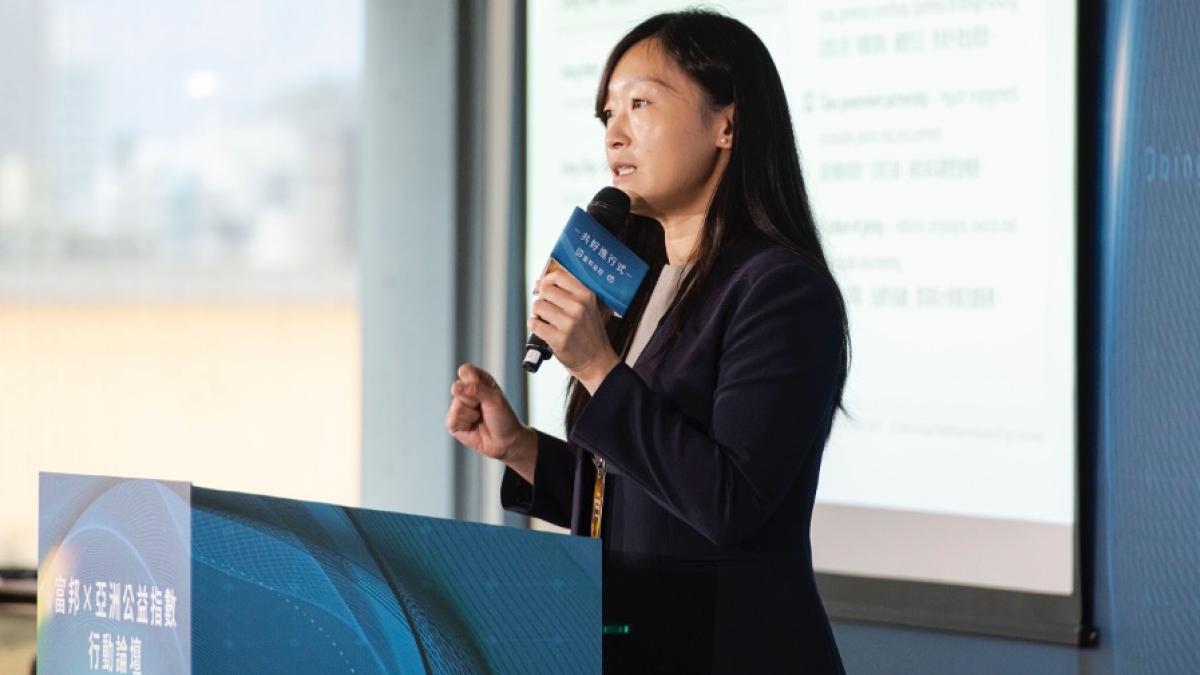
Taiwan's philanthropic environment is structurally sound, with corporate funding and volunteer collaboration ranking among the highest in Asia. However, nonprofit organizations still face challenges in talent recruitment, funding structure, and long-term capacity building. Fubon Financial, in collaboration with the Centre for Asian Philanthropy and Society (CAPS) and TVBS GOOD, hosted the "Co-Good Forward: Fubon × Asia Philanthropy Index Action Forum," bringing together government, research, corporate, media, and nonprofit partners to discuss how Taiwan can evolve from a solid foundation toward more resilient and impactful development, based on research data and frontline practices.
Angie Chong, CAPS' Research and Consulting Director for Greater China, described the Asia Philanthropy Index as a "health check report" for Asia's nonprofit sector. The focus is not on how much money is donated in each region, but on whether policy regulations, tax incentives, philanthropic ecosystems, and government procurement systems enable individual and corporate goodwill to evolve from one-time contributions into long-term, strategic actions.
Since 2016, CAPS has conducted the Asia Philanthropy Index, surveying 17 Asian economies through nonprofit organization questionnaires and expert interviews to identify factors that promote or hinder sector development. Chong noted that while Asia faces aging populations, climate risks, rising inequality, and growing demand for social services, it also contends with the withdrawal of international aid and tightening government resources in some areas. Asia does not lack goodwill or resources; the real issue lies in whether systems can effectively mobilize and connect these resources to where they are most needed.
The study shows Taiwan has consistently ranked in the "Doing Well" group, with a solid foundation for its philanthropic environment. For example, registering a nonprofit organization in Taiwan takes an average of 45 days and costs about USD 18, outperforming the Asian average of 91 days and USD 26. Eighty-three percent of surveyed organizations find the donation tax deduction process convenient, 66% find it easy to obtain charitable status, and another 83% believe relevant regulations are effectively enforced. These figures reflect that Taiwan already has the basic conditions to support nonprofit operations in terms of organizational setup, tax incentives, and regulatory predictability.
Corporate engagement is another standout strength in Taiwan. According to the study, 86% of surveyed Taiwanese social service organizations have received corporate funding, and 84% have collaborated with corporate volunteers—both the highest proportions in Asia. Eighty-eight percent of organizations reported access to unrestricted funding, significantly higher than the Asian average of 45%, allowing greater operational flexibility and long-term planning. In digital application, 83% of Taiwanese organizations have used AI tools, and over 90% have official websites—both relatively advanced in Asia.
However, CAPS also found that while corporate engagement in Taiwan is broad, there is room for deeper professional collaboration. Only 31% of Taiwanese companies have provided professional or technical support to nonprofits, below the Asian average of 40%. The proportion of nonprofit board members with corporate backgrounds is 38%, also below the Asian average of 47%. Chong analyzed that while Taiwanese companies are active in donations, volunteering, and event participation, the next step is to further contribute core business knowledge, technical expertise, governance experience, and long-term mentorship, evolving corporate-nonprofit collaboration from breadth of participation to depth of capacity building.
Talent is one of the most apparent current challenges. Eighty-four percent of surveyed Taiwanese organizations reported difficulty in staff recruitment, nearly half need skill enhancement and leadership development, yet 41% said donors have never supported staff capacity building. Chong pointed out that nonprofits need professional talent, but society may still believe nonprofit workers should accept lower compensation. Without parallel improvements in talent training and career environments, nonprofits may struggle to accumulate long-term service capacity even if they secure funding.
Funding and trust also require ongoing attention. About half of Taiwanese nonprofit budgets come from local individuals and foundations, government funding accounts for about a quarter, corporate funding is less than one-fifth, overseas funding is nearly zero, and self-generated service revenue has long remained below 10%. CAPS believes the funding challenge is not just about raising more money, but also about whether different income sources can balance each other and reduce organizational dependence on a single source.
On trust, the proportion of surveyed organizations believing Taiwan's nonprofit sector is sufficiently trusted by society increased from 18% in 2020 to 45% in 2026. However, trust in the nonprofit sector is highly interconnected—individual organizations not involved in controversies may still be affected by the overall environment.
Chong stated that Taiwan's key challenge in the next phase is not necessarily adding another standalone policy, but making existing systems more effectively respond to nonprofits' needs in talent, funding, and trust, and aligning government incentives, corporate expertise, and societal goodwill to create synergistic effects.
In the spirit of cross-sector collaboration, Fubon Financial announced the launch of Run For Green® "Bangzhu Program" at the forum, inviting the public to participate in designated races and accumulate 40 kilometers of running to autonomously support environmental sustainability, underprivileged education, rural companionship, or sports equity, transforming public participation into concrete support for social causes. From CAPS' research diagnosis to cross-sector discussions at the forum, Taiwan's next step in philanthropy is not just about injecting more resources, but about forming long-term linkages between systems, expertise, and frontline needs, allowing goodwill to truly accumulate into sustainable social impact.
FACT BOX
- Source: PR Times
- Category: Survey
- Organizations: TVBS GOOD