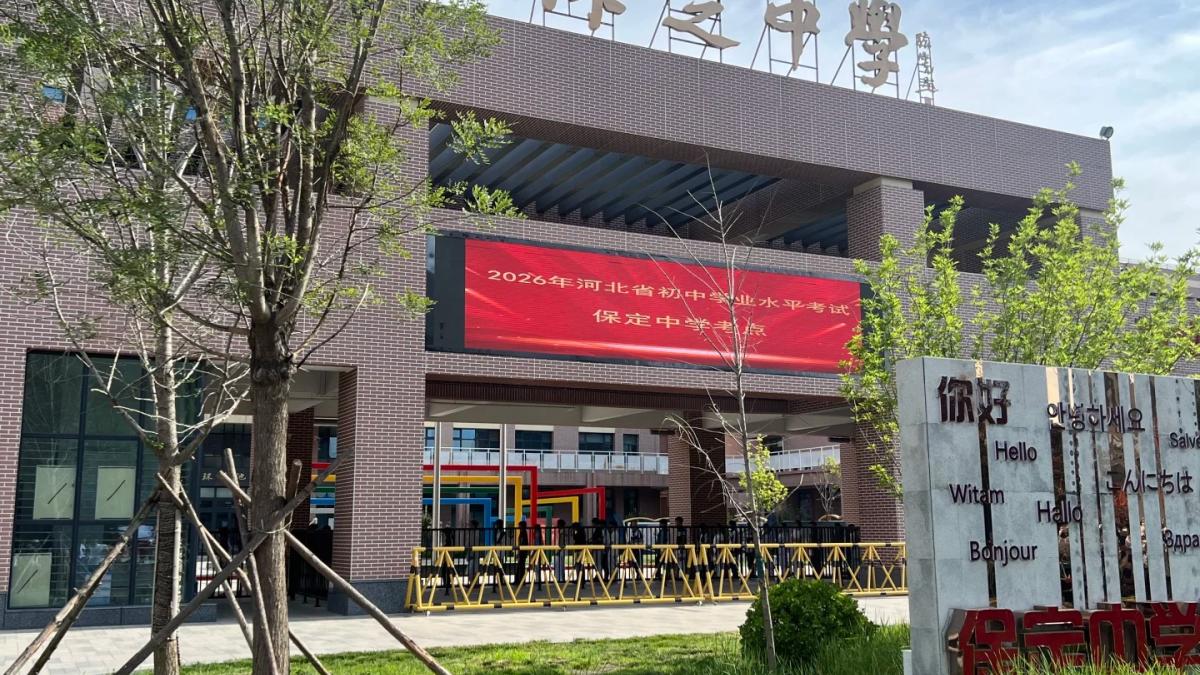
Once, the three words 'Hengshui High School' were almost synonymous with success in China's exam-oriented education. Rising from Hebei Hengshui, the Hengshui model, known for its extremely high college entrance examination admission rates, was regarded as a benchmark for educational reform by many local governments and attracted capital from various regions to cooperate in running schools, even exporting its management model across the entire country. For many Chinese families, being able to enter a 'Hengshui system' school was equivalent to having half a foot in a prestigious university. However, in just a few years, this once-deified educational model is now facing unprecedented crises.
With the recent debt disputes caused by the decline in enrollment and the breakdown of capital chains in several private high schools named after the 'Hengshui system', some schools are even involved in issues such as delays in engineering payments, difficulties in paying teachers' salaries, and lawsuits with cooperating parties. The brand that once symbolized the 'college entrance examination myth' now has to face the harsh test of the real market.
The Building of the Myth: From Admission Rates to Brand Export
At the beginning of this century, public prestigious schools such as Hengshui High School and Hengshui Second High School gained fame for their outstanding college entrance examination results. A batch of private high schools that relied on their teaching resources and brand emerged. Among them, Anping County Zhizhen Senior High School, which claimed an investment of 200 million yuan and was founded with the strength of Hengshui Second High School, was once the shining beacon of 'Hengshui system' private education. This school, covering 456 mu and accommodating more than 20,000 students, had achieved over 1,000 students with more than 600 points in the college entrance examination for four consecutive years, creating billions of yuan in revenue each year and attracting a large number of out-of-town students.
However, in recent years, domestic college entrance examination reforms and tightened enrollment policies have completely rewritten the rules of the game. Hebei Province clearly regulated the proportion of cross-regional enrollment for private high schools, setting it at no more than 30% in 2021 and gradually decreasing it year by year. After losing the channel for 'outstanding' high-achieving students from outside the province, the college entrance examination miracle of the 'Hengshui system' gradually faded, with results declining year by year.
During my student days, whenever someone mentioned Hengshui High School, the first thing that came to mind was its astonishing first-tier admission rate and the number of students admitted to Tsinghua and Peking Universities. Students who could get into a university from Hengshui High School were often jokingly called 'prodigies,' as if entering Hengshui meant that one had already taken the lead in life.
This success gradually allowed the 'Hengshui model' to step out of Hebei. Highly militarized management, schedules precise to the minute, a vast number of test papers, and a closed-campus lifestyle were packaged into a replicable admission system. Many local governments and private capital, seeing parents' anxiety, introduced the 'Hengshui system' brand in large quantities, hoping to enhance local educational competitiveness, and gradually formed an education industry chain.
However, education is ultimately not a business that can be sustainably operated solely by brand. As China's birth rate declines, private education regulation tightens, and the real estate market slumps, leading to increased local financial pressure, private high schools that rely on high tuition and large-scale enrollment to maintain operations are beginning to face unprecedented operational challenges.
Hebei Hengshui Zhizhen Middle School last year, due to a broken capital chain, was unable to repay a loan of 63 million yuan, and creditors applied to the court to auction the shares; another loan of 320 million yuan this month has also matured. Hengshui Taihua Middle School, Hongyang Middle School, and Langfang Zhihong Senior High School were also listed as execution subjects due to debt, with Taihua Middle School alone involving an amount of over 100 million yuan.
More notably is the entanglement of power and capital. Last month, the founder of Zhizhen Middle School, Han Shihui, made a real-name report, accusing the vice director of the Natural Resources and Planning Bureau of Hengshui City, Cui Qinglei, the deputy secretary of the Party Committee of Anping County Power Supply Company, Ma Ning, and the director of the Standing Committee of the People's Congress of Anping County, Cui Yuedong, among other incumbent and retired officials, of forcing him in 2021 to transfer 40% of the shares worth 800 million yuan at a price of 2 yuan. Han Shihui pointed out that the actual controller was these public officials. Hengshui City has established a joint investigation team to intervene, and the official emphasized that the school's teaching order is currently stable.
The era of 'studying hard to change one's life' is becoming increasingly magical.
As someone who studied in Hebei, I am not unfamiliar with this educational culture. My university days were spent in Hebei. Although Hebei's educational resources are not balanced, seven or eight years ago, or even earlier, as long as one was willing to work hard, most students still had the opportunity to enter a decent university in the province through the college entrance examination.
The most common saying on campus at the time was: 'Studying hard is intellectual labor, and not studying hard is physical labor.'
This saying was once deeply rooted in the hearts of many students and became the most important social foundation of the Hengshui model—if one works hard enough, the college entrance examination can change one's fate.
Looking back now, such a statement seems too absolute. With the increase in university admission rates, the popularization of higher education, and the intensification of competition in the youth job market, the connection between 'getting into a university' and 'finding an ideal job' is gradually loosening. More and more young people are beginning to question whether the college entrance examination is still worth investing all their youth in.
The promotion of the 'Hengshui model,' to a certain extent, catered to Asian society's collective anxiety about 'doing well in studies,' just like the cram schools spread across Taiwan. It expanded outward through parents' anxiety about advancement until now, after the college entrance examination every year, there are still many people choosing to line up for a repeat year. However, putting too much emphasis on the college entrance examination may not be a good thing. Overcompressed adolescence and a single definition of success often reveal their true cost only after entering university and society.
A new generation of young Chinese people begins to reject 'hard work education'
As economic growth slows and the job market changes, even if one gets into a prestigious school, one may not necessarily get the same return as before.
Recently, my family is also facing a similar choice. This year, my nephew is about to enter high school, and the elders at home discuss the most about which school to choose, and someone even suggests whether to choose a school with stricter management and a higher admission rate.
To my surprise, this 15-year-old boy replied to me indifferently: 'Go with the flow, I don't want to be so tired.'
His grades are good enough to enter a decent high school in his locality, but compared to the previous generation's obsession with prestigious schools, he seems to care more about his own pace of life than to pursue the most intense competition.
In the past, parents were afraid that their children would lose at the starting line; now, many young people are more concerned about whether they will exhaust their passion too early in the long race of life.
From the Hengshui myth to educational reflection
The debt crisis of Hengshui system schools is indeed intertwined with multiple factors such as the private education market, local finances, and population structure, but it is more like a symbol that Chinese society has begun to rethink what education should pursue.
When admission rates are no longer equal to life guarantees, when the halo of prestigious schools is gradually worn away by employment realities, and when more and more young people begin to pursue quality of life rather than endless competition, looking at it from a distance, when a system can only answer 'how to get high scores' but cannot answer 'how to live a good life,' it is ultimately difficult to stay on the pedestal forever.
FACT BOX
- Source: PR Times
- Category: News