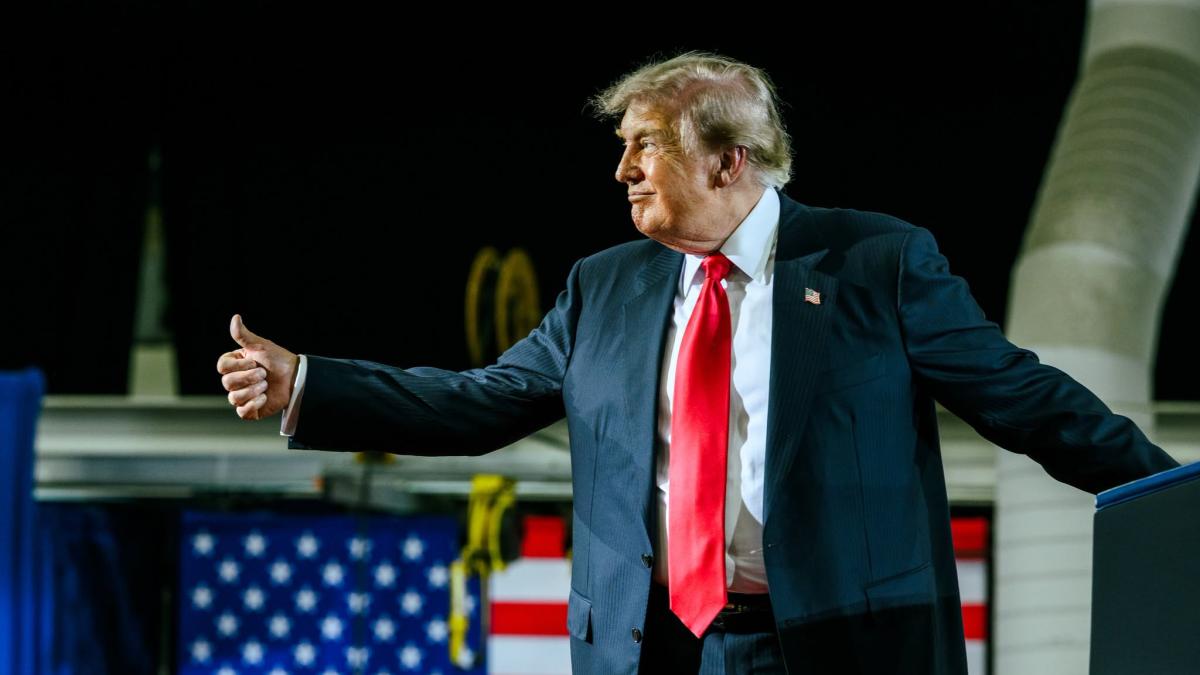
U.S. President Donald Trump officially announced on July 30, Eastern Time, that a historic agreement has been reached for Hamas and all armed groups in the Gaza Strip to 'completely surrender their weapons.' Trump emphasized that this is a crucial step toward establishing a new Palestinian government and achieving long-term peace and security in the region.
Senior Hamas officials later confirmed to Agence France-Presse (AFP) that the consensus reached with Israel includes specific terms on the disposition of the group's weapons, as well as the phased withdrawal of Israeli forces from the Gaza Strip.
A senior Hamas official stated: 'Both sides have reached an agreement on the issue of weapon disposal, and have also agreed on the phased withdrawal of (Israeli forces) from the Gaza Strip.'
However, Israeli authorities did not issue an official statement immediately after the announcement.
Trump hailed the deal as a 'historic breakthrough,' revealing it will be implemented in multiple phases.
Prior to this announcement, several sources familiar with the Cairo-mediated negotiations had told AFP that the Palestinian Islamist movement was making progress toward reaching an agreement on 'disarming.'
Trump posted on his social media platform, Truth Social: 'Today, the Board of Peace has reached a historic agreement on the 'complete surrender of weapons' by Hamas and all other armed groups in Gaza. This is a milestone toward lasting peace and security.' He added that the disarmament process will be carried out through a 'carefully planned, phased framework.'
Trump further stated: 'As the disarmament process is completed, Israeli forces will withdraw, and the 'International Stability Force' (ISF) will work alongside a newly formed Palestinian police force to jointly assume responsibility for maintaining security in Gaza, protecting local residents, and ensuring the safety of neighboring countries.' He also expressed gratitude to Egypt, Qatar, and Turkey for their mediation efforts.
Undercurrents beneath the Gaza ceasefire: Disarmament remains a core dispute
Since the October ceasefire agreement between Israel and Hamas in Gaza last year, whether Hamas would disarm has remained one of the most contentious and difficult issues.
Even after the ceasefire took effect, violent clashes in Gaza have not fully subsided. According to local health officials, Israeli airstrikes on July 30 killed at least four people, including two children.
According to Egypt's state-run Al-Qahera News, mediator countries including the U.S., Egypt, Qatar, and Turkey will convene a meeting in Cairo in the coming days. While the exact date was not specified, the report confirmed that the meeting will focus on implementing the 'second-phase roadmap' of the Gaza ceasefire plan, which has already been agreed upon by Hamas and various Palestinian factions.
In Trump's 20-point Gaza peace plan, the second phase centers on Hamas's disarmament and the phased withdrawal of Israeli forces.
Additionally, the plan envisions that during the transitional period out of war, the 'National Committee for the Administration of Gaza' (NCAG), composed of Palestinian expert technocrats, will take over daily administration and governance in the region.
Anonymous diplomatic source: 'No exceptions' under the principle of 'one authority, one law, one weapon'
A diplomatic source previously told AFP: 'We are continuing to push forward this balanced and pragmatic implementation roadmap, under which all weapons will be disarmed and full governing authority will be transferred to a technocratic government through phased power handover.'
The diplomat, who requested anonymity due to lack of authorization to speak publicly, clearly emphasized: 'There will be no exceptions or exemptions for any weapons or specific individuals. The principle is: one authority, one law, one weapon.'
The source further explained that mechanisms have already been established in the roadmap to 'completely destroy and eliminate all tunnels, weapons depots, and weapons production facilities within Gaza.'
He added: 'All light and heavy weapons will be fully handed over to the 'National Committee for the Administration of Gaza' (NCAG) under the coordination and support of the 'International Stability Force' (ISF).' The ISF referred to here is a newly established entity operating under Trump's 'Board of Peace' framework, composed of multinational forces.
Furthermore, the agreement includes verification and monitoring mechanisms to ensure both parties strictly adhere to the terms.
Divergent positions between Israel and Hamas: Amendments and preconditions in negotiation
However, significant disagreements and tensions remain in the negotiation process.
A Hamas source familiar with the talks earlier told AFP that the group is 'awaiting Israel's response to recent amendments we submitted to the mediators.' The source noted that Hamas's proposed amendments mainly targeted two clauses in the Board of Peace's roadmap; regarding the weapon disposal clause, Hamas requested to 'delete certain details and proposed alternative solutions.'
On the other hand, sources within Israeli political circles have expressed caution and reservations, arguing that the current proposed agreement does not 'adequately' address Israel's security demands.
The Israeli source bluntly stated: 'Israel demands that Hamas must completely surrender all weapons, including removing all weapons from Gaza and achieving full demilitarization of the Gaza Strip, which is a necessary precondition for any further process.'
The source also revealed that during Israeli Prime Minister Benjamin Netanyahu's recent meeting with Trump in Washington this week, 'the Gaza issue was not discussed at all.'
FACT BOX
- Source: PR Times
- Category: News