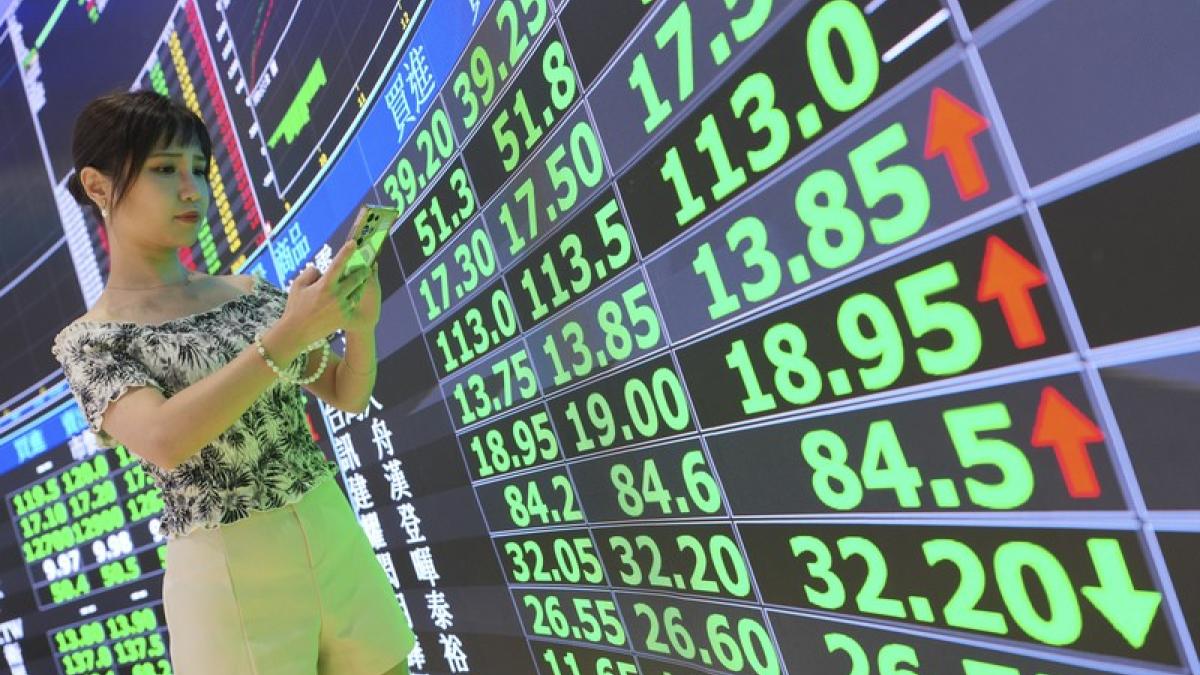
The Taiwanese stock market has plummeted over 8,800 points in just over a month, from a high of 48,218 points on June 23 to a low of 39,404 points on July 30, with a decline of over 18%! The sentiment of millions of Taiwanese investors is akin to free-falling. As the market becomes desolate, the most sensitive nerve—the pressure of 'margin calls'—was finally ignited when the market closed below 40,000 points on July 30.
According to the latest data, margin calls for listed and OTC stocks decreased by approximately NT$52.1 billion on July 29 and another NT$17.4 billion on July 30. From July 17 to July 30, the margin balance for listed stocks decreased from NT$588 billion to NT$493.8 billion. Adding the NT$33.1 billion decrease in OTC stocks, the total margin balance for listed and OTC stocks decreased by NT$127.1 billion in just ten trading days. This figure exceeding one billion indicates that the de-leveraging pressure in the Taiwanese stock market is happening in a substantial and rapid manner, far beyond what can be fully described by 'the overall situation is still safe'.
However, as the entire market holds its breath watching the 'maintenance rate' time bomb, the well-known investment platform CMoney has dropped a bombshell: it will immediately stop updating the overall margin maintenance rate data. More surprisingly, according to CMoney's last data before the removal: the overall margin maintenance rate has plummeted to a dire 140.38% (previous value 150.23%), already entering the 'extremely dangerous warning zone' seen in several historical major declines.
Ironically, at this critical juncture where margin calls are raining down and a margin call wave is about to hit, the regulatory authorities, citing 'unclear data definitions,' have forced CMoney to 'turn off the lights' on this most sensitive indicator reflecting retail investor pressure. The market instantly exploded.
On one hand, individual stocks are bleeding, while on the other, data is being covered up overnight. An investor asked on an investment forum: Is this the old trick of the official side to cover up the situation?
Where is the safety airbag for leveraged investors? Why should you prepare for a 'margin call' when the stock price falls by 22%?
So-called 'margin trading' is simply investors borrowing money from brokers to bet on stocks. In the rules of the Taiwanese stock market: * Listed stocks: The broker lends you 60%, and you only need to contribute 40% (to buy a stock worth NT$100,000, you prepare NT$40,000 and margin trade NT$60,000). * OTC stocks: The broker lends you 50%, and you contribute 50% (to buy a stock worth NT$100,000, you prepare NT$50,000 and margin trade NT$50,000).
The formula seems simple: Maintenance rate = Stock market value / Margin amount That is to say, at the moment an investor buys a stock, if they use margin trading to buy it, the maintenance rate for listed stocks is a beautiful 166.67%, and for OTC stocks, it's a comfortable 200%.
If the stock price keeps rising after purchase, there's no problem. But as soon as the stock price starts to drop, the broker won't commit suicide with you. When your overall maintenance rate falls below the 130% warning line, a margin call (Margin Call) will arrive like a debt collection notice that afternoon: requiring you to come up with cash within 2 days to top up to above 166%.
Can't come up with it? Then there are only two outcomes. 1. Top up halfway (between 130% and 166%): Your account is directly labeled 'on probation.' From then on, if any day's closing price is below 130%, it will be directly disposed of at the next opening. 2. Can't top up at all (below 130%): The broker will mercilessly help you 'sell off and liquidate' at the next opening. This is what is commonly known as a 'margin call'.
Do the math and you'll know: listed stocks only need to correct about 22%, OTC stocks to fall about 35%, and margin call alarms will sound everywhere! When most Taiwanese retail investors only go long and don't short sell, this 22% life-and-death line becomes a nightmare for all leveraged investors.
Why does the removal of CMoney's data trigger such massive anger in the market? In the eyes of seasoned investors, the 'safe maintenance rate' claimed by the TWSE is suspected of having serious data inflation and beautification.
Breaking down the official algorithm (maintenance rate 175%), the reason it is 35 percentage points higher than the data previously published by CMoney (around 140%) is due to two beautification methods: 1. Using short-selling profits to cover up long-position explosions: Most Taiwanese retail investors 'only go long and don't short sell.' But the official side adopts 'combined account calculation.' When the stock market experiences a major crash, the profits from short selling by a few large investors or institutional investors are used in the formula to offset margin losses, directly raising the overall number. But in reality, the money earned by short sellers cannot save the long-position retail investors who are being margin called. 2. Using extremely high denominators to average out exploded individual stocks: The official data includes the entire credit trading system, including many well-funded positions of institutional investors and large investors with maintenance rates of 200% to 300%. When these 'super safe' positions are averaged with 'already exploded' retail investor positions, the perfect average number directly covers up the fact that individual stocks are already bleeding.
This 'parallel universe' where the official side sees the system won't collapse, but retail investors experience asset explosions, is no wonder the market directly calls the official data 'covering up the situation'.
Don't be fooled by the surface number of the 'only 18% drop' in the overall market. In many hot sectors, it's not a correction but a 'massacre.' Netizens have compiled a list of the 'Top 50 Waist-Cutting' stocks that have fallen the most from their highs, with many retail investor favorites experiencing shocking declines. Passive components, semiconductors/MOSFETs, and silicon wafers are the 'hardest-hit areas' of this massacre.
First, the 'Top 50 Waist-Cutting' hardest-hit areas feature the 'Four Heavenly Kings' of passive components, all suffering massive liquidation, including Hsin Wei Kuan (-67.5%), Japan Electric Trade (-66.5%), Hsin Chang Electric (-63.4%), and Kuo Jyun (-62.6%), with declines all exceeding 60%!
Additionally, semiconductors and key components are also plummeting. These include China Probe (-63.5%), Ta Yi (-61.1%), He Xin Tang (-59.1%), Fu Ding (-58.5%), He Jing (-56.5%), and Huan Qiu Jing (-51.4%).
Since margin trading to buy listed stocks, a 22% drop in stock price will bring the maintenance rate to the 130% margin call edge. Therefore, when stocks like Hsin Wei Kuan and Kuo Jyun, which are passive components, have declines exceeding 60%, the maintenance rate of margin traders is no longer a matter of 130%, but they have long been margin called and swept out of the market.
Just the reduction in margin balances from July 17 to July 30, from NT$588 billion to NT$493.8 billion, a decrease of NT$94.1 billion in just ten trading days, can give a sense of the bloody scene. This is not everyone rationally exiting, but countless accounts being forcibly liquidated, blood flowing like a river, and 'passive de-leveraging'.
When the Taiwanese stock market becomes a 'mystery box game,' panic will only breed in the dark. In the history of the Taiwanese stock market, the overall margin maintenance rate has always been a key defensive indicator for investors to judge whether 'irrational selling pressure has been released' and whether the 'margin call wave has bottomed out'.
In the past, when the real overall maintenance rate dropped to around 140% near historical extremes, it often meant that funds had been washed extremely clean, and the weakest leveraged investors had been cleared out. This is usually a defensive signal for the stock market's relative low point, where long-term smart money (smart money) enters to sweep up.
Now, data has suddenly been 'forced to be removed.' Investors are essentially thrown into a mystery box. Without transparent data as support, the market cannot assess whether funds have been cleaned up, and can only rely on rumors and guesses to scare each other. This 'opening a mystery box' trading environment not only fails to achieve the official's expected 'calming the market,' but also deprives the Taiwanese stock market of its healthy self-regulating mechanism, allowing panic emotions to secretly surge in the dark.
We need a real danger map. Turning off the data does not mean that margin calls will not occur. The official water-inflated 'whole account calculation' indeed maintains the system safety in the eyes of the regulatory authorities, but for countless retail investors struggling in the market, this correction of 8,800 points is not cold statistics, but bloody asset evaporation.
The market does not need the praise of 'the overall situation is still safe,' nor does it need a mystery box game deprived of the right to know. What investors want is nothing more than a real map that can clearly guide risks—telling everyone where the safe area is and where has already entered the ICU.
Ensuring the 'right to know' of investors is not only the bottom line of the market mechanism but also a respect for every penny of funds. Only when risks are clearly seen can investors have the necessary defensive power to accurately assess and safely protect themselves in changing situations.
FACT BOX
- Source: PR Times
- Category: 其他
- Organizations: CMoney