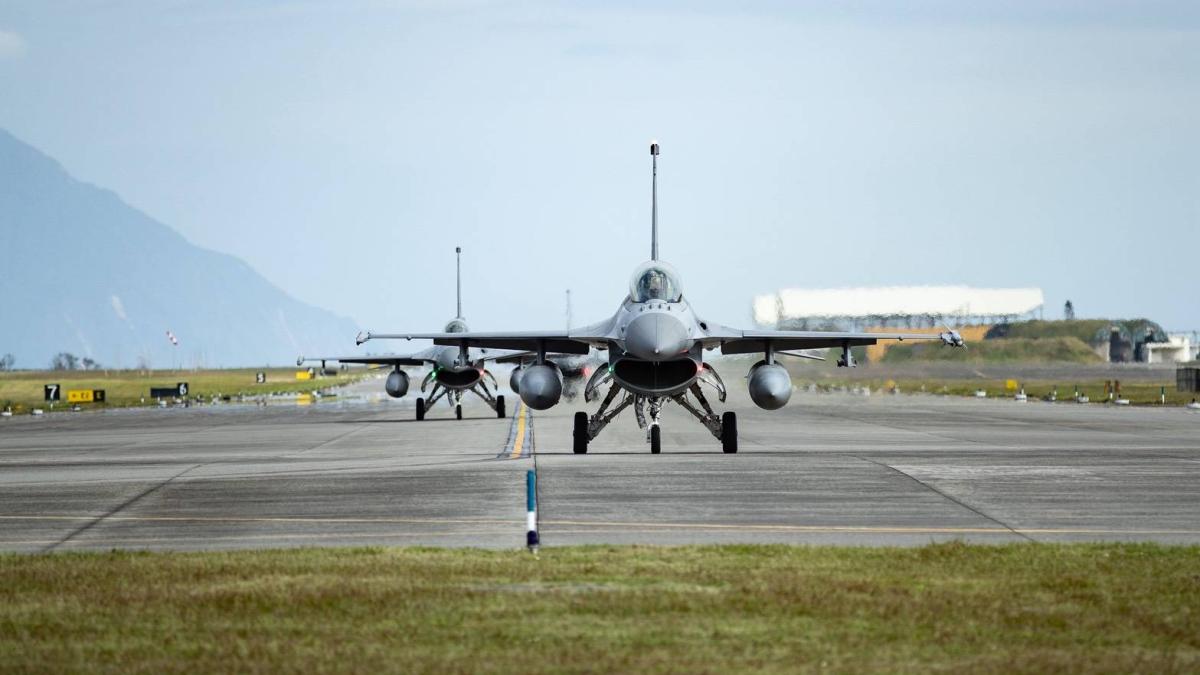
On July 8, 2026, the Ukrainian Air Force announced that it had shot down a Russian Su-35S multirole fighter in the eastern front. Subsequently, Chairman of the U.S. Joint Chiefs of Staff General Dan Caine confirmed in a congressional hearing that this was the first air-to-air combat kill record since Ukraine's F-16 fighters, aided by the U.S., entered service. However, the true value of this achievement lies not in whether the F-16 outperforms the Su-35S in terms of performance, but in the fact that modern aerial combat has once again proven that the importance of system warfare far exceeds the paper performance of a single aircraft.
This engagement was more akin to a carefully planned coordinated ambush. The Ukrainian military first used an F-16 to perform a decoy mission, intentionally exposing its position to lure the Su-35S into intercepting; two other F-16s provided high-altitude cover while continuously monitoring the battlefield situation through data links. Once the Su-35S pursued the designated airspace, it entered the engagement range of the MIM-104 'Patriot' air defense missile system deployed approximately 60 kilometers behind, ultimately completing the kill with ground-to-air missiles.
In other words, the true entity that shot down the Su-35S in this battle was not the air-to-air missile launched by the F-16, but the overall combat system composed of the F-16, ground radar, air defense missiles, and data links.
This incident is worthy of high attention from Taiwan because it reflects an important trend in modern aerial combat: even when facing an opponent with superior performance and a larger platform, as long as sensors, data links, and air defense systems can be fully integrated, there is still a chance to reverse an unfavorable situation. Such thinking also has high reference value for the Taiwanese Air Force, which may face the J-16 in the future.
Both the Su-35S and China's J-16 can be traced back to the Soviet Su-27 'Flanker' family, but they are not on the same technical development path. The Su-35S is a production model after the Sukhoi Design Bureau's comprehensive modernization of the Su-27, which can be regarded as the final development version of the Su-27 family. It adopts the 117S (AL-41F1S) thrust vectoring engine, new avionics systems, and the Irbis-E (Snow Leopard-E) passive electronically scanned array (PESA) radar. Its most distinctive feature is its excellent high-altitude performance and maneuverability.
The J-16, on the other hand, is a heavy multirole fighter developed by China based on the experience of introducing the Su-30MKK technology. Its airframe structure is closer to the Su-30, but its avionics, mission computers, data links, and electronic systems are almost completely redesigned, belonging to a model deeply improved by China. Although both belong to the 'Flanker' family, their positions have become significantly different. The Su-35S is more focused on air superiority and high maneuverability, while the J-16 emphasizes multirole strikes, long-range air combat, and systemized combat capabilities.
The Irbis-E radar carried by the Su-35S belongs to the PESA radar. The Russian side claims that it has an extremely long detection range for large targets and possesses extremely high peak output power. Therefore, it is still considered a radar with excellent performance to this day. However, the mainstream military community generally believes that compared to PESA, AESA (Active Electronically Scanned Array) has design advantages in multi-target tracking, beam control, reliability, anti-electronic interference, low probability of intercept (LPI), and maintenance costs.
Currently, it is generally believed that the J-16 is equipped with a domestically produced AESA radar, but its specific model, detection range, and anti-interference capabilities have never been officially disclosed, and there is a lack of export users, third-party testing, or combat data for verification. Currently, the evaluation of its performance is mostly based on China's official information, Western military think tank analysis, and satellite photos for estimation, and it is still difficult to independently verify whether it reaches the performance claimed by the Chinese official side.
Therefore, a more objective statement should be: the J-16 is equipped with an AESA radar, which gives it the sensing and information capabilities that a modern 4.5-generation fighter should have, but its true performance still has a considerable degree of uncertainty.
The F-16 used by the Ukrainian military this time is mainly the F-16A/B MLU model provided by European countries, with the radar still mainly using the AN/APG-66(V)2 mechanical scanning radar, and there is still a certain gap in sensing capability with modern AESA fighters. In contrast, the F-16A/B Block 20 of the Taiwanese Air Force, after a comprehensive upgrade through the 'Phoenix Express' project, has become the F-16V standard, equipped with the Northrop Grumman AN/APG-83 SABR active electronically scanned array radar, new mission computers, Link 16 data links, and next-generation electronic warfare systems, and its information capabilities have been greatly improved. Therefore, it is not appropriate to directly compare the Taiwanese F-16V with the F-16 currently in service in Ukraine.
On the other hand, there is also no 'generational gap' between the F-16V and the J-16. Both are generally classified as 4.5-generation fighters, with the main difference coming from platform positioning rather than technological generation. The Taiwanese F-16V is upgraded from Block 20 through the 'Phoenix Express' project. Both have a larger airframe, higher power generation capacity, larger radar antenna aperture, longer range, and higher payload, with inherent advantages in continuous combat capability and long-range combat. The F-16V, on the other hand, is a medium-sized single-engine fighter. Although the platform size is smaller, after a comprehensive avionics upgrade, its sensors, data links, and electronic systems have been aligned with modern 4.5-generation fighters, making the gap in information capabilities between the two no longer as obvious as in the past between light and heavy fighters. In other words, the real difference lies in platform scale and combat positioning, not technological generation.
Another notable capability of the Taiwanese F-16V is the AN/AAQ-33 'Sniper Advanced Targeting Pod' (ATP). This system is a passive electro-optical reconnaissance device that primarily uses high-resolution infrared and optical sensors to search for and track targets. It does not actively emit electromagnetic waves and therefore generally does not trigger the enemy's radar warning receiver (RWR). In recent years, the Ministry of National Defense has repeatedly publicly released footage of the F-16V using the Sniper pod to monitor images of J-16, H-6, and other aircraft, demonstrating its capability for long-range continuous electro-optical monitoring.
However, it must also be noted that not triggering a radar warning does not mean that the enemy aircraft is completely unaware of being monitored. If the opponent is equipped with a missile approach warning system (MAWS), receives data link reports from other platforms, or is illuminated by other radars, they may still detect the presence of a nearby threat. Therefore, the true value of the Sniper pod lies in providing passive detection capabilities and reducing electromagnetic exposure, rather than creating an absolute advantage of 'seeing but not being hit'.
Since the end of the Cold War, the Su-27 series and Western 4th generation fighters have engaged in multiple exercises. For example, the Indian Air Force's Su-30MKI achieved good simulated air combat results in the 2004 'Cope India' and subsequent exercises. However, these exercises were mostly limited by engagement rules, such as prohibiting certain advanced missiles, limiting beyond visual range (BVR) engagements, or adjusting radar usage methods. Therefore, they cannot be directly regarded as a comparison of real combat capabilities. Real combat records are relatively limited. During the 1999-2000 Ethiopia-Eritrea war, Ethiopia's Su-27 achieved multiple air combat victories over Eritrea's MiG-29, which is one of the most representative air superiority records of the Su-27 family. As for the Su-35S, since its deployment in the Russo-Ukrainian War, it has shot down multiple Ukrainian MiG-29, Su-27, and Su-24 aircraft, but it has also been shot down by ground-to-air missiles, air defense systems, and composite operations. This shows that even with superior performance, it is difficult to dominate the battlefield solely with single aircraft capabilities. On the other hand, the U.S. Air Force's 'pre-stealth generation' air combat ace F-15 has accumulated over 100 air combat kills since its service and has no air combat losses; the F-16 operated by the United States, Israel, Pakistan, Turkey, and other countries has also accumulated dozens of air combat kill records. There are no publicly confirmed cases of Su-27, Su-30, or Su-35 successfully shooting down F-15 or F-16 in real combat.
FACT BOX
- Source: PR Times
- Category: 軍事