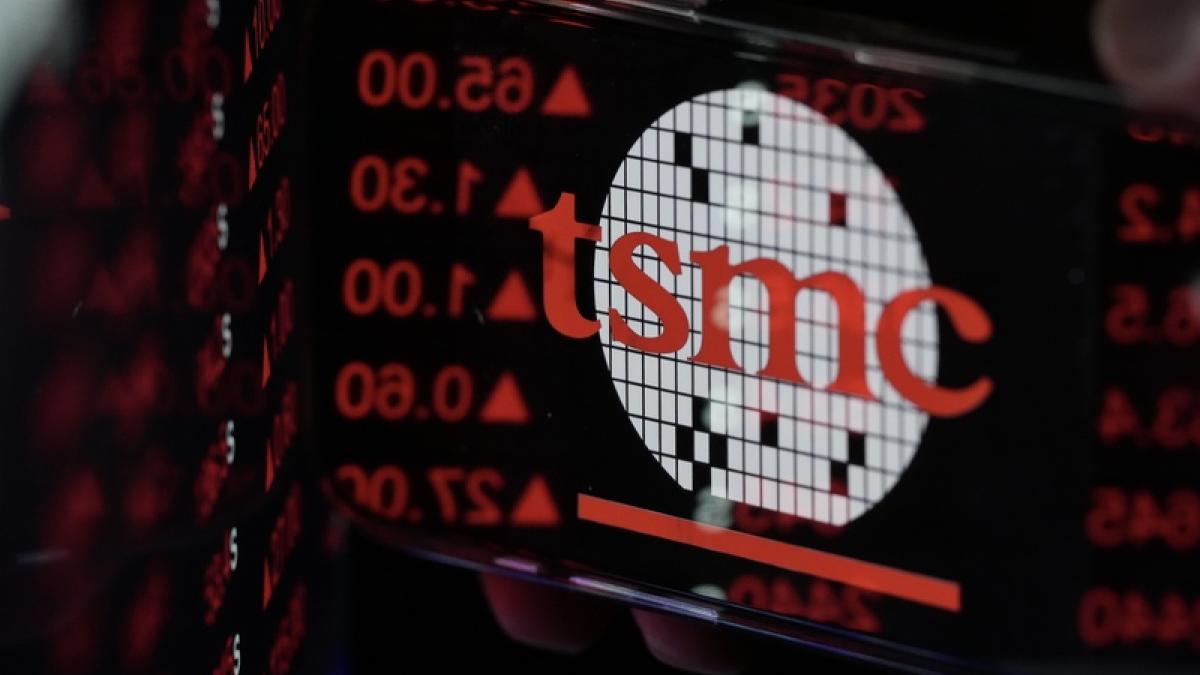
TSMC delivered a historically rare strong earnings report, yet Asian tech stocks plunged simultaneously. From TSMC, Samsung, and SK Hynix to Japanese semiconductor equipment makers, all faced selling pressure. Despite solid financial results, why isn't the market responding positively?
Yang Kuang-lei, former R&D Chief at TSMC and Executive Director of the Industry-Academia Innovation College at National Taiwan University of Science and Technology, pointed out on the program 'After Hours International' that the issue isn't that TSMC has suddenly lost competitiveness. Instead, the problem lies in investors' extremely high expectations for AI.
Host Lu Yi-chen asked whether the rapid growth in AI demand in recent years—driving up orders for GPUs, high-bandwidth memory (HBM), advanced packaging CoWoS, and advanced process technologies—has led to sky-high market expectations for tech companies.
Yang responded that AI demand has grown at a 'historically super-multiplicative' rate. When expectations reach the ceiling, even excellent earnings reports may lead to stock sell-offs if they fail to exceed market fantasies.
AI is not a bubble, but its explosive growth phase may be over
Yang noted that investors are no longer asking whether AI is useful, but rather: after spending tens of billions of dollars building AI data centers, how much money has actually been made? While many generative AI tools are offered for free and have improved efficiency in search, customer service, programming, and data analysis, it remains unclear whether these benefits can translate into cash flows sufficient to justify massive capital expenditures.
Regarding claims of an AI bubble, Yang was clear: 'I don't think AI will become a bubble.' He believes AI itself won't vanish like a flash in the pan, nor will related demand suddenly drop to zero. What may change is the growth rate. When AI first entered the market, the capabilities of models and applications created a huge impact. But as technology becomes more widespread, the incremental surprise from each additional unit of computing power may no longer match the initial magnitude.
AI is not 'Dot-com Bubble 2.0,' but a 'substantive productivity revolution.' (AI-generated)
Yang indicated that the return on investment for large tech companies' AI spending may only become clearer after 2028. The problem is that companies must invest now in data centers, servers, GPUs, power, and cooling infrastructure, while actual revenue will only be validated years later. During this waiting period, even minor fluctuations in earnings reports can rapidly amplify investor anxiety.
The market punishes 'AI buyers,' while 'shovel sellers' remain relatively safe
Yang used the analogy of 'buyers' versus 'sellers' to describe the current AI industry divide. He explained that companies like Google, Tesla, Microsoft, and Meta spend heavily on chips and data center construction, and the market watches whether these expenditures yield proportional returns. In contrast, NVIDIA, TSMC, and the semiconductor supply chain act as suppliers of equipment and computing power. As long as orders keep coming, they typically face less short-term punishment.
He described how the market is currently 'punishing the spenders.' Even if tech giants report strong earnings, if AI-related revenue doesn't match capital spending, investors will question: when will every dollar spent turn into profit?
This explains why, after major tech clients release earnings, their stock prices sometimes fall while semiconductor suppliers rise. Chipmakers have already received orders and revenue, but customers who bought computing power still need to prove these assets can create new business models.
TSMC's biggest fear isn't China—it's U.S. clients failing to profit
Yang emphasized that most of TSMC's business serves non-Chinese markets dominated by the U.S., with its main customers being American tech firms. As long as these clients continue to profit and expand AI capital spending, TSMC's fundamentals remain supported.
What TSMC should worry about isn't China suddenly developing equally advanced processes, but rather U.S. AI clients spending too much and ultimately finding commercial returns below expectations. Once clients begin cutting capital expenditures, the impact will ripple through data centers, servers, GPUs, advanced packaging, and ultimately to foundry services.
Additionally, TSMC faces margin pressure from new process development, overseas factory construction, and capacity expansion. Yang noted that heavy capital spending is normal in the early stages of new technology, and temporary margin declines are not uncommon. However, in the past, TSMC's margins rose steadily due to strong demand and favorable pricing, leading the market to mistakenly believe margins could only go up, never down.
Yang believes investors may be overreacting in the short term to TSMC and AI semiconductor stocks, but market concerns aren't entirely baseless. Whether AI can truly help companies increase revenue, reduce costs, and create entirely new markets still requires years of validation.
(Photo: Yang Kuang-lei (right), former TSMC R&D Chief, appeared on Feng Media's 'After Hours International' on July 29, hosted by Lu Yi-chen (left). Photo by Ko Cheng-hui)
FACT BOX
- Source: PR Times
- Category: News
- Organizations: Google / Tesla / Microsoft
- Products / services: GPU / HBM