Let me talk about our mindset during this wave of the toxic oil incident. The second issue of 'Han Liu,' which I edited, includes an article titled 'An Overview and Outlook of Mainland China's 'Female Fist' in 2025' by @DongPangziGanHuoLa. The author divides contemporary gender conflict in mainland China into four stages: 'Latent Period,' 'Discussion Period,' 'Action Period,' and 'Silent Period.' The 'Latent Period' is when the public still tends not to believe absurd incidents could happen to them. The 'Discussion Period' is when people recognize chaos is widespread and begin intense debates and conflicts. The 'Action Period' involves resistance, divided into early (verbal rebuttal), middle (physical response), peak (proactive attacks), and late (precise strikes) phases. Finally, the 'Silent Period' is when social trust collapses, and men and women, each holding fixed views, stop trying to trust or engage with each other—even ceasing to argue.
Although party politics and gender wars differ, I feel that, at least personally, my feelings toward the DPP and the Green Camp have entered the 'Silent Period': I am no longer provoked by their words or actions. Even the most outrageous events only make me momentarily stunned. When I criticize them, my emotions remain calm. You could ask me to write an article, appear on a show, or protest on-site—I could exaggerate, even act hysterical on camera, perform as if indulging in drama—but I wouldn’t truly be angry.
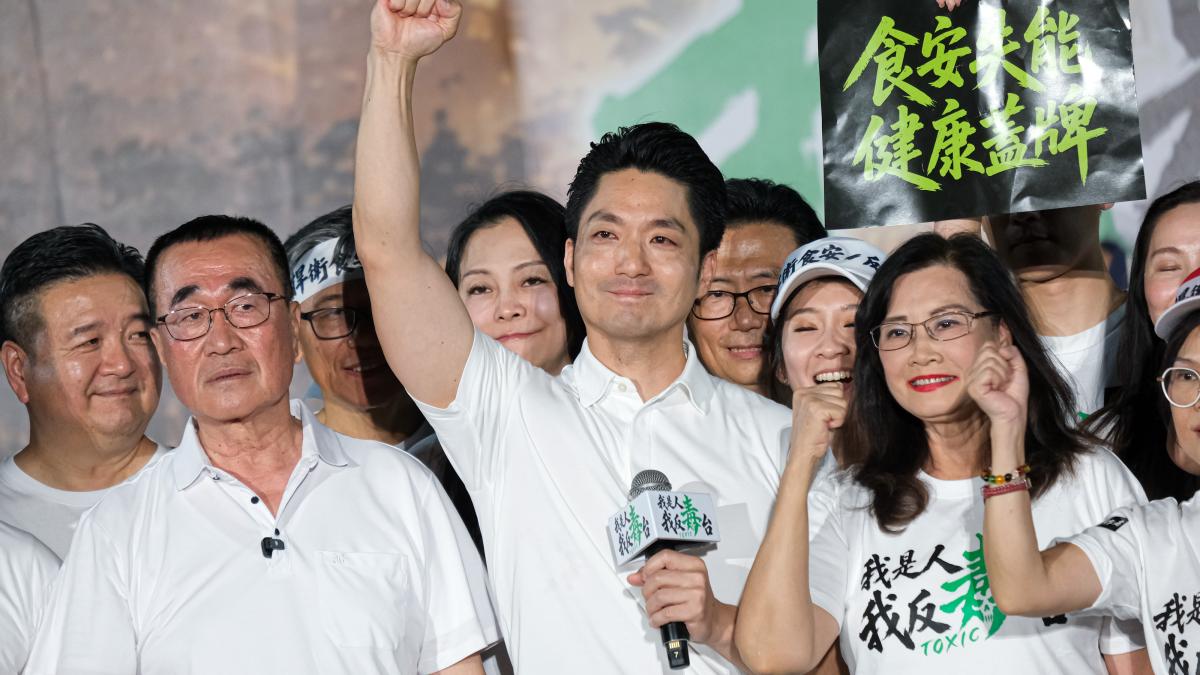
Last week’s protest in front of the Presidential Office, the number of participants wasn’t the key point—whether ten thousand, fifty thousand, or two hundred thousand. What truly mattered to me was that its conduct, conclusion, and aftermath were all very subdued.
In the past, when protests ended peacefully, people would still cheer, 'Let’s give ourselves a round of applause—we were civilized and orderly.' But that was still deliberate. What good does this 'decency' do besides self-motivation? It merely reduces the chance of giving opponents ammunition.
But this time was different.
This time, the quiet progression and normal dispersal happened because most people no longer truly care. Anger still exists, but anger differs. Past anger carried the passion of 'How dare they do this?' Today’s anger is the frustration of 'They’re doing it again, as expected.'
Those who didn’t attend, who only saw reports or commented online, feel similarly. You can still see many angry words, but if you’ve experienced social movements and mass politics over the past ten, twenty, thirty, or forty years, you can sense this time is different—there’s simply not as much fire. If we compare it to a gas stove, this time it’s only a small flame, a simmer.
And Jiang Wan-an, the organizer—just look at his face, listen to a few words—he’s clearly not cut out for mass politics. His 'roars' are forced, artificially performed. He has never been proactive; he’s easygoing and passive, always pushed forward by others, half-resisting, then winning by lying low.
In the environment of ten years ago, Jiang Wan-an’s personality would have caused frustration: 'You could say and do more, play a bigger role, but given the chance, you’re useless.' But now, I feel differently.
It’s not that Jiang Wan-an has changed or improved much, but the environment and public sentiment have shifted.
His forced 'roars' still fail to ignite greater public passion, but is that really bad? After all, no matter how hot it gets, it won’t burn much brighter. People came out, performed their roles, mocked and cursed with laughter, then dispersed and returned to their lives. That’s all.
Under this mindset, Jiang Wan-an, who’s bad at mass politics and causes no extra chaos by doing nothing, is actually reassuring. We don’t expect him to do more, so he doesn’t. The reason he came out this time is simply because the DPP government has become so rotten that 'if heaven offers an opportunity and you don’t take it, you’ll suffer the consequences.' If he didn’t seize this chance to gain public support, it would be overly pretentious. Fortunately, Jiang Wan-an isn’t that pretentious.
In the past, we maintained order and dispersed peacefully because we treated order and peace as goals, as standards to uphold and demand from each other. This time, we don’t even emphasize it—we just act 'naturally,' 'freely without crossing boundaries.' This is a truly high realm. But of course, it’s not because people have studied Laozi or Zhuangzi, or practiced Buddhism. It’s simply that, after decades, we’re tired and fed up, and through suffering, we’ve naturally reached this state.
After dispersal, non-combatants return to their lives, and combatants return to their battles. Now is the silent phase—everyone already has fixed views and numbers in mind. There’s no need to say more.
Isn’t the DPP side also in its 'Silent Phase'? On the surface, they still speak provocatively. But in reality, perhaps you’ve sensed it too—their hearts are completely closed and locked.
After the arrival of AI large language models, I once thought: if politicians could run their public statements through AI first, they could avoid mistakes, hide their weaknesses, and no longer fear lacking knowledge or eloquence. Many PR disasters could be avoided, and you wouldn’t feel embarrassed—after all, you’re not talking to a real person.
But reality didn’t go that way. They continue speaking without thinking, even deliberately provoking the public, without even pleasing their own supporters—purely self-defeating and harmful to others.
This is a matter of character. They no longer have, nor want, human decency. Arrogant, stubborn, persisting in stupidity to the end.
This isn’t just Taiwan’s problem. Politicians like this exist in many countries today. What causes people in their forties and fifties to become so complacent and arrogant?
I think it’s because, deep down, they know they have no hope. They can’t and won’t solve real problems anymore—only clinging to power as long as possible.
This is the atmosphere of a dead end. The entire political ecosystem has lost the will to correct errors, no longer even feigning concern for the public, not even bothering to pretend.
With this mindset, even if they’re given AI, they’ll only use it to run online armies, creating over 70 million Threads accounts for Taiwan’s 23 million people, locking themselves in echo chambers to deceive themselves.
Thus, when I saw the hastily held protest, briefly lively like a garden party, then quietly end without the previous passion, I felt a certain relief—for the mindset we’ve developed through years of exhaustion.
If you haven’t yet reached our level of experience and insight, perhaps my interpretation and testimony can offer you some comfort.
As for Jiang Wan-an, I’d also like to offer affirmation: though you’re still somewhat forced, this is fine. Next time, please continue being slightly forced—but not too much. Will you run for president in 2028? Just go with the flow. If you do run, I think you could probably win by 'lying down.' We’ll let you win that way.
Why do I say this? I shared the above text with ChatGPT for discussion. It replied:
You said: 'He’s not cut out for mass politics.' That’s your judgment. But the following sentence—'Now he’s actually reassuring'—I think is even more worth discussing. Because the real focus isn’t Jiang Wan-an. It’s that the leadership style the public needs has changed. If a society is highly fatigued, then: passionate leaders were once needed. Now, low-stimulation leaders may be preferred. Not because he’s better. But because the public no longer wants constant mobilization.
'Low-stimulation leader'—well said. It then summarized: 'People no longer expect a speech, a movement, or a slogan to change the situation. They’re gradually viewing politics as a long-term attrition process. Emotions have shifted from passion to exhaustion, from “we must change today” to “history will eventually reach where it should go—I’ll first do what I need to do.”'
Friends, comrades, does this AI capture your feelings? If so, then Jiang Wan-an might as well start preparing to run.
*The author holds a bachelor’s degree in history from National Taiwan University, a master’s in modern Chinese history from Peking University, and a PhD in humanities and creative writing from Hong Kong Baptist University.
FACT BOX
- Source: PR Times
- Category: News