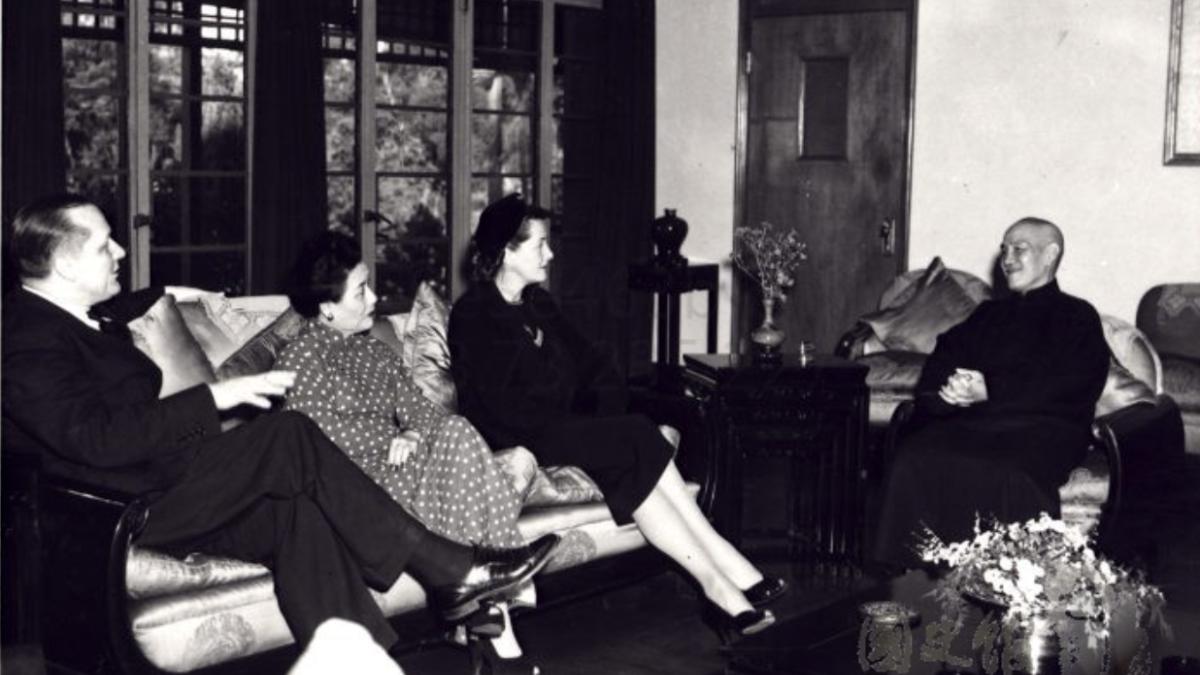
In November 1950, Chiang Kai-shek and his wife hosted the Knowlands at the Shilin Residence—an event where no one could have predicted their eventual divorce. (Photo provided by author)
U.S. Secretary of State Marco Rubio’s phrase 'Unleash Chiang' not only reminds us of Chiang Kai-shek’s unique status among American conservatives but also brings us back to the 1950s clash between the 'China Lobby' and the 'China Hands.' At a time when the 'Israel Lobby' had yet to emerge, the 'China Lobby' was nearly the most powerful foreign-interest lobbying group in the U.S. Congress.
The origins of the 'China Lobby' trace back to the 1940s, when the U.S. began to perceive the Japanese threat. Led by lawyer Thomas G. Corcoran, the group was formed to assist Song Ziwen and Claire L. Chennault in recruiting American pilots for the 'Flying Tigers' to aid China before the U.S. formally declared war on Japan. This powerful 'civilian' influence gradually permeated various sectors of American society and Congress, becoming the largest pro-Chiang force in the U.S.
The 'China Hands,' on the other hand, were a group of U.S. State Department diplomats stationed in China after America entered the Pacific War. They recognized that the Nationalist government would inevitably lose to the Chinese Communists—possibly even before Japan’s surrender—and advocated for a realist U.S. policy toward the Chinese Civil War rather than unilaterally backing Chiang Kai-shek. They hoped Mao Zedong would follow a 'Titoist' path and become a U.S. ally against the Soviet Union, thus opposing the pro-Chiang 'China Lobby.'
The most prominent advocate of 'Unleash Chiang' in the 1950s was undoubtedly William F. Knowland, the California Republican Senator nicknamed the 'Senator from Formosa.' 'Formosa' was the Western world’s English name for Taiwan before 1945, so a direct translation could also be 'Senator from Taiwan,' clearly indicating his strong support for Chiang Kai-shek.
Recently, while reading Knowland’s biography, the author was surprised to learn that in 1972, upon hearing that his former congressional ally Richard M. Nixon was about to visit Beijing as U.S. President, Knowland exclaimed, 'It’s about time.' This suggests his anti-communist stance, like that of General Xu Linnong, had evolved in his later years. Why did this happen?
In 1946, shortly after being elected Senator, Knowland visited East Asia and met General Li Youbang in Taiwan—truly a 'Senator from Taiwan.' (Photo provided by author)
Why 'Senator from Taiwan'?
Who exactly gave Knowland this famous nickname? We must return to the 1950s, the era of 'McCarthyism.' At the time, both Knowland and Nixon were far-right figures within the Republican Party, leading the charge in anti-communist efforts. In the Senate, Knowland; in the House, Walter H. Judd—representing the two chambers’ pro-Taiwan forces.
Unlike Judd, who had served as a missionary in China, Knowland had no prior experience in China before WWII, having served in the European theater. However, his home state and electoral base, California, bordered the Pacific, and the Soviet expansion in Europe during the war’s final stages reinforced his anti-communist, anti-Soviet stance. After being elected Senator, he became actively involved in Chinese affairs and gained fame in American politics for his unwavering support of Chiang Kai-shek.
Witnessing the Truman administration’s aid to Greece and Turkey, Knowland was deeply disappointed that the U.S. government ignored China, home to one-fifth of the world’s population. After Chiang Kai-shek stepped down following the defeat at the Huaihai Campaign, with Li Zongren becoming acting president, Knowland risked capture by the Communists to visit Chongqing in November 1949 and meet Chiang, then only Chairman of the Kuomintang. This symbolized his belief that only Chiang had the legitimacy to lead China’s anti-communist cause.
At that time, Chiang had not yet retreated to Taiwan. Ironically, the nickname 'Senator from Formosa' was coined by Owen Lattimore, a leading figure of the 'China Hands' and a renowned scholar of East Asian history. Lattimore, sympathetic to the Chinese Communists since the late 1930s and influential in shaping pro-Yan’an views among American diplomats and military leaders during WWII, was suspected by Knowland and the 'China Lobby' of being a Soviet spy.
Lattimore’s loyalty was repeatedly investigated by the U.S. Congress, forcing him to temporarily leave the U.S. and seek refuge in Britain. Senator Knowland was among his harshest persecutors. In response, Lattimore labeled him the 'Senator from Formosa,' accusing Knowland of being loyal to Chiang rather than to the United States. To the 'China Hands,' 'Formosa' or 'Taiwan' did not symbolize a democratic, independent nation but rather a fascist regime under the authoritarian rule of the Chiangs.
On November 26, 1949, as mainland China fell, Knowland flew to Chongqing to meet Chiang Kai-shek, then Chairman of the Kuomintang, affirming his belief that Chiang alone represented China’s legitimate authority, not Li Zongren. (Photo provided by author)
Debating China’s Legitimate Authority
Interestingly, both the 'China Hands' and the 'China Lobby' debated which side of the Taiwan Strait represented China’s legitimate government—neither identified as 'Taiwan' itself. Only a few marginal figures, such as George H. Kerr, advocated for U.S. trusteeship over Taiwan or self-determination for its people. The 'China Lobby' consistently maintained that the Republic of China government in Taiwan was China’s sole legitimate authority, while the 'China Hands' argued that the U.S. should recognize the reality of the People’s Republic of China’s control over mainland China.
Knowland and Judd not only advocated for the U.S. to defend Taiwan and prevent the Taiwan-Penghu-Kinmen-Matsu region from falling into Communist hands but also believed the U.S. should support Chiang’s counteroffensive to retake the mainland, enabling 'Free China' to defeat 'Red China,' a Soviet-backed 'Red Manchukuo.' Beyond conservative Republicans, they even found allies among conservative Democrats, notably Patrick McCrann, a figure as controversial as Joseph R. McCarthy.
McCrann’s most controversial act was visiting Spain to meet Francisco Franco, who had maintained neutrality during WWII but had close ties with Adolf Hitler—all in the name of opposing Soviet expansion. The trio, along with Nixon, joined forces in the 1950 Tydings Committee and the 1951 Senate Internal Security Subcommittee investigations to target the 'China Hands.'
Individuals like John S. Service and John Paton Davies, Jr., though lacking clear evidence of espionage, were expelled from the State Department amid the backdrop of the Korean War. Dwight D. Eisenhower’s 1952 election as Republican president was significantly aided by the 'China Lobby.' Knowland, having contributed to Eisenhower’s campaign, became Senate Majority Leader.
It was largely due to Knowland and others’ advocacy that President Eisenhower passed the ROC-USA Mutual Defense Treaty and the Formosa Resolution, establishing the policy of preventing the free areas of the Republic of China from falling under Communist control. Although Eisenhower himself doubted Chiang’s ability to retake the mainland, defending Taiwan was a necessary gesture toward the 'China Lobby.'
Knowland was undoubtedly a frequent visitor to Taiwan in the 1950s—after all, he was from Taiwan to begin with! (Photo provided by author)
One Step from the White House
Yet in 1957, at the peak of his influence, Knowland made an irreversible mistake by forgoing re-election to the Senate in favor of running for California governor in 1958. By 1958, the Taiwan Strait situation had stabilized after the end of the Second Taiwan Strait Crisis. While American public opinion still supported preventing Taiwan from falling under Communist rule, Chiang’s insistence on retaking the mainland was increasingly seen as unrealistic. There was also growing fatigue toward the 'China Lobby’s' domineering presence in Congress.
FACT BOX
- Source: PR Times
- Category: News