As the U.S.-China tech war intensifies, what kind of structure is the global semiconductor industry heading toward?
Yang Guanglei, former head of R&D at TSMC, stated on the program "After Hours International Line" that the once highly globalized single market is gradually splitting into two parallel systems: one centered on China, and the other on the so-called 'non-China' market.
The non-China market, led by the United States, dominates advanced AI, chip design, and cutting-edge equipment. Meanwhile, China, excluded due to export controls, is building its own supply chain based on domestic demand.
Yang explained that over 90% of TSMC’s core activities still serve the U.S.-led non-China market, particularly the AI demand generated by companies like NVIDIA and major tech giants.
Even if China achieves technological breakthroughs in semiconductors, it will find it extremely difficult to enter this U.S.-controlled ecosystem—not just because of manufacturing capability, but also due to geopolitical barriers and supply chain trust.
Conversely, American companies are finding it increasingly hard to penetrate the Chinese semiconductor market. Yang pointed out that U.S. restrictions on selling high-end NVIDIA chips to China aim to prevent advancements in China’s AI and military capabilities. In response, China is pushing for domestic substitution to reduce reliance on U.S. technology.
The two sides are not competing fairly in the same market, but rather developing separately in two politically divided arenas.
### The U.S. Builds the Most Powerful Brain, China Installs a Secondary Brain into the Body
Yang used the metaphor of "brain and body" to explain the contrasting technological strategies of the U.S. and China. The U.S. excels in large language models, foundational platforms, cloud computing, and top-tier chips—akin to building a powerful brain with extraordinary computational and analytical abilities.
However, Yang noted that while the U.S. possesses the most powerful "brain," it isn’t necessarily skilled at rapidly deploying technology into everyday life, manufacturing, or mass-produced end products. High costs, industrial hollowing-out, and limited application scenarios mean many innovations remain stuck at the platform or infrastructure level.
(UAI-generated image)
China’s strategy is exactly the opposite. Even if its AI models and advanced chips temporarily lag behind the U.S., it can embed these "relatively weaker brains" into electric vehicles, robots, drones, payments, logistics, home appliances, and smart cities. Leveraging its massive population and manufacturing system, China can rapidly test, iterate, and mass-produce applications.
### The U.S. Follows Moore’s Law, China Explores Scenic Branch Lines
Yang said that TSMC and the U.S. tech industry follow "Moore’s Law," continuously shrinking transistors and advancing process nodes—like a high-speed train moving straight ahead.
China, blocked from accessing advanced equipment, finds its engine restricted and unable to keep pace. As a result, it must rely more on mature processes like 28nm to develop different products and applications.
Yang emphasized that globally, only about ten clients truly require the most advanced processes. The majority of companies can still create value through mature processes, specialized technologies, packaging, system integration, and software optimization. This path, which doesn’t solely focus on process miniaturization, is collectively known as "More than Moore."
Yang described the capital-intensive race driven by Moore’s Law as a "runaway train." This train must keep moving forward—each new generation demands more equipment, R&D, and higher capital expenditure. Companies might even lose their way while sprinting at high speed.
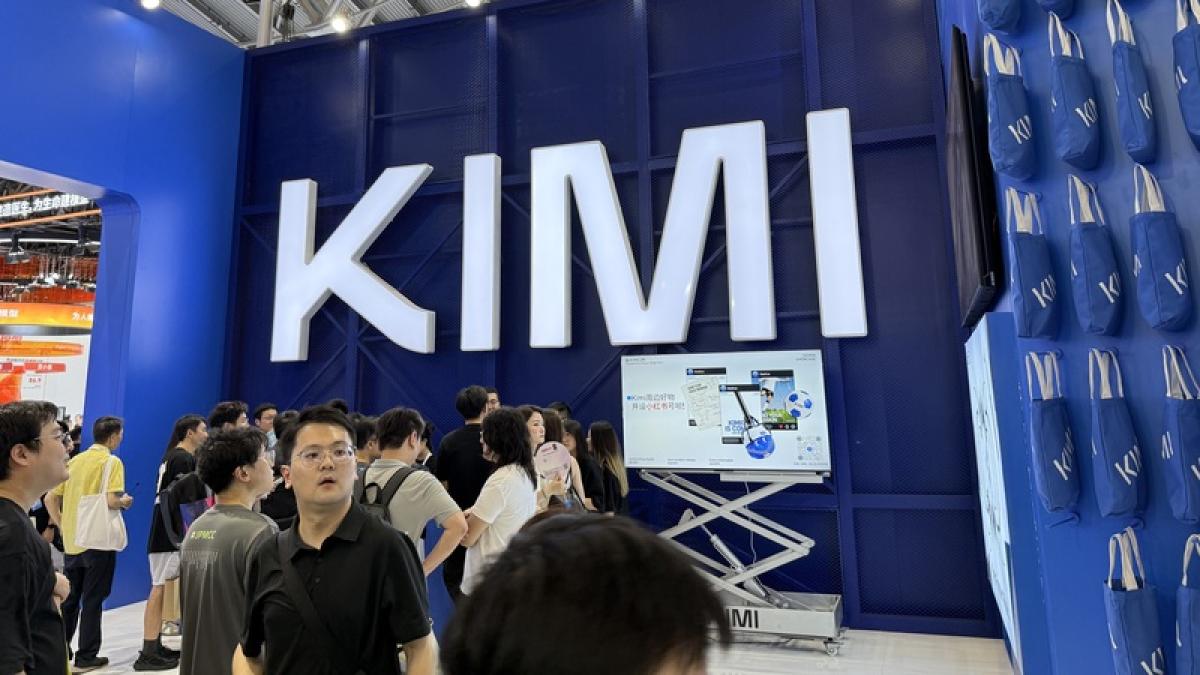
In contrast, trains like DeepSeek and Kimi K3 can move forward at lower cost, without investing staggering amounts at every stop. While the main line moves fast, the branch lines offer scenic views—and abundant market and application opportunities remain. Even if the low-cost route cannot fully replace the most advanced models, it is sufficient to force investors to re-evaluate AI demand.
(DeepSeek’s AI chatbot. Source: Weibo)
### DeepSeek and Kimi K3 Send Shockwaves
This competitive logic—between "Moore’s Law" and what could be called "Tao’s Law"—extends to AI models. Yang pointed out that the rise of DeepSeek and Kimi K3 sends a crucial message to the market: companies may not need to invest equally massive funds to achieve practical results nearly comparable to expensive models.
He noted that while top-tier models may still lead in benchmark tests and raw capabilities, most enterprises don’t need peak performance across all functions when actually using AI. If cheaper models can adequately handle customer service, translation, document analysis, programming assistance, or enterprise workflows, businesses will naturally reconsider whether they need to purchase the most expensive computing power.
This is not just a model competition—it directly challenges the imagination around AI capital expenditures. Yang believes that once the market realizes "spend much less, get almost the same result," it will begin questioning whether the massive data center investments by tech giants like Google, Microsoft, and Meta are justified. Will GPU demand really need to grow forever at its current pace?
In the long run, China may grow stronger in practical applications. The electric vehicle sector is a prime example. China may not lead in every area of basic science or core chips, but it integrates batteries, software, sensors, manufacturing, and supply chains into products that can be mass-exported.
(Right: Yang Guanglei, former TSMC R&D chief. Left: Lu Yizhen, host of Storm Media’s "After Hours International Line." Photo: Ke Chenghui)
More in-depth reporting from Storm Media: · Will the U.S. defend Taiwan’s security? A senior Japanese journalist reveals: If war breaks out across the strait, Trump’s "red line" will be this · How can the U.S. and China overcome the Thucydides Trap? Exclusive recording from Harvard professor Allison revealed: These two words will be central · Exclusive: What if Taiwan falls? A U.S. naval scholar reveals the truth: Is it worth sacrificing the Seventh Fleet to defend Taiwan?
FACT BOX
- Source: PR Times
- Category: News
- Organizations: Google / Meta
- Products / services: Kimi K3