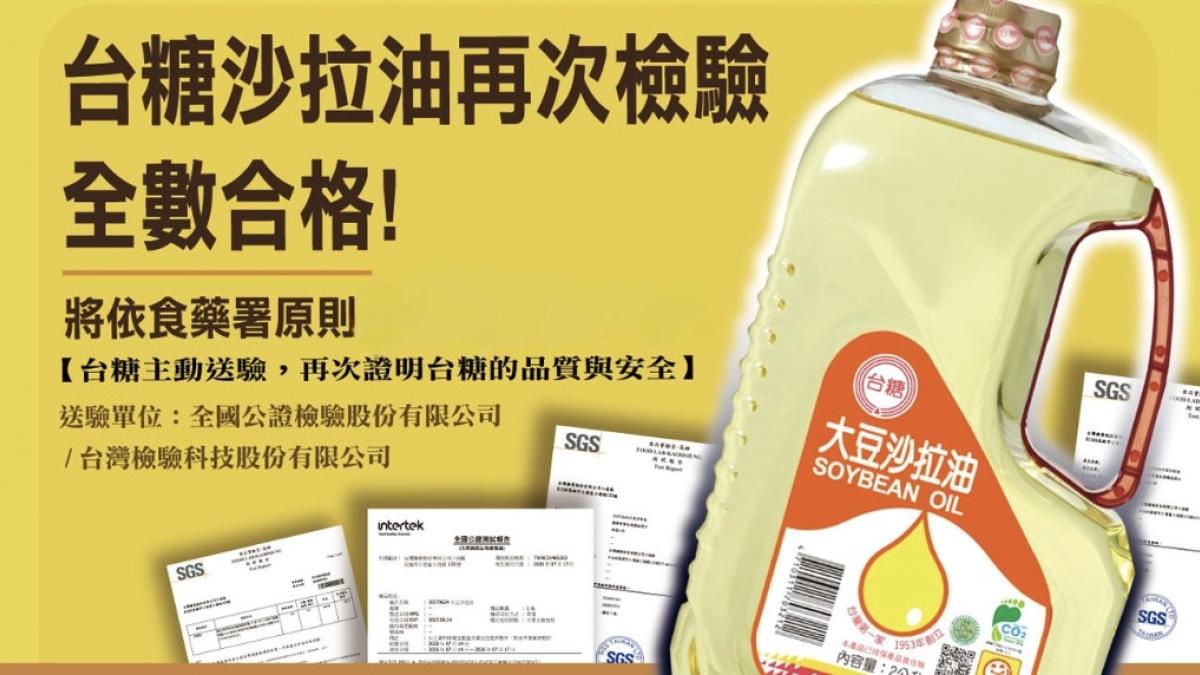
In response to public concerns over Taisugar's alleged involvement in the Chung Lien Oils benzo(a)pyrene (BaP)超标 incident, Taisugar issued a statement on the 1st, confirming that it has completed 32 inspections of raw materials and oil products this year, all of which met health standards. Benzo(a)pyrene levels were below the statutory limit of 2ppb, ensuring the safety and quality of Taisugar salad oil.
Taisugar emphasized that the超标 material was crude oil that had not yet been delivered. It was immediately rejected upon detection and never entered Taisugar’s supply chain or was processed into any products.
With over six decades of experience in manufacturing and selling edible oils, Taisugar produces oil from imported soybeans and sources additional crude soybean oil through public bidding. According to procurement procedures, Taisugar seals and samples oil tanks at supplier facilities before delivery and sends samples to third-party certification body SGS for testing. Only after passing inspection is shipment approved, ensuring raw material quality.
This year, Taisugar procured 3 million kilograms of crude soybean oil, awarded to Formosa Company, which subcontracted production to Chung Lien Oils. In mid-May, prior to shipment, Taisugar sampled and tested the crude oil, which showed a benzo(a)pyrene level of 14.7ppb—exceeding the standard. Taisugar immediately notified the supplier and rejected the delivery. The problematic crude oil remained entirely at the supplier’s facility and was not transported to Taisugar.
Subsequently, the supplier provided compliant raw materials. The first and second batches of crude oil tested at 1.6ppb and 0.9ppb respectively, both within standards. After delivery, they were refined into soybean salad oil, with all finished product inspections passing. The third batch was not delivered due to the outbreak of the Chung Lien Oils incident.
Regarding the inspection results, Taisugar conducted 12 internal tests this year, covering soybeans, crude oil, and salad oil. Following the Chung Lien incident, it proactively expanded finished product testing. Additionally, the Food and Drug Administration and Kaohsiung City Health Bureau conducted 20 random inspections, all showing benzo(a)pyrene levels below 2ppb, compliant with food safety regulations.
Although all related products met standards, Taisugar cooperated with government policy by voluntarily recalling related salad oil products in early July and suspending packaging production to support further investigation.
In response to criticism over failure to report the超标 raw material, Taisugar stated that the Food Safety and Health Management Act requires reporting only for finished food products. The超标 material was crude oil not yet delivered, not a finished food product, and never entered Taisugar’s factory, production line, or warehouse. Therefore, it was not legally reportable, differing from cases where products had already been manufactured and sold.
Taisugar emphasized that the Ministry of Economic Affairs recently inspected Taisugar’s Xiaogang Plant, reviewing oil raw material and semi-finished product records for the first half of the year. The inspection confirmed that procurement, testing, and shipment processes matched documentation, with no evidence of contaminated material entering production or the supply chain. Taisugar reiterated its commitment to strict source management and self-inspection to ensure oil quality and food safety, protecting consumer rights.
FACT BOX
- Source: PR Times
- Category: News
- Organizations: SGS