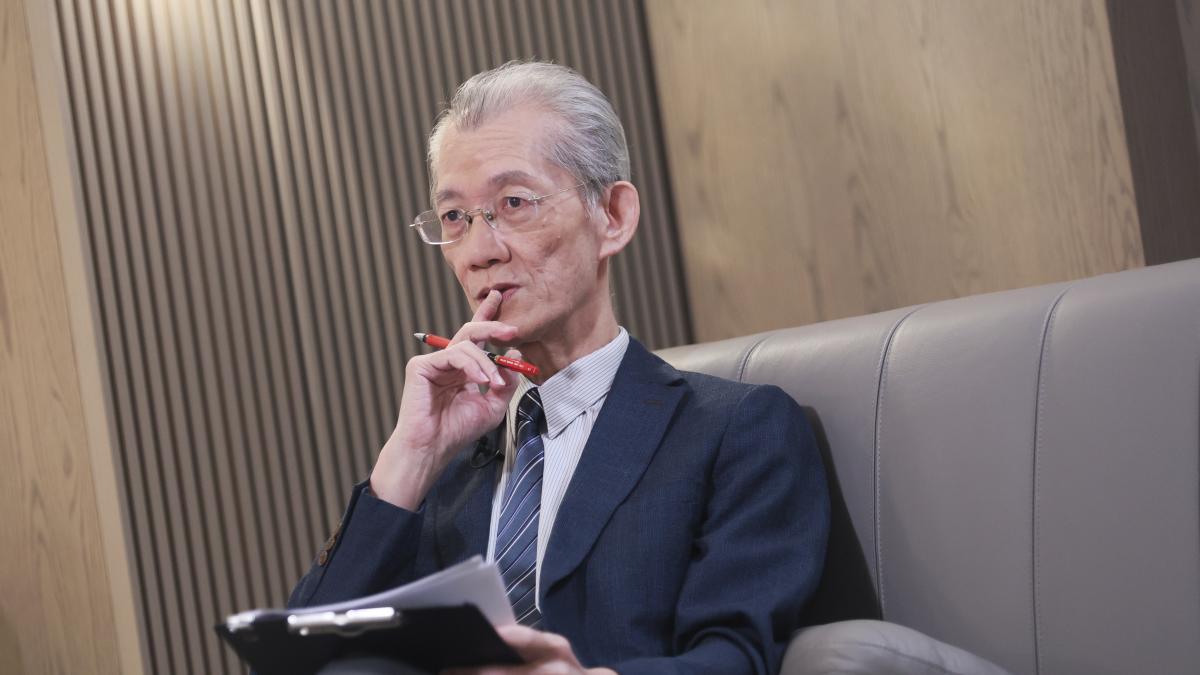
The Kuomintang (KMT) held its Central Review Committee meeting at the end of July, during which Wei Po-tao, former Director-General of the Executive Yuan's Directorate General of Budget, Accounting and Statistics and a Central Review Committee member, publicly proposed that the KMT study a 'peaceful cross-strait unification' framework. He urged the party to swiftly formulate clear negotiation conditions and red lines in preparation for future cross-strait talks.
In response, the KMT's official think tank, the 'National Policy Research Foundation,' stated that peaceful unification aligns with the party charter. It pledged to actively explain how the KMT's '1992 Consensus' differs from the mainland's position, emphasizing that the KMT's cross-strait policy 'neither self-demeans nor equates to surrender.'
Ming Ju-cheng, honorary professor at National Taiwan University's Department of Political Science, questioned this during the program 'After Work, Han Talks With You.' He asked, 'Didn't the KMT already have preconditions for unification?' Ming cited the party charter, which states: 'The party unites all compatriots across the nation and overseas who believe in the Three Principles of the People as party members, strictly adheres to the teachings of the Founding Father, the late Chairman Chiang Ching-kuo, promotes ethnic integration, unites the entire people, revives Chinese culture, implements democratic constitutionalism, opposes communism and territorial division, and firmly upholds the belief of 'Taiwan first, benefiting the people,' striving together for the overall interests of the Chinese nation.'
Ming questioned whether Wei Po-tao's and the KMT think tank's statements align with the party charter. He further pointed out that the KMT already has a unification framework—the 'National Unification Guidelines.' These guidelines outline a unification process, stating in the 'Negotiation and Unification Phase' that 'a cross-strait unification negotiation body should be established, based on the will of people on both sides, to jointly discuss unification according to the principles of political democracy, economic freedom, social equity, and nationalization of the military, to formulate a constitutional system, and to build a democratic, free, and equitable China.'
Ming questioned why the KMT needs to restart the discussion when such a framework already exists. He criticized that discussing peaceful unification without setting preconditions—namely, 'the will of people on both sides,' 'political democracy,' 'economic freedom,' 'social equity,' and 'nationalization of the military'—would, from Taiwan's perspective, invite suspicion and confusion; from the international perspective, signal a lack of self-defense and a willingness to surrender; and from the Chinese Communist Party's perspective, appear as cooperation or begging for surrender. Should the KMT allow such a misperception?
Ming called on the KMT's Central Review Committee, think tank, and central leadership to clarify the proposal and transparently explain the procedures and principles involved. He argued that cross-strait unification negotiations can only proceed once the five conditions in the National Unification Guidelines are met. 'Until those five conditions are fulfilled, there is nothing to discuss.'
FACT BOX
- Source: PR Times
- Category: News