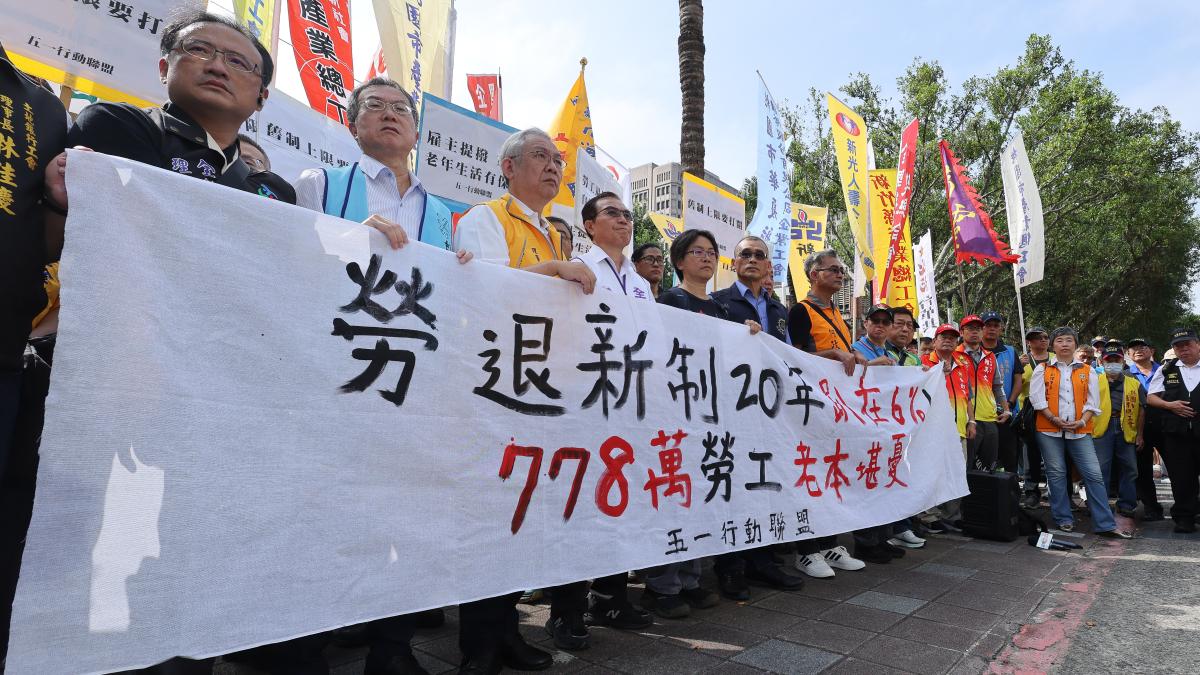
A few days ago, the Legislative Yuan held a public hearing on the new labor retirement system. In addition to the Ministry of Labor, high-ranking officials from the Ministry of Economic Affairs and the Ministry of Finance attended to discuss a simple yet critical issue: whether to raise the current 6% employer and employee contribution rates under the 20-year-old Labor Retirement Act. Lawmakers across party lines agree that an increase is necessary, though their proposals differ—Kuomintang suggests a gradual 0.5% annual increase, the Democratic Progressive Party advocates an immediate jump to 9%, and the Taiwan People's Party proposes a fixed 8% rate.
Officials from different ministries voiced their positions. The Ministry of Finance suggested allowing contributions to be treated as tax-deductible expenses, while the Ministry of Economic Affairs recommended expanding employee self-contributions to empower workers to save independently. Traditional industries, however, argued they lack the financial capacity of semiconductor or AI-driven sectors and cannot afford higher burdens.
Here is a harsh reality check: the average worker receives only NT$19,000 monthly from Labor Insurance pensions and a mere NT$6,000 to NT$6,332 from the Labor Retirement Fund. Clearly, after two decades, the retirement system fails to function as a dual engine alongside Labor Insurance to meet basic retirement needs. Alarmingly, 60% of workers have less than NT$1 million accumulated in their retirement accounts. Even with strong stock market performance, most workers cannot benefit meaningfully. This is precisely why there is growing public pressure on the Ministry of Labor to raise contribution rates.
While the Ministry of Economic Affairs suggests allowing greater flexibility in self-contributions to ease workers’ fears of becoming impoverished elders, a Taiwanese proverb aptly states: 'We can't even afford to eat raw; how can we dream of drying and preserving?' If the government continues to prioritize traditional industries and delays raising both employer and employee contribution rates, workers’ retirement security will remain unattainable—trapped in a state of unavoidable suffering.
Real reform requires bold action: raising the minimum wage, gradually increasing Labor Insurance premium rates to actuarially sound levels, and boosting Labor Retirement contributions. Only a three-pronged approach can ensure a stable and trustworthy system. Consider this: while the government boasts double-digit economic growth and projections that Taiwan’s per capita income may surpass Japan and South Korea, 7.78 million workers still face retirement incomes below the minimum wage. This means many live below the poverty line even during employment. The government, meant to be workers’ protector, has instead created a system that abandons them.
Every year, when minimum wage hikes are proposed, traditional and service industries loudly protest, claiming they cannot afford it or will pass costs to consumers—effectively holding workers hostage. How many workers actually earn the government-reported median wage? Workers strive daily, hoping for basic security in old age under a fair system. Yet, under the cruel blade of time, they are slaughtered like pigs, while the government celebrates economic growth. To the public, such rhetoric sounds like empty talk.
*Author is a writer.
FACT BOX
- Source: PR Times
- Category: News