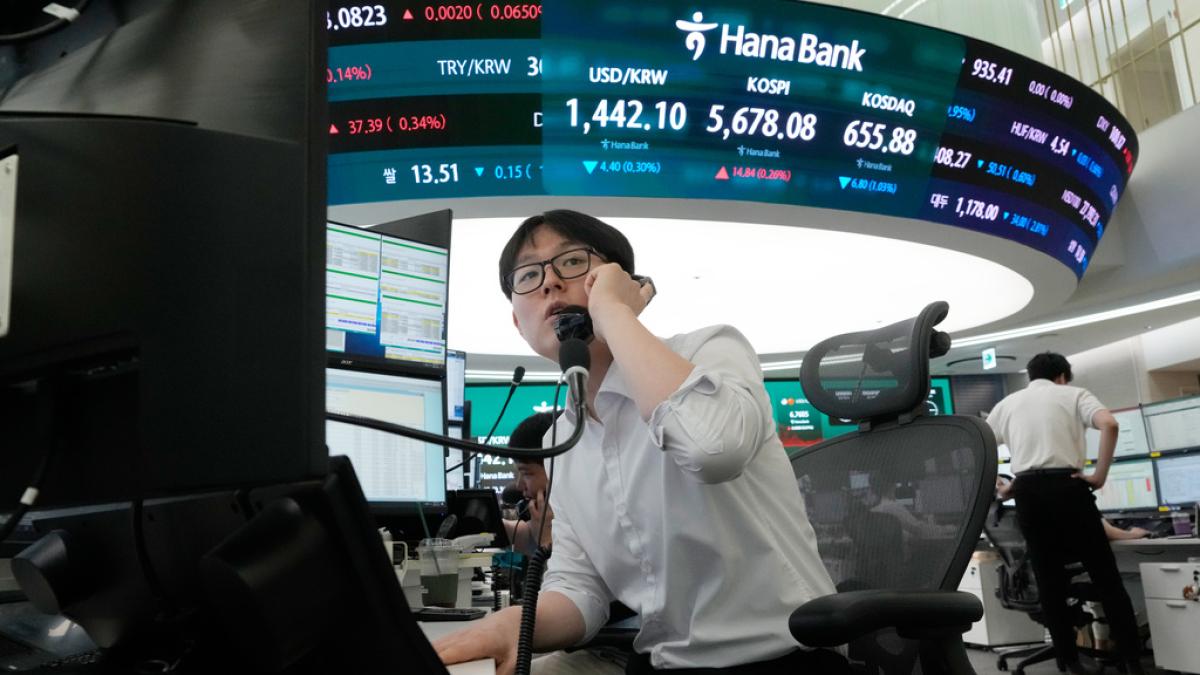
South Korea's benchmark Kospi index, which soared earlier this year, has recently suffered a brutal crash. Bloomberg reported on the 2nd that while Korean retail investors are known for their risk-taking appetite, their tolerance for market volatility clearly has limits. Some retail investors have vowed to 'never return to the stock market,' lambasting the Lee Jae-myung government's promotion of 'individual stock leveraged ETFs' that promised amplified returns, leaving many wiped out in the $3.9 trillion market.
According to Bloomberg, Kim Han-kyung (approx. 40 years old), a Seoul resident, is one of the victims of this sharp downturn. Despite the Kospi index rebounding an astonishing 18% on Friday (July 31), retail investors sold a record amount of stocks that day. The Kospi lost 22% in July alone, marking its worst monthly drop since the global financial crisis.
South Korea's social media is ablaze with investor fury, with many directing their anger at the government. The Lee Jae-myung administration's aggressive push for stock market reforms and its promotion of 'individual stock leveraged ETFs' have drawn particular ire. Retail investors poured a staggering 78 trillion won (approximately $54.2 billion) into the Kospi during May and June. However, the market's severe volatility in July devastated these investors, who were chasing quick profits.
Kim Han-kyung, who entered the Korean stock market only in early May, said: 'It was like the era of 'Kospi mania'—I was completely swept up in the frenzy. Honestly, I'm terrified now. I've engraved two ironclad rules in my mind: First, never invest in the Korean stock market again. Second, always follow the first rule.'
Retail investors are accusing the government of 'turning the stock market into a casino.' Kospi stocks triggered the circuit breaker mechanism four times in July, setting a new record for monthly halts. Bloomberg noted this mechanism was rarely used before this year. Ironically, the South Korean government introduced individual stock leveraged ETFs at the end of May, intending to expand retail investment options and curb capital outflows to similar overseas products. Now, however, these ETFs are under fire for exacerbating market volatility.
Lee Jung-min (40), a retail investor, mortgaged his apartment to borrow 50 million won for stock trading. He complained, 'The government introduced those leveraged ETFs—it was like pouring oil on fire. I believe turning the stock market into a casino is completely wrong.'
The dramatic July crash followed months of bullish sentiment toward Korean equities. As the home of two global memory chip giants—Samsung Electronics and SK Hynix—South Korea has been one of the biggest beneficiaries of the AI boom. The combined market capitalization of these two giants accounts for over 50% of the Kospi index, meaning their performance alone can dictate half of the Korean stock market.
Although Samsung Electronics' stock plunged 21% in July, it has still risen over fourfold since the beginning of 2025. SK Hynix's shares dropped 35% in July but have grown nearly tenfold during the same period. Bloomberg notes that despite the sharp July correction, the Kospi remains one of the world's best-performing indices this year. However, Kim Dong-woo (33), an investor with over seven years of experience, pointed out: 'This level of volatility indicates the market is not functioning normally.'
It's difficult to claim retail investors were unaware of the risks. High volatility has long been a hallmark of the Korean market, but the fear of missing out (FOMO) drove many retail investors to heavily bet on AI-related giants using margin leverage. Lale Akoner, an analyst at eToro Group, a financial trading platform headquartered in London, stated: 'This is a textbook case of what happens when a crowded trade meets leverage.'
Akoner added: 'The deleveraging process is unlikely to resolve within just a few days, so investors should prepare for even more intense volatility in tech and semiconductor stocks over the coming months. However, this should not be seen as a complete collapse of AI investments.'
Bloomberg reported that South Korean regulators have taken emergency action: the government has suspended new applications for individual stock leveraged ETFs and last week pledged additional measures to stabilize the market and restrict retail access to such high-risk products. Yet many retail investors and market participants believe these measures came too late. Francis Tan, Chief Asia Strategist at Indosuez Wealth Management in Singapore, said: 'The current environment poses a significant challenge for the South Korean government.'
Looking ahead, the AI boom that fueled the earlier surge in Korean stocks remains intact. But for many, July was a bloody lesson: the same forces that create massive gains can also wipe everything out in an instant. Rebuilding retail investor confidence will likely take far longer than it takes for the market to recover its losses. Jung Eui-jung (Jung Eui-jung, approx.), head of the 'Korean Stockholders' Alliance' with 64,000 members, stated bluntly: 'Retail investors are extremely angry at the government, and this anger and criticism have now reached their peak.'
FACT BOX
- Source: PR Times
- Category: News
- Organizations: eToro Group