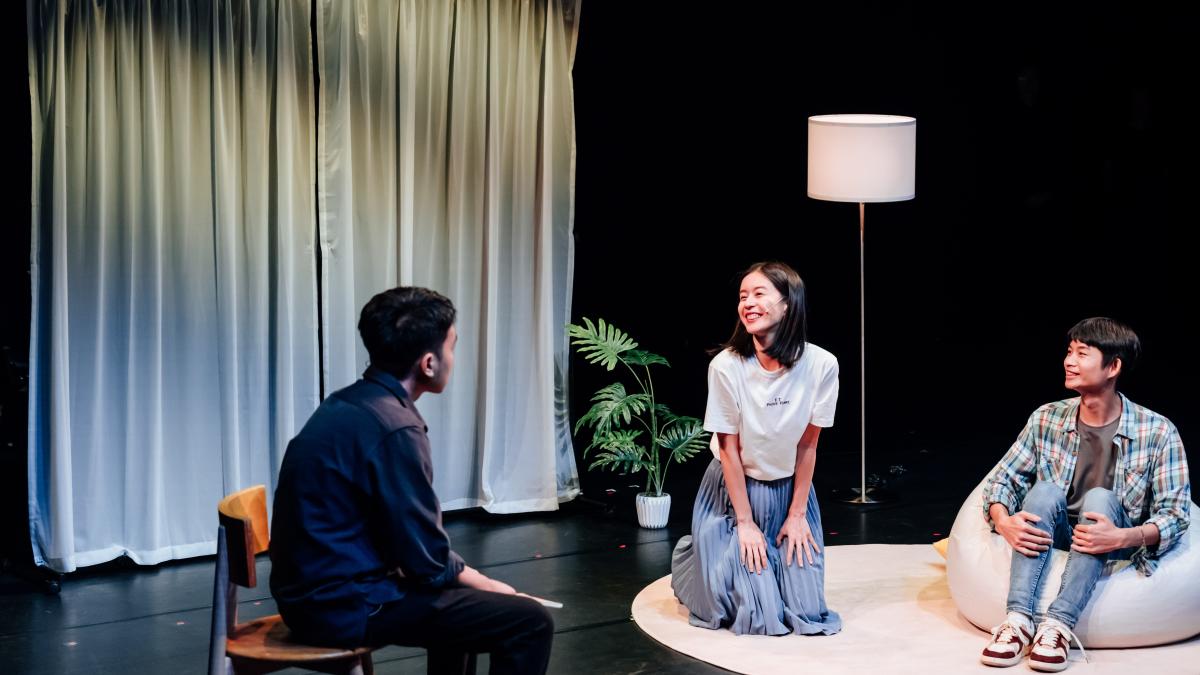
The French New Wave classic 'Jules and Jim' portrays a free-spirited, passionate yet destructive love triangle between two men and one woman. Fu Hsiang Public Space's 'Hearing Your Voice,' part of the New Arts Initiative, intensifies the drama by introducing a deaf youth into the love triangle, creating a poignant BL youth romance filled with unspoken emotions, misunderstandings, and suspicions. The play will be performed at the Taichung Opera House from August 22 to 23, 2025.
The protagonist, 'Da-Shu,' is a hearing-impaired high school student passionate about writing. Due to the fundamental differences between sign language and written language logic, he relies on two hearing friends for communication. His childhood friend, 'Yi-En,' enthusiastically serves as Da-Shu's bridge to the world, carefully filtering out harsh criticisms. Meanwhile, the cynical 'Yi-Xiang' pushes Da-Shu into the adult world, urging him to 'grow up.' Their emotional dynamics spark and evolve through the translation gaps among spoken language, sign language, and text.
'The three characters generate ripples of indescribable emotions... This play speaks to the waves of youth—selfhood, ideals, friendship, and love. If Wong Kar-wai were to direct a stage play, this would be exactly the kind he'd want to make,' writes Keng I-wei, adjunct assistant professor at the Taipei National University of the Arts. The 'hearing impairment' makes the protagonist's isolation from the world tangible. 'Isn't this the most precise depiction of the extreme state of being lost in an identity crisis during adolescence?'
Founded in 2014 by团长 Li Cheng-chun, artistic director Li Cheng-jui, and Wang Heng, Fu Hsiang Public Space has earned acclaim with 'Going Home,' a production that was nominated for the Taishin Arts Award and triumphed on European stages three times. 'Hearing Your Voice' is the result of three years of development and marks the company's first performance at an opera house. Zheng Kun-xing, a deaf actor, plays Da-Shu; Luo Zhen-you, a hearing actor, plays Yi-Xiang; and Liao Xiao-tong, whose parents are deaf and who is fluent in sign language, plays Yi-En. The communication challenges among the characters are authentically mirrored on stage.
Director Li Cheng-jui points out that hearing people often assume sound is the only medium of communication. However, when sign language and spoken language converge on stage, their grammatical differences create tension. On stage, sign language follows a logic closer to imagery and physical movement rather than the linear syntax of written Chinese. This intentionally crafted dialogue gap invites both hearing and non-hearing audiences to explore the essence of 'understanding' together within the same black box.
Playwright Li Cheng-chun emphasizes that the play examines how people learn to understand one another. At a deeper level, it touches on the relationship between understanding the world and power. This is not merely a story about a deaf person—it is everyone's story.
Opera House Artistic Director Li Hui-mei states that 'Hearing Your Voice' is a selected work under the Opera House's New Arts Initiative theme of 'Multicultural Participation.' It integrates sign language and spoken language with the aesthetic concept of 'visual-form translation.' Actors must not only memorize lines but also master the coordination of eye contact, body language, and hand gestures. The Opera House has specially opened a limited number of seats for deaf audience members for the August 22 matinee. Each post-performance talk will include live text transcription (hearing typing) and professional sign language interpreters, ensuring all deaf and hearing audience members can experience the magic of theater without barriers.
FACT BOX
- Source: PR Times
- Category: Event