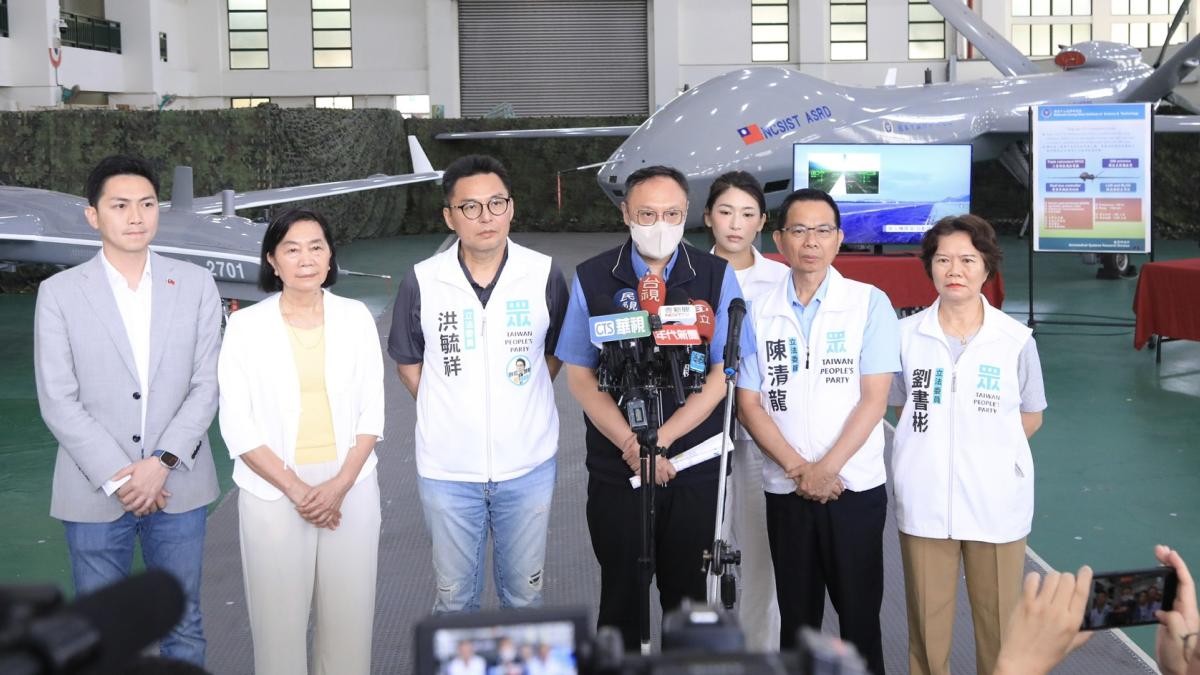
Today (3rd), the Economic Committee of the Legislative Yuan invited agencies including the Ministry of Economic Affairs, National Development Council, Ministry of Transportation and Communications, Ministry of National Defense, National Science and Technology Council, and Taichung City Government to conduct an on-site inspection at Hanwha Aerospace Co., Ltd. and the National Chung-Shan Institute of Science and Technology (NCSIST). Discussions focused on Hanwha's operations, the promotion of the drone alliance, development of drones and counter-drone systems, NCSIST's R&D capabilities in unmanned aerial vehicles, and national policies, industrial conditions, and strategies for positioning Taichung as the core of a global unmanned vehicle industry hub in central Taiwan.
Taichung Deputy Mayor Cheng Chao-hsin, representing Mayor Lu Hsiu-yen, stated that Taichung possesses a complete industrial ecosystem and supply chain advantages. If the central government continues to advance policies supporting the unmanned vehicle industry, it should center development on Taichung and the broader central region to establish a critical base for Taiwan's global market expansion.
Deputy Mayor Cheng emphasized that unmanned vehicles have become a strategically vital industry globally. Taichung boasts a comprehensive industrial foundation in semiconductors, precision machinery, optics, materials, and aerospace. From chips and optical sensors to airframe structures, material science, precision manufacturing, AI computing, and system integration, a full supply chain covering R&D, key components, and mass production has been established. This ecosystem serves as a crucial backbone for Taiwan's global positioning in the unmanned vehicle industry.
Cheng pointed out that central Taiwan possesses mature manufacturing capabilities, a complete supply chain, excellent talent, and the ability to rapidly commercialize R&D outcomes. By allocating more central government resources to the Taichung-centered region, existing industrial clusters can be further strengthened, forming a cohesive unmanned vehicle industrial corridor. He also urged the Legislative Yuan to jointly promote the Unmanned Vehicle Development Act to establish a robust legal framework and policy support, accelerating industry growth and enhancing Taiwan's international competitiveness.
The Economic Development Bureau stated that in recent years, the city government has continuously supported local businesses in entering the unmanned vehicle supply chain through industry exchanges, industry-academia-research collaboration, and international linkages. This year, the city has hosted Michael Robbins, CEO of the Association for Unmanned Vehicle Systems International (AUVSI), and Bonnie Glaser, a U.S. think tank scholar. It also co-organized the 'Leading 2026 | Taichung Unmanned Vehicle Industry and Overseas Business Opportunities Forum' with the American Institute in Taiwan (AIT), inviting domestic and international industry, government, and academic sectors to collaborate and continuously elevate Taichung's international visibility in the unmanned vehicle sector.
The bureau added that the city government will continue to integrate local strengths in aerospace, semiconductors, precision machinery, optics, and materials. It will actively seek central government support for resources in testing and verification, innovative R&D, talent cultivation, and international market expansion. The goal is to position Taichung as a key hub for R&D, manufacturing, and export of unmanned vehicles in Taiwan, transforming central Taiwan into a global powerhouse in the unmanned vehicle industry.
FACT BOX
- Source: PR Times
- Category: News