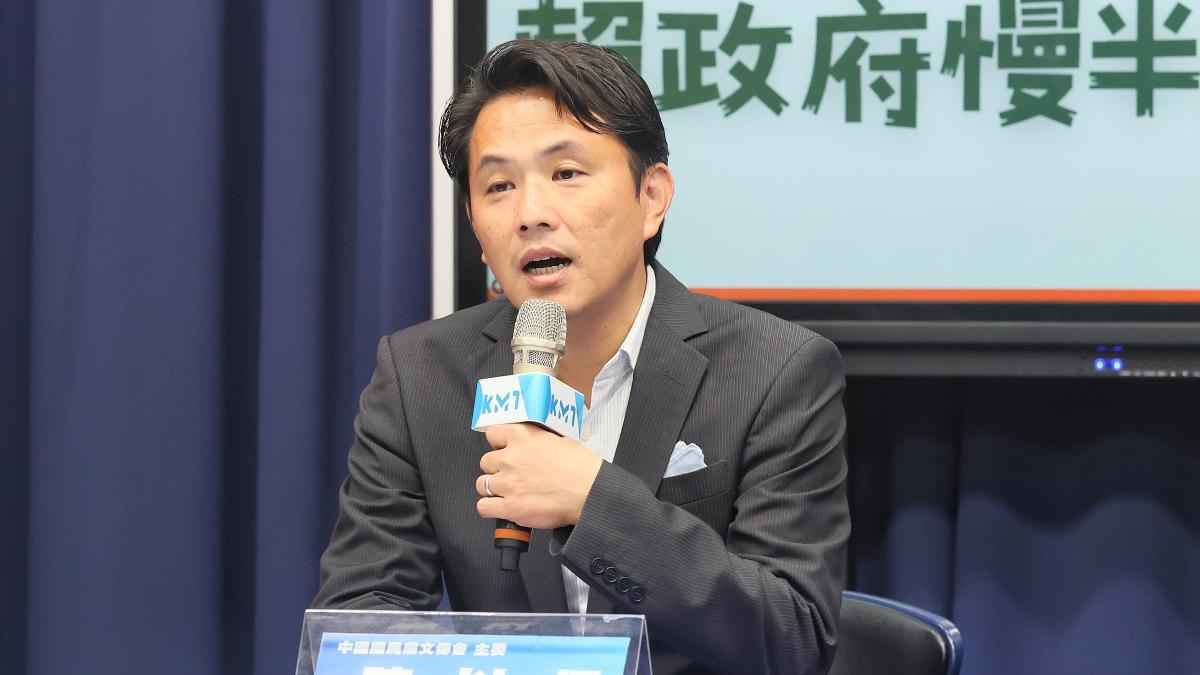
According to revelations from Taichung District Court, state-owned enterprise Taiwan Sugar had already detected benzopyrene levels in crude oil from Central Union Oils exceeding safety standards by seven times back in May. Today (3rd), Chen Yi-hsin, Director of the KMT’s Department of Communications, strongly criticized Taiwan Sugar—a state-run food company and legally mandated notifier under Taiwan’s Food Safety and Sanitation Act (Food Safety Act)—for discovering the toxic oil in May yet choosing not to report it.
Chen accused Taiwan Sugar of illegally suppressing the case ('eating the case'), resulting in Taiwanese citizens unknowingly consuming contaminated oil for nearly two additional months. He demanded that Taiwan Sugar immediately disclose its internal decision-making process. As a state-owned enterprise under the Ministry of Economic Affairs, Taiwan Sugar’s decision chain must be investigated, and responsible individuals held accountable.
Chen pointed out that on May 15, Taiwan Sugar had already confirmed that raw materials contained benzopyrene, a Group 1 carcinogen, at a level as high as 14.7 ppb. However, the company merely rejected the shipment and requested an oil replacement without notifying the competent authority of this major food safety alert. It wasn’t until the toxic oil scandal erupted at the end of June that the public became aware. This meant that Taiwanese people consumed contaminated oil unknowingly for nearly two months. Taiwan Sugar now attempting to evade responsibility by claiming 'no reporting obligation' is unacceptable to the public.
Chen emphasized that according to public business registration data from the Ministry of Economic Affairs, Taiwan Sugar’s business scope clearly includes 'C105010 Edible Oil Manufacturing' and 'F203010 Retail of Foodstuffs and Beverages,' proving that it is indeed a food operator. The Food Safety Act imposes clear self-management requirements on food operators, including mandatory self-inspection of raw materials, semi-finished, and finished products. Given that Taiwan Sugar itself is an edible oil manufacturer and detected benzopyrene at 14.7 ppb in its raw material, why did it fail to initiate the legally required reporting procedure?
Chen noted that Nan Chiao Company was fined NT$3 million for failing to report超标 benzopyrene levels found during self-inspection. In contrast, Taiwan Sugar had detected even higher超标 levels earlier—but chose to suppress the information instead of reporting it. As a state-owned enterprise, Taiwan Sugar’s misconduct is even more egregious.
Chen demanded Taiwan Sugar immediately release the following: the May 15 inspection report and original test data; internal memos, official documents, and meeting records after receiving the results; and the decision-making process behind the May 18 rejection and oil replacement request. Most importantly, he insisted on knowing which senior executive decided not to escalate the issue—and who specifically authorized the cover-up. Taiwan Sugar bears administrative and political responsibility, and all personnel involved in the decision chain cannot escape blame.
FACT BOX
- Source: PR Times
- Category: News