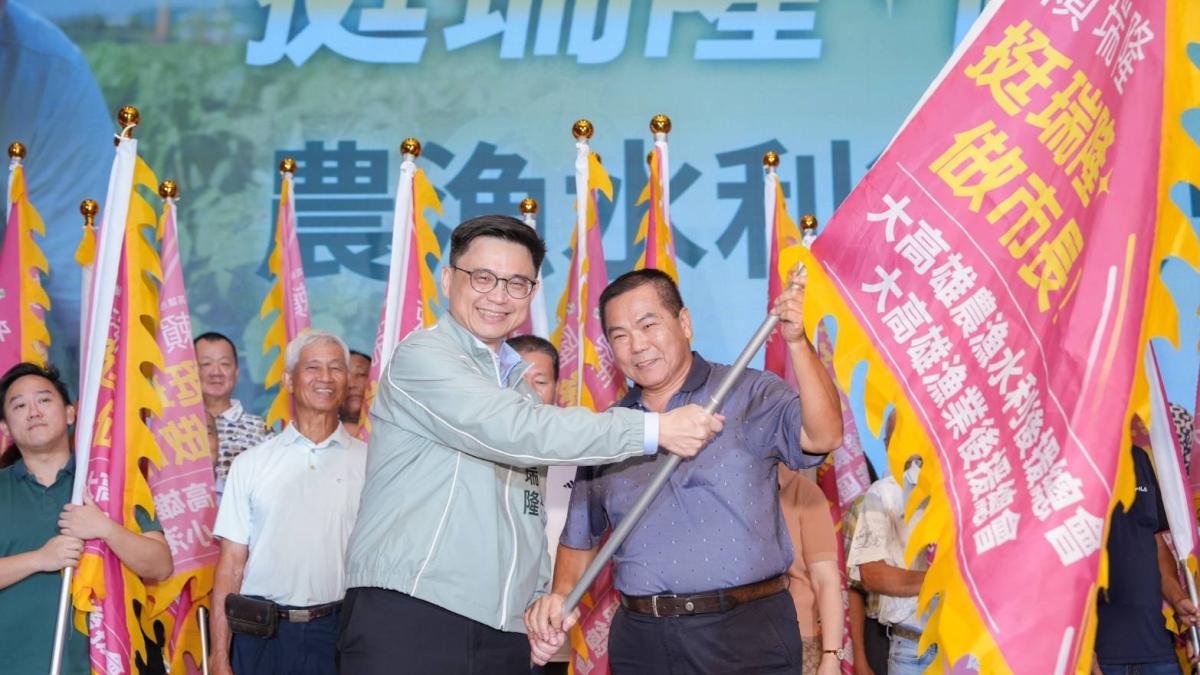
In preparation for the 2026 Kaohsiung mayoral election, Lai Jui-long’s first major organizational move carries more weight than anticipated. All 44 agricultural, fisheries, and water conservancy support associations—including 27 farmers’ associations and 7 fisheries associations—attended the event, along with integrated systems from water management, model farmers, young farmers, and fruit and vegetable markets. This marks near-total alignment of Kaohsiung’s grassroots agricultural and fisheries networks. This is not merely a campaign rally, but a collective showcase of the DPP’s long-term local organizational development, symbolizing Lai’s formal takeover of Chen Chi-mai’s grassroots resources.
Notably, the lineup of speakers extended beyond local figures to include former Council of Agriculture Chairperson Tsao Chi-hung, former Minister of Agriculture Chen Chi-chung, Deputy Minister of Agriculture Huang Chao-chin, and heavyweight politicians such as Chiu I-ying, Lee Po-i, and Kang Yu-cheng. This convergence of central, local, and industry forces sent a clear message: the DPP in Kaohsiung has completed its internal consolidation.
Agricultural and fisheries systems have long been pivotal voting blocs in Kaohsiung elections. Beyond urban areas, regions like Qishan, Meinong, Shanlin, Liugui, Jiaxian, Neimen, Dashu, Linyuan, Yong’an, Mituo, Cijin, and Jiaxian significantly influence the mayoral race. Though these areas rarely make headlines, they possess robust local organizations and mobilization capabilities. Farmers’ associations, fisheries associations, and irrigation societies have historically served as key election hubs; once activated, they mobilize not only votes but also local opinion leaders, village chiefs, and grassroots groups.
By consolidating 44 support associations at once, Lai has effectively completed a preemptive inventory of local organizations, fully inheriting Chen Chi-mai’s grassroots infrastructure.
For Ko Chih-en, the pressure is just beginning. Ko, the KMT’s mayoral candidate, has recently emphasized education, youth, AI, and urban issues, gaining visibility in urban districts. However, agricultural and fisheries sectors have not been the KMT’s strong suit in Kaohsiung in recent years. With the central government consistently investing in projects like the redevelopment of Cianjhen Fishing Port, agricultural cold chains, smart agriculture, and disaster prevention infrastructure, the DPP has accumulated tangible policy achievements—enabling Lai to campaign on the promise of “continuing development.”
Lai’s three pledges—“Strong Agriculture, Revitalized Fisheries, Resilient Water Systems”—are backed by existing achievements, not blank policy checks. In contrast, Ko must present more concrete and compelling new narratives to win over grassroots agricultural and fisheries communities; otherwise, challenging the current political landscape will be difficult.
Thus, the significance lies not just in the number of support associations. Politically, what matters most is not how many associations are formed, but who publicly shows up. The collective appearance of 34 agricultural and fisheries representatives signifies not just support, but a political stance.
The event conveyed three key messages:
First, Lai has completed intra-party integration, and local systems are now fully activated.
Second, the agricultural and fisheries development achievements from Chen Chi-mai’s eight-year administration are being converted into electoral capital.
Third, the Kaohsiung mayoral race has shifted from media warfare to grassroots mobilization—where organizational strength and local presence will determine the outcome.
Lai has seized the initiative in the election timeline. Though voting is still distant, elections don’t begin in the final month. By establishing large-scale support networks among labor, religious, and agricultural-water sectors, Lai demonstrates a strategy focused not just on media visibility but on solidifying traditional organizational votes.
For Ko Chih-en, failure to deliver breakthroughs in grassroots organization, local factions, or policy narratives may result in an election campaign characterized by “strong media presence but weak grassroots penetration.”
The Kaohsiung mayoral race is still in its warm-up phase, but through this grand gathering of agricultural, fisheries, and water forces, Lai has already sent a clear signal to his opponent: this election will not be won by volume, but by solid grassroots foundations and comprehensive organizational strength.
FACT BOX
- Source: PR Times
- Category: News
- Dates in source: 2026