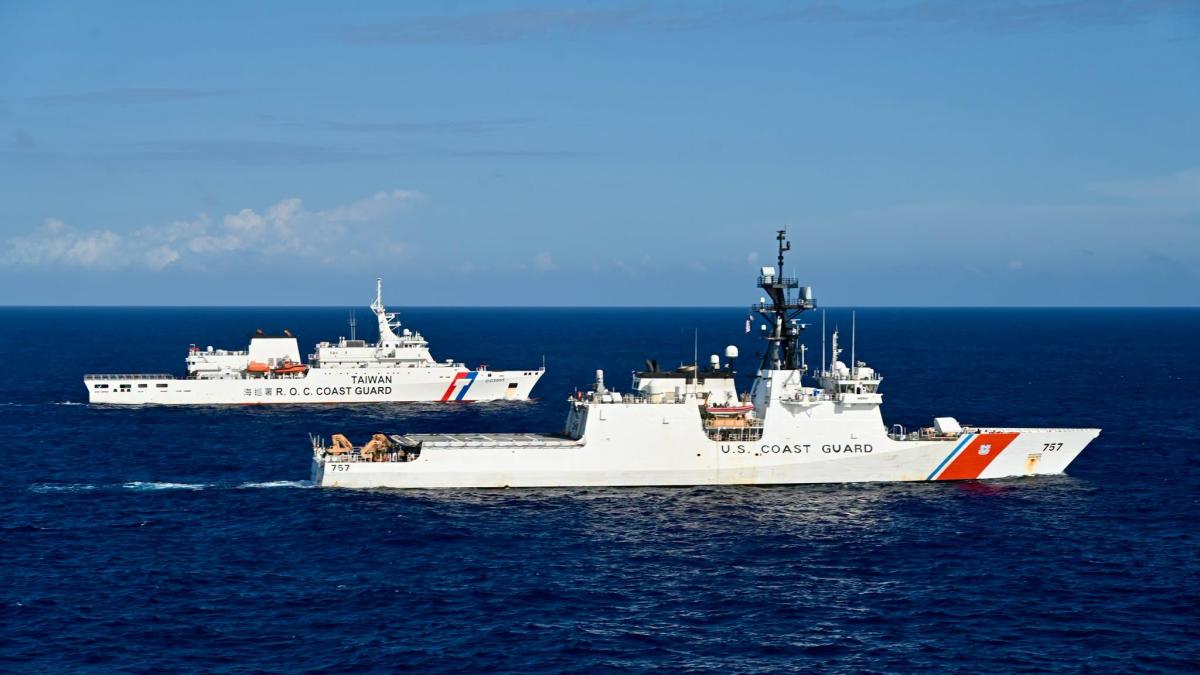
The strategic debate in Washington over the Taiwan Strait situation has long centered on whether the U.S. military should explicitly commit to defending Taiwan—a debate known as 'strategic clarity' versus 'strategic ambiguity.' However, as 'gray zone operations' across Asia have become a key strategy for Beijing to threaten and gradually erode Taiwan's sovereignty, this traditional debate appears increasingly outdated. Whether 'strategic ambiguity' or 'strategic clarity,' both are pre-emptive responses to potential Chinese military action. But 'gray zone operations' are not military actions, so the U.S. military’s stance on defending Taiwan—whether 'ambiguous' or 'clear'—seems unable to produce a deterrent effect.
In response to Beijing’s 'gray zone operations' and 'salami-slicing tactics,' Eyck Freymann, a researcher at Stanford University’s Hoover Institution, introduced the concept of 'structured ambiguity' in his April-published book, *Defending Taiwan: A Strategy to Prevent War with China*. This idea has since sparked intense discussion in Washington think tanks and policy circles. Can 'structured ambiguity' truly better protect Taiwan? Why do some think tank scholars still worry that a Trump administration might fail to uphold the spirit of 'structured ambiguity,' leaving Taiwan as 'the loneliest island'?
Debunking the '2027 Invasion Deadline' Myth
Freymann emphasized in a May discussion at Stanford University with former Deputy Secretary of Defense Colin Kahl, and in a June interview on the podcast *Analyse Podcast*, that Washington has been asking the wrong questions for the past decade. In 2021, former U.S. Indo-Pacific Commander Phil Davidson proposed a 2027 timeline for a potential invasion of Taiwan. But Freymann clarifies that 2027 is a 'capability milestone' set by Xi Jinping for the People’s Liberation Army, not a fixed 'invasion deadline.' Therefore, this date is not Taiwan’s true crisis point. The macro timeline truly constraining General Secretary Xi Jinping is the 'great rejuvenation of the Chinese nation' by 2049, the centenary of the founding of the People’s Republic of China. In other words, Xi Jinping is not in a hurry to resolve the Taiwan issue.
Freymann bluntly states: 'This dispute is more likely to be decided by a “crisis” than by a “war.”' Beijing is fully aware that launching a cross-strait amphibious landing would entail extremely high military risks and the cost of failure. Therefore, Xi Jinping’s preferred path to unification is not traditional 'kinetic invasion,' but rather 'gray zone operations' using China’s coast guard and legal warfare—such as imposing a 'quarantine' by requiring ships and flights entering or leaving Taiwan to first declare to or undergo inspection by Chinese customs. As Beijing uses customs enforcement as a pretext to gradually control the flow of people and goods to and from Taiwan, insurance markets, shipping companies, and airlines may be forced to comply, ultimately making Taiwan’s external connections effectively dependent on Beijing.
In this scenario, the question the U.S. should consider shifts from 'If Beijing uses force against Taiwan, should Washington order military intervention?' to 'Should Washington fire upon Chinese coast guard vessels intercepting a few merchant ships?' If the answer is no, Beijing effectively controls Taiwan’s maritime and air transport routes. If the answer is yes, the U.S. becomes the party breaking the peace—because it was not China that fired first. How to respond within the current 'One China' policy framework to Beijing’s increasingly frequent and sophisticated gray zone pressure has become a reality the U.S. must confront.
What Is 'Structured Ambiguity'?
In the face of Beijing’s 'salami-slicing' tactics, the traditional debate between 'strategic clarity' and 'strategic ambiguity' appears insufficient. Since the 1979 *Taiwan Relations Act*, U.S. policy toward Taiwan has long been based on 'strategic ambiguity.' This means the U.S. does not pre-commit to military intervention, which has the benefit of deterring both Beijing’s adventurism and Taipei’s declaration of independence (dual deterrence). However, in an interview with *The Diplomat*, Freymann points out that while 'strategic ambiguity' was effective when the U.S.-China power gap was large and Beijing’s options were limited, it is now being exploited in reverse.
As U.S.-China power balances shift and Xi Jinping links 'unification' with 'national rejuvenation,' developing a comprehensive set of military, economic, legal, and informational pressure tools, traditional ambiguity is being turned against the U.S. Beijing’s gray zone operations—routine air and sea provocations around Taiwan, coast guard 'law enforcement,' demands for airlines to submit passenger lists, 'inspections' of passing vessels, large-scale military exercises, information warfare, and cognitive operations—are deliberately kept below the threshold of 'armed conflict.' The implicit message of traditional strategic ambiguity—'We’ll decide how to respond after you fire the first shot'—effectively invites the adversary not to fire first, but to incrementally change the status quo through 'salami-slicing,' forcing the U.S. into a painful choice between 'escalation' and 'acquiescence.'
'Strategic clarity,' on the other hand, advocates for the U.S. to give Taiwan an explicit security guarantee. Former President Joe Biden has repeatedly stated during his term that 'if Beijing uses force, the U.S. will defend Taiwan.' But Freymann warns in the *Into Asia* podcast interview that 'strategic clarity' could lead Beijing to believe the U.S. is giving Taiwan’s independence leaders a 'carte blanche,' potentially forcing Beijing to escalate prematurely under political pressure, triggering an irrational disaster.
Faced with the traditional 'ambiguity vs. clarity' debate, Freymann insists that 'strategic ambiguity is the most reasonable position,' but acknowledges it is no longer sufficient to counter current 'gray zone operations.' He argues that the U.S. government should focus not on low-probability extreme scenarios, but on the plans Xi Jinping is actively pursuing.
Freymann proposes that the U.S. continue to uphold the political framework of the three communiqués, six assurances, and the *Taiwan Relations Act*, while establishing a proportionate response strategy in communication and action: 'We can tell China: Just because we maintain ambiguity on certain policy points doesn’t mean we’ll allow you to win through salami-slicing. If China attempts to slightly alter the status quo, we will proportionally and moderately reconfigure the status quo in political, economic, or military cooperation.'
Because 'structured ambiguity' is designed specifically for 'gray zone operations'—'if the enemy doesn’t move, we don’t move; if the enemy moves, we move'—it makes Beijing more cautious when attempting 'salami-slicing.' 'Structured ambiguity' maintains ambiguity for high-intensity scenarios (full blockade or invasion), but responds to gray zone actions with 'proportionality': if Beijing makes small incremental changes, Washington will respond in kind but in different domains—such as deepening political, military, technological, and energy cooperation with Taiwan, or adjusting deployments and intelligence sharing. If intelligence indicates Beijing has made a major operational decision, the U.S. and its allies reserve the right to 'preemptive action,' rather than waiting for the first shot before scrambling to decide whether to intervene.
The 'Silicon Magnet' and 'Avalanche Decoupling'
On economic sanctions in response to potential Chinese military action, Freymann refutes in his book the idea that 'mutually assured economic destruction' can deter China. If a crisis erupts in the Taiwan Strait and the U.S. immediately imposes comprehensive economic sanctions on China, the cost would trigger a global depression, which neither the U.S. nor its allies can afford. Beijing knows the U.S. is unwilling to press this button.
To address this, Freymann proposes 'avalanche decoupling': not seeking to sever trade with China overnight, but instead building coordination mechanisms with allies (especially core allies like the UK, Canada, Australia, and Japan) to gradually and predictably escalate tariffs and quotas on the most critical supply chains—such as drone components, essential medicines, and high-end machine tools—forcing companies to gradually shift production to secure third countries. This approach reduces dependence on China in a coordinated, predictable, and prioritized manner, rather than aiming for mutual economic destruction from the outset.
Regarding semiconductor industry preparedness, Freymann introduces the concept of the 'silicon magnet' to replace the 'silicon shield' theory. He argues that TSMC, which produces the world’s most advanced AI chips, is not a 'shield' protecting Taiwan from attack, but more like a 'magnet' tightly linking U.S. national economic interests to Taiwan. In the U.S. S&P 500 index
FACT BOX
- Source: PR Times
- Category: News
- Organizations: TSMC