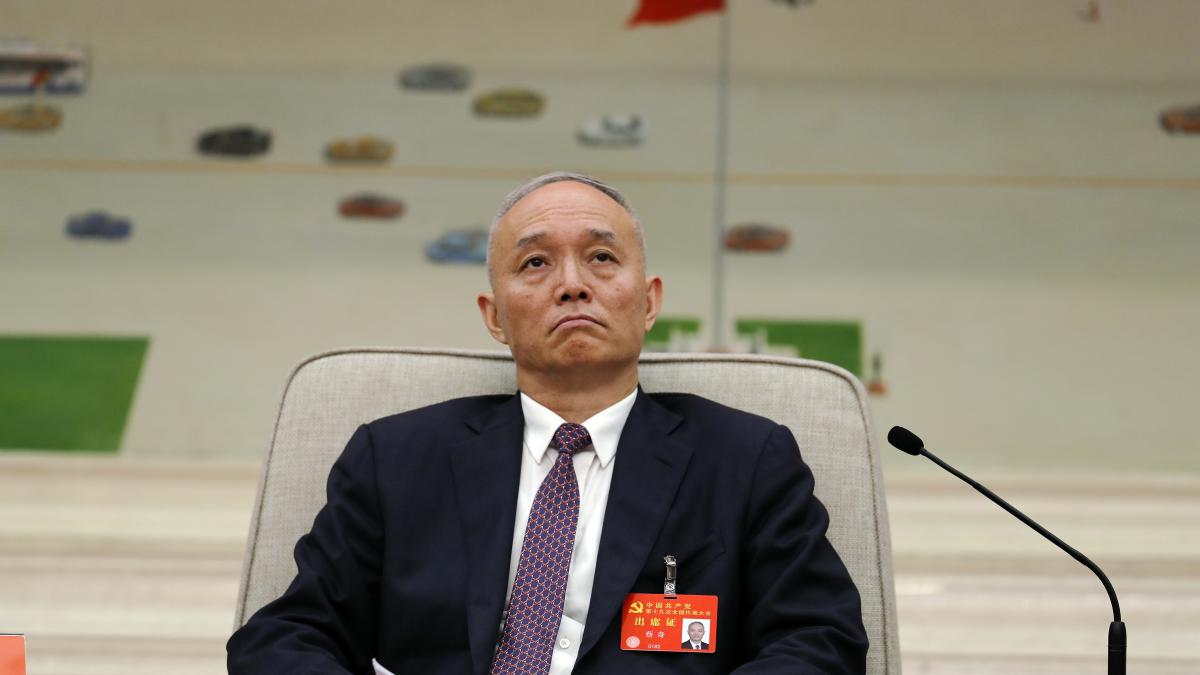
Xi Jinping, General Secretary of the Communist Party of China (CPC), turned 73 in June. In early June, he appointed Cai Qi, a member of the CPC Politburo Standing Committee, as head of the Central Party School, attracting significant attention.
The Nikkei analyzed this move, noting that Cai Qi assumed the role at age 70—unlike Xi Jinping, who was 54 when he took the position at the end of 2007, and Hu Jintao, who was 50 when he assumed the same role in early 1993. This appointment may signal that Xi Jinping has no intention of enabling generational leadership transition within the top echelons of the CPC.
In other words, ahead of the 21st National Congress of the Communist Party of China (21st CPC National Congress) in autumn 2027, Xi Jinping not only has no plan to cultivate a successor or hand over power, but also intends to seek an unprecedented fourth term as General Secretary of the CPC Central Committee.
The Nikkei recently analyzed Xi Jinping’s recent personnel arrangements from several angles, revealing how he is resisting internal party calls for leadership succession.
First, Cai Qi’s appointment as head of the Central Party School.
According to a Xinhua News Agency report in early June on an event at the Central Party School, Cai Qi was named as the school’s president. This was the first official confirmation by Chinese authorities of his new role.
Observers note that Cai Qi, at age 70, taking over the Party School leadership may indicate that, in the eyes of the CPC’s top leadership, 70 is no longer considered the age ceiling for holding key party and state leadership positions. This also suggests that Xi Jinping is sending a signal of resistance to generational turnover within the Zhongnanhai leadership.
Moreover, Cai Qi succeeded Chen Xi, who is also 72 this year and has served as Party School president for nearly a decade.
Furthermore, given that Cai Qi assumed the role at age 70, there is much speculation about whether he will retain his position as a member of the CPC Politburo after the 21st National Congress next year.
On October 27, 2022, the latest lineup of the Politburo Standing Committee was unveiled, with the six members besides Xi Jinping being Li Qiang, Zhao Leji, Wang Huning, Cai Qi, Ding Xuexiang, and Li Xi.
Second, both Xi Jinping and Hu Jintao were under 55 when they took over the Party School leadership.
Looking at the career trajectories of previous CPC leaders entering the succession pipeline: Xi Jinping was 54 when he assumed the Party School presidency at the end of 2007 and became Vice President of China in March 2008. Hu Jintao, on the other hand, took over the Party School role at age 50 in early 1993.
In contrast, Cai Qi was relatively old when appointed. He simultaneously holds key positions including Director of the General Office of the CPC Central Committee, First-ranked Secretary of the Secretariat of the CPC Central Committee, and Vice Chairman of the Central National Security Commission.
Nikkei analysis points out that Cai Qi’s age is particularly significant. He is younger than Xi Jinping, but will turn 71 by the time of the 21st National Congress next year. Even if he steps down from the Politburo Standing Committee after the Congress, he may still continue serving as Party School president.
Third, Xi Jinping’s remarks on longevity.
On September 3, 2025, China held a major military parade in Beijing. Russian President Vladimir Putin and North Korean leader Kim Jong-un were invited. As Xi Jinping, Putin, and Kim walked together onto the viewing stand, microphones accidentally captured their conversation about “organ transplantation” and “human lifespan,” turning this moment into the biggest topic outside the ceremony.
From live footage preserved by international media, it can be heard that Putin, through a translator, said: “With continuous advances in biotechnology, human organs will be transplanted repeatedly, people will grow younger, and even achieve immortality.”
Xi Jinping immediately responded: “Some predict that in this century, humans might live up to 150 years.” Kim Jong-un, standing nearby, only smiled, and it is unclear whether he received the translation.
Although this was not an official statement by Xi Jinping, when viewed in the context of leadership succession within the CPC, it fuels speculation that he has no intention of stepping down after the 21st National Congress and aims to continue seeking a fourth term as General Secretary.
On September 3, 2025, Russian President Vladimir Putin, North Korean leader Kim Jong-un, and Chinese President Xi Jinping jointly attended the September 3 military parade in Beijing.
Observation Points for the Fifth Plenum
Additionally, according to Xinhua News Agency, the Fifth Plenary Session of the 20th Central Committee of the Communist Party of China (Fifth Plenum) is scheduled to be held in Beijing in October. This will be a key moment for observing how Xi Jinping replenishes fresh blood into the Central Military Commission.
After Zhang Youxia, Vice Chairman of the Central Military Commission, and military commission member Liu Zhenli were removed in January, only four active-duty PLA generals appeared publicly during the National People’s Congress (NPC) in March—far below the approximate quota of 40 generals.
Moreover, the PLA delegation to the NPC had a significant number of absences: out of 281 members, only 243 attended, meaning 38 were absent. For the first time, the delegation also abolished the position of deputy head.
Zhang Wuyue, Director of the Cross-Strait Relations Research Center at Tamkang University, stated that the reason to watch this year’s Fifth Plenum is “because next year holds two major milestones for the CPC: first, the autumn convening of the 21st National Congress, and second, the 100th anniversary of the founding of the PLA.”
He pointed out: “Personnel matters will be decided at the Fifth Plenum—whether Zhang Shengmin will be promoted to a Politburo member, whether a new Vice Chairman of the Central Military Commission will be appointed, and whether the four members of the Central Military Commission will be filled. These are all within the authority of the Fifth Plenum, and this will make the situation clear.”
FACT BOX
- Source: PR Times
- Category: News