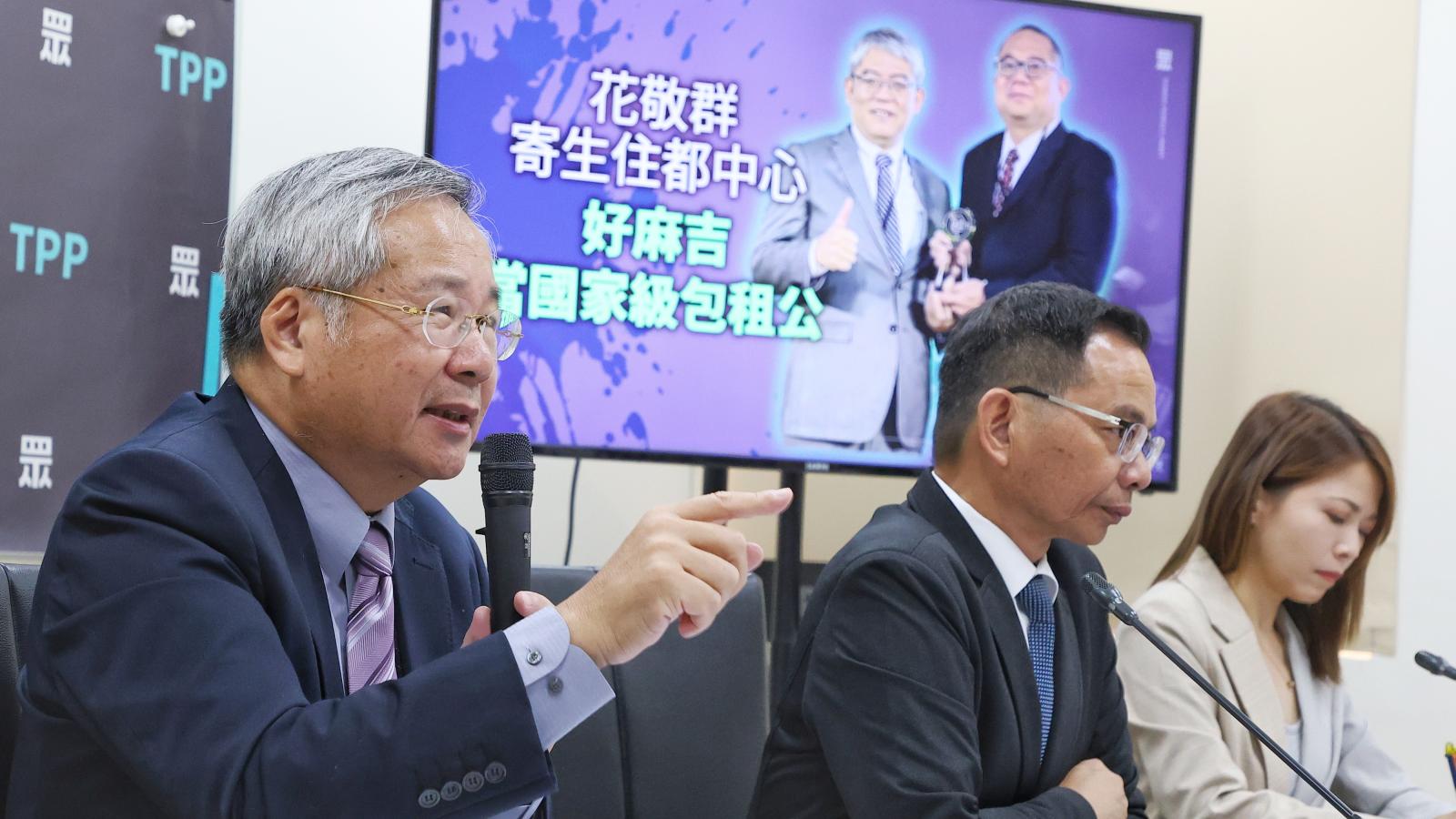
The Taiwan People's Party (TPP) legislative caucus held a press conference today (4th) regarding the recent financial and operational crisis involving Zhaoji Group—the leading housing management and leasing company in Taiwan—and related firms Zhaoji Investment and Hermit Crab Management Consulting, all of which have defaulted on corporate bonds and are suspected of illegal fundraising, severely damaging the rights of numerous landlords and investors.
TPP legislator Hsu Chung-hsin questioned whether the government had fulfilled its due diligence in selecting and reviewing partner companies, suspecting possible malfeasance, and called for prosecutors to launch a full investigation.
Hsu pointed out that Hua Jing-chun, chairman of the Housing and Urban Development Center (HUDC), has been aggressively promoting the government's social housing leasing and management policy since his time as Deputy Minister of the Interior, despite widespread skepticism. Hua was seemingly the only one 'awake' amid a 'drunken crowd,' persisting with 'professional conviction.' Coincidentally, Zhaoji Group, led by former CEO Li Chien-cheng, was the most enthusiastic supporter of this policy, raising suspicions about a close personal relationship between the two.
Hsu questioned whether Hua Jing-chun had effectively become a 'national-level landlord' and whether the HUDC had become an accomplice to fraud. Hua, he noted, had openly admitted his close ties in media interviews, calling Li Chien-cheng a 'mountain-climbing friend.' During his tenure as Deputy Interior Minister and HUDC chairman, Hua vigorously promoted the leasing and management policy and publicly praised Li for his early commitment to the rental market and policy alignment.
The TPP caucus bluntly stated that former Deputy Interior Minister Hua Jing-chun had become a 'national-level landlord.' (Photo credit: Yan Lin-yu)
Hsu highlighted that since the launch of the social housing leasing and management policy in 2017, the list of contracted service providers has consistently included 'Zhaoji' and 'Hermit Crab' every year. How could this alignment be so seamless? He accused these two companies of 'parasitizing' the national HUDC under the guise of public policy.
He lamented that a policy originally intended to achieve housing justice and solve people's housing problems had instead become 'a murky pool.' Zhaoji Group, the national leader in leasing and management with over 30,000 managed units and about 30% market share, had attracted Acer Group's investment of NT$1 billion and planned to become the first publicly listed rental housing company. Yet, it is now embroiled in illegal fundraising using government contracts and funds, leaving hundreds of landlords crying, 'Why did we trust the government only to be scammed?' Has the Ministry of the Interior become an accomplice to a 'national-level fraud ring'?
Hsu analyzed company registration data and found that 'Zhaoji Management Consulting,' 'Hermit Crab Rental Company,' and 'Zhaoji Investment' are all cross-held by the same group, with overlapping directors, supervisors, and executives. 'Zhaoji Investment' leveraged the government policy support and public contracts enjoyed by 'Zhaoji Management Consulting,' along with Li Chien-cheng's personal connections with Hua Jing-chun, to attract investors—ultimately causing investor losses, which is deeply troubling.
Hsu explained that if investors merely received returns from government-contracted leasing services, they would be creditors. But when investments were converted into equity, they became 'risky assets.' In the event of company liquidation, remaining assets would be minimal.
Further analysis revealed that the social housing leasing and management business is indeed highly profitable. Hsu found that service providers have collectively received NT$6.8 billion in management fees from HUDC contracts over the years—meaning taxpayers' hard-earned money has flowed directly to private contractors, while the supply of social housing remains inadequately improved, leaving the public disillusioned.
Hsu also discovered from government procurement records that HUDC's leasing and management tenders were often conducted through 'restricted bidding,' explaining why 'Hermit Crab' consistently won contracts across all six major cities, accumulating over NT$1 billion in awarded contracts. Further tallying historical bids revealed that 'Zhaoji Management Consulting' alone had secured nearly NT$5 billion in contracts.
Hsu questioned whether such tender procedures were truly fair. With specific firms repeatedly winning high-value contracts at both central and local levels, accumulating such substantial awarded amounts, isn't there a clear suspicion of favoritism or illicit benefit transfer?
Hsu argued that the government and HUDC must undergo stricter scrutiny regarding vendor qualification reviews, contract performance monitoring, and risk management. Hua Jing-chun, having repeatedly attended public events promoting leasing and management achievements and publicly commended these firms, cannot remain uninvolved now that partner companies face major controversies. As the chief architect of the policy, he should proactively explain whether the collaboration process adhered to principles of administrative neutrality and conflict-of-interest avoidance.
Hsu emphasized that housing justice must not become an empty slogan. The government must return social housing policy to its original purpose of safeguarding housing rights, not allow it to become a tool for funneling public funds into the pockets of political allies. He urged the Ministry of the Interior and HUDC to immediately release complete historical data on leasing and management tenders, contract performance, and evaluations for public scrutiny. He also called on Taipei prosecutors to launch a comprehensive investigation into whether illegal activities, profiteering, or favoritism occurred in the policy's implementation, swiftly restoring fairness and justice to social housing policy.
FACT BOX
- Source: PR Times
- Category: News