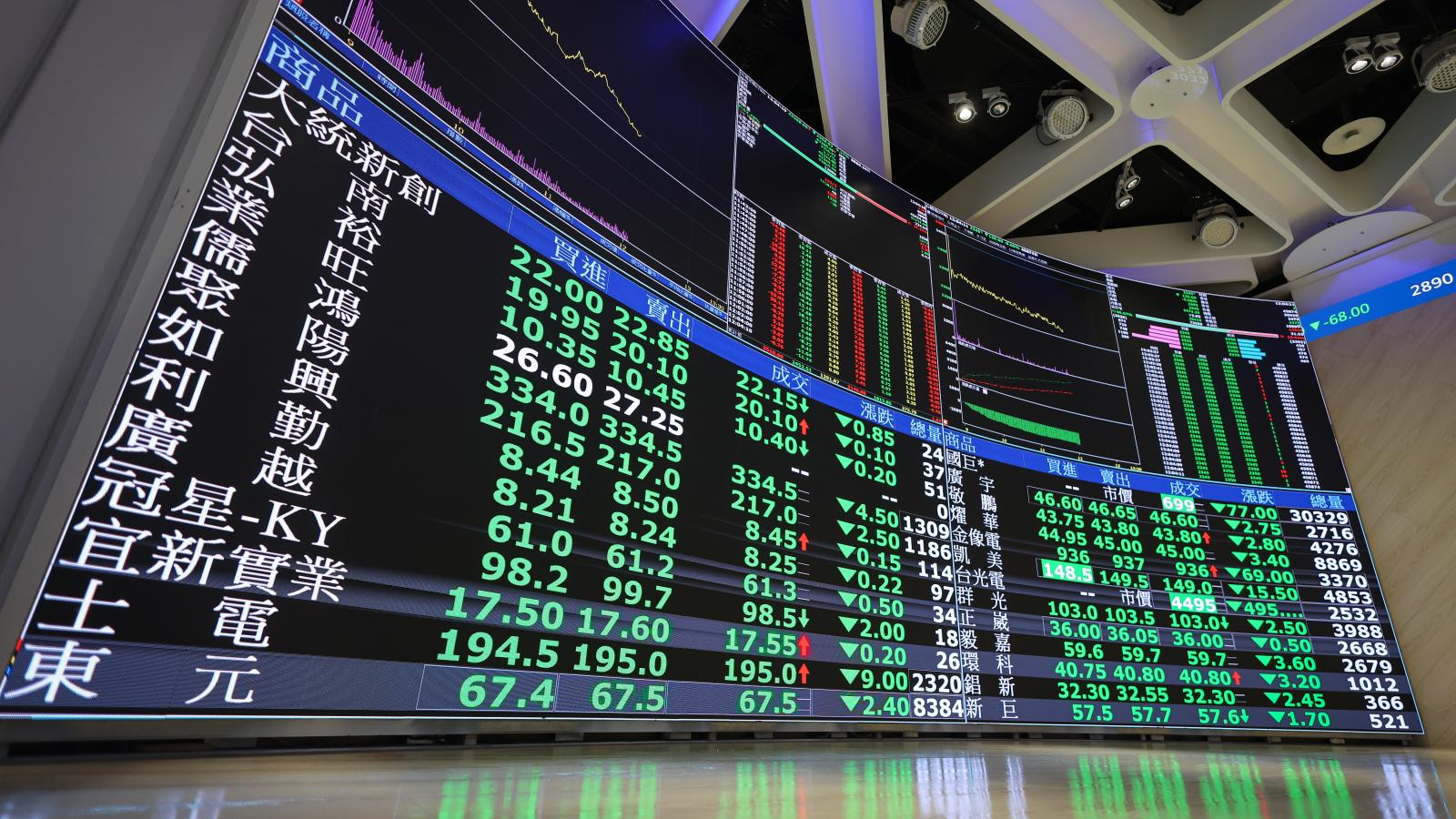
Taiwan's stock market has recently experienced heightened volatility at elevated levels. The Taiwan Stock Exchange (TWSE) recently announced amendments to its monitoring and treatment rules. The matching interval for treated stocks will be adjusted from approximately every 5 or 20 minutes to roughly every 2 minutes. This new system will take effect on August 10.
Media personality Chen Feng-hsin, appearing on the program "Shaokang Battlefield," stated, "Even if trading occurs every 2 minutes, it still imposes significant limitations on foreign investors and asset managers. Ideally, Taiwan should adopt a 'circuit breaker mechanism.'"
Chen noted that last week's Taipei stock market represented a 'deleveraging' process. However, she emphasized this was only a short-term correction, not the beginning of a long-term bear market. While she cannot predict exactly where the lowest point lies, she believes a key signal appears when margin calls and collateral demands erupt simultaneously—"like a thousand arrows being fired at once." Last Wednesday and Thursday saw precisely such a wave of margin and collateral calls, indicating that, to some extent, the first phase of deleveraging has been completed.
Chen reiterated that when margin calls and collateral demands surge en masse, it typically marks a market bottom.
Does this mean the market can now relax? Chen pointed out that the market surged around 60% in the first half of the year, accompanied by extremely high trading volumes. Thus, last Friday's massive 3,000-point green candle helped stabilize the market. However, recent trading volumes have been insufficient—hovering around just over NT$800 billion but under NT$1 trillion. This suggests the market may need time to consolidate, meaning the adjustment period could be prolonged.
A simple benchmark for completion of consolidation is whether the market holds above last week's lows. If it does, consolidation and deleveraging are likely complete. However, individual companies cannot be guaranteed, as each faces unique challenges.
Chen highlighted that the issue of 'monitored stocks' and 'treated stocks' affects more than just retail investors. Recently, foreign investment in Taiwan's stock market has become highly distorted. On one hand, net short positions in futures have reached 90,000 contracts; on the other, there is massive buying of ETFs—not individual stocks.
Foreign institutions possess research teams and reports. So why aren't they buying individual stocks, but instead pouring money into ETFs?
What is the stock treatment system? When a stock's price, volume, or turnover rate shows abnormal fluctuations, the exchange activates a phased warning and control mechanism to cool the market. Once a stock is designated as 'treated,' its trading shifts from continuous matching to batch matching every 5 minutes (first-time treatment) or every 20 minutes (second-time treatment). Trades exceeding certain sizes require pre-delivery of cash or securities, drastically reducing liquidity.
Chen explained that Taiwan's stock treatment framework was originally tailored for a much smaller market—like a custom-fitted dress. But today's Taipei market has grown significantly, making the old rules uncomfortable and restrictive.
For foreign institutions, buying any major Taiwanese company—even TSMC, the largest firm—could trigger treatment thresholds. Let alone companies like MediaTek or Delta Electronics, which, despite not being the top in market cap, rank second or third and could still be subject to restrictions due to the system's strict criteria.
What happens when a stock is treated? Large institutional investors need both entry and exit flexibility. But under current rules, when a stock falls sharply, it gets 'quarantined'—matched only every 5 or 10 minutes. You can't buy when prices plunge, nor sell when they spike. This discourages foreign investors from engaging with Taiwan's truly high-quality stocks.
Originally designed to curb speculative stocks, the system now inadvertently impacts many fundamentally sound companies.
Chen argues this is why foreign investors are 'exploiting ETFs.' As foreign funds accumulate individual stocks, they risk triggering treatment status and losing the ability to sell. Yet they can freely sell ETFs. They can't buy treated stocks, but they can buy ETFs. Ultimately, trust companies using retail investors' money end up disadvantaged—being 'taken advantage of' by foreign players.
The TWSE's recent relaxation likely reflects awareness of this market distortion.
However, Chen believes relaxation isn't the right solution. Even with 2-minute matching, foreign and institutional investors still face severe constraints. The best approach, she insists, is to emulate the 'circuit breaker mechanism'—rather than treating individual stocks like 'babysitters' for every investor.
Alternatively, companies experiencing sharp price swings could be required to disclose monthly earnings. Intraday trading restrictions may ultimately distort institutional behavior and aren't necessarily beneficial for the public.
Chen emphasizes that while easing treatment rules helps, adopting a circuit breaker mechanism would be far more effective.
What is a circuit breaker mechanism? When the stock market plummets due to sudden negative news, triggering panic selling, exchanges proactively 'pull the plug'—temporarily halting trading to prevent cascading fear and potential financial collapse, similar to systems in the U.S. and South Korea.
FACT BOX
- Source: PR Times
- Category: News
- Products / services: ETF