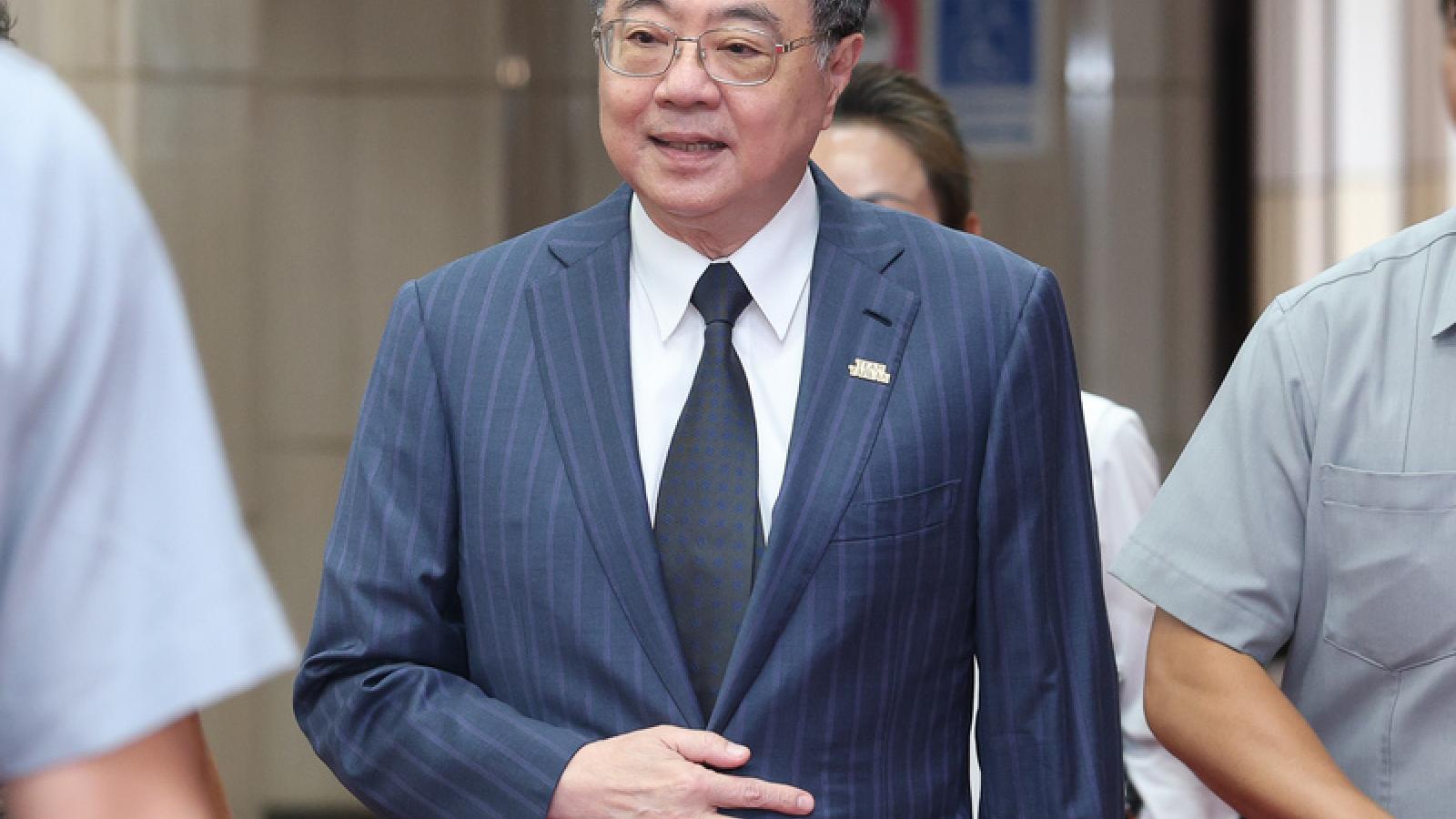
Among nations worldwide, Taiwan has long been a democratic country practicing party politics, with multiple elected presidents and party alternations. However, over the past two-plus years under the Lai administration, Taiwan's democratic development appears to have regressed severely. Many current political appointees lack political integrity, refusing to resign or step down over policy failures or inappropriate remarks. Even the Premier and certain green cabinet members have become near-permanent officials, entirely beyond legislative and public oversight.
Take the recent 'Zhonglian Oils' carcinogenic salad oil incident as an example—it has significantly impacted domestic society and public safety. Yet, the Lai government's handling of the toxic oil crisis has been slow and chaotic, attempting to 'cover it up.' Precisely because the Executive Yuan intentionally concealed the truth about the tainted oil, public and societal anger intensified, leading 200,000 people to protest on Ketagawa Boulevard on July 25, escalating the food safety storm. According to media reports, by the end of July, authorities had identified at least seven batches totaling over 5,000 tons of carcinogenic oil—such a massive quantity has caused widespread public panic.
Globally, food safety crises are recognized as equivalent to national security threats, requiring immediate and effective resolution; otherwise, public food safety becomes highly precarious. The DPP has governed consecutively for over a decade, during which Taiwan has faced major incidents including plasticizers, toxic starch, gutter oil, mixed oils, and Sudan dyes. Now, it confronts an even more severe carcinogenic oil scandal, causing society to almost entirely lose trust in the DPP government’s food safety management policies.
Had it not been for the continuous investigations by the opposition Blue and White parties and relentless public scrutiny, many tainted oils might have quietly continued circulating in the market, unknowingly consumed by citizens, later becoming carcinogenic threats. Yet, despite such severe mismanagement in food safety—failures in systems, policies, and execution—the Lai government has seen no central-level political appointee, including Premier Cho Jung-tai or Health and Welfare Minister Shih Chong-liang, take political responsibility or resign. This shows that many senior officials in the Lai administration deeply disrespect mainstream public opinion and lack political integrity.
Since President Lai took office in May 2024, opposition parties have repeatedly criticized Premier Cho Jung-tai for refusing to co-sign bills, failing to allocate sufficient budgets, not enforcing laws, and neglecting food safety—labeling his cabinet a 'constitutional-destroying cabinet.' Thus, the strong calls from many Blue and White legislators and county mayors for Lai Ching-te to apologize and for Cho to resign are fully justified. 'If food safety fails, officials must step down'—this is the bare minimum of responsible governance and the norm of democratic oversight.
Unfortunately, since the Lai administration took power, many officials’ erroneous policies and inappropriate conduct have only revealed arrogance and authoritarianism in wielding power, with no humility or self-reflection toward public opinion. The 2025 'Great Recall' campaign, promoted by the presidential office, Executive Yuan, and DPP, attracted widespread attention. The voting result showed a huge gap between 'disagree' and 'agree' votes, ending in a 32-to-0 defeat—no KMT legislator was recalled. This indicates that the Lai government’s governance over the past year has completely lost public support, even causing social division and widespread public anxiety. Yet, not a single government official publicly apologized or took political responsibility for initiating the recall campaign.
During last year’s recall campaign, Premier Cho Jung-tai led nationwide tours, campaigning aggressively against opposition legislators. After the recall’s massive failure, Cho should have voluntarily resigned as a demonstration of responsible governance. Yet afterward, not only did Cho remain firmly in office, but Interior Minister Liu Shih-fang and Education Minister Cheng Ying-yao—both criticized for inappropriate conduct and violating administrative neutrality during the campaign—also retained their positions, deeply frustrating the opposition and the majority of the public. Liu Shih-fang repeatedly publicly urged making Lai Ching-te the 'master of Taiwan the nation' at recall events. Cheng Ying-yao permitted recall petition stations in school campuses and openly supported the 'one country on each side' stance regarding Taiwan and China.
Moreover, former Foreign Minister and current National Security Council Secretary-General Wu Chao-hsiang, during his six-year tenure as foreign minister, oversaw the loss of eight diplomatic allies. The Blue and White opposition has criticized his foreign policy failures and inability to maintain diplomatic relations. Yet Wu has never taken political responsibility or resigned. Furthermore, Wu’s former aide was involved in a Chinese spy case, leaking state secrets and severely damaging Taiwan’s national security and interests—revealing Wu’s poor judgment in personnel appointments. Despite this, the Lai government continues to retain Wu as National Security Council Secretary-General. These cases show that the current Lai administration lacks democratic concepts of 'responsible governance' and 'governance by public opinion,' and even disregards the principle of 'legislative oversight.'
'Political appointees' refer to senior government officials who should enter or leave office with party changes or policy needs—such as the Premier, heads of ministries, and政务委员 under the Lai administration. Their main duties are to formulate public policies and make political decisions aligned with Taiwan’s public opinion. When major failures occur in policies or operations under their purview (such as the botched handling of this toxic oil case), and these diverge severely from public sentiment, triggering strong public backlash and causing significant social harm, political appointees should take responsibility and resign. Alternatively, the 'appointing authority' (such as the president or premier) should proactively remove ministers who have committed serious errors and are unfit for office, to quell public outrage. However, observing the Lai administration over the past two-plus years, whether the Premier or unfit ministers, many have engaged in unconstitutional and chaotic governance, ignoring public opinion, yet continue to be trusted and retained by President Lai. This illustrates that under DPP rule, Taiwan has created the global political miracle of 'perpetual premiers and perpetual cabinet members'!
*Author: Former President of Taiwan Shoufu University, Former Commissioner of the Central Election Commission.
FACT BOX
- Source: PR Times
- Category: News