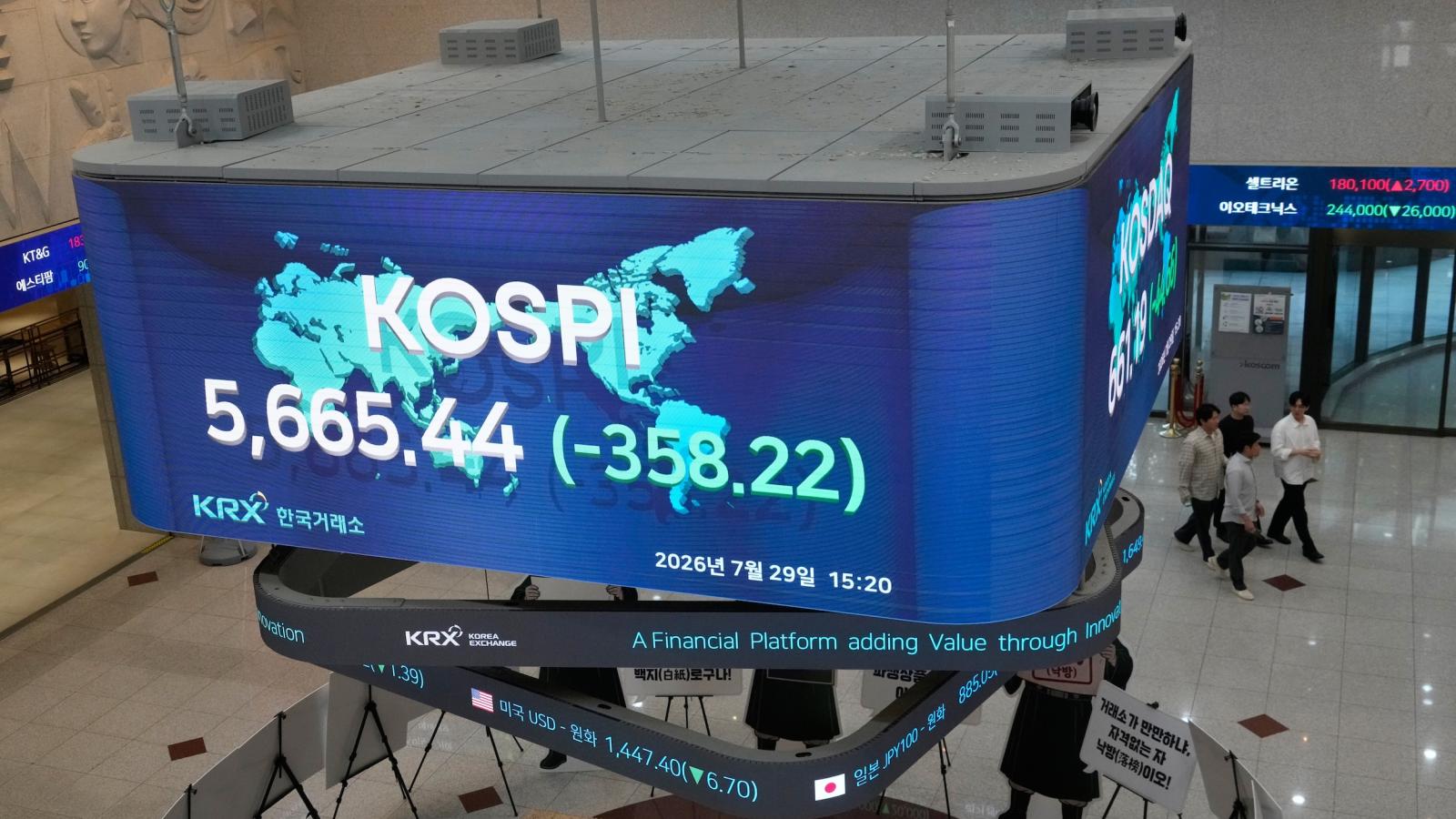
South Korea's stock market has surged in recent years amid a memory-chip investment boom, sparking a nationwide craze for leveraged stock trading. However, this speculative surge has led to a sharp market correction, making South Korea one of the hardest-hit regions globally. Many retail investors have been forcibly liquidated, and the decline in the KOSPI index has surpassed even the 1997 Asian financial crisis and the 2008 global financial meltdown.
In response, Bloomberg columnist Shuli Ren criticized President Lee Jae-myung's series of policy missteps, arguing they fueled speculative mania and declaring, "South Korea is becoming increasingly unsuitable for investment."
Ren acknowledged that bulls might argue South Korea is different from China a decade ago—the corporate fundamentals remain solid, with Samsung Electronics and SK Hynix, both direct beneficiaries of the AI infrastructure boom, accounting for over half of KOSPI's market capitalization. Additionally, KOSPI's forward P/E ratio stands at around 5.5x, a near-decade low, making it appear highly attractive and poised for a rebound.
However, Ren countered, "I disagree with this overly simplistic argument." Before predicting a market recovery, she urged deeper reflection: Have the recent sell-offs and the government's clumsy attempts to prop up KOSPI already shattered the confidence of a new generation of investors and cast a dark shadow over the market? "In other words, people can still be optimistic about the AI-driven global economic boom while simultaneously choosing to stay away from KOSPI."
Why are foreign investors continuing to exit Korean stocks? Ren pointed to abnormally high market volatility as the key factor. Since June, KOSPI's volatility has remained unusually elevated, with 33 trading days this year seeing intraday swings exceeding 5%. In contrast, Japan's Nikkei 225 had only four such days, and Hong Kong's Hang Seng Index had none. "This is a major issue for overseas institutional investors. As long as KOSPI continues to experience extreme volatility, they are unlikely to increase their holdings."
One significant cause of this high volatility, according to Ren, is the rapidly growing influence of leveraged ETFs. After the South Korean government approved single-stock leveraged ETFs in late May, these products expanded quickly. ETF issuers must mechanically rebalance their portfolios daily according to fixed rules, leading to automated "buy-high, sell-low" behavior that amplifies price swings.
According to Goldman Sachs estimates, during KOSPI's peak in June, a mere 5% fluctuation in SK Hynix's share price could trigger ETF rebalancing trades equivalent to 40% of the stock's average daily volume.
Bloomberg columnist Shuli Ren argues that a series of mistakes by South Korean President Lee Jae-myung (pictured) are making the country increasingly unsuitable for investment. (Photo via AP)
Did leveraged ETFs trigger the stock market crash? Ren noted that while the South Korean government has acknowledged the negative impact of leveraged ETFs and plans to restrict retail investor participation, authorities in Seoul have not directly suspended these products. As a result, despite shrinking significantly during the July market crash, leveraged ETFs still wield considerable influence. On volatile trading days, leveraged products could still account for up to 17% of SK Hynix's trading volume, meaning KOSPI will likely continue experiencing severe fluctuations.
More troubling, Ren emphasized, is the damage these policy failures have inflicted on retail investors. The Korean stock market has long suffered from a "Korea discount," where shares trade at a valuation gap due to investor skepticism. Yet, after President Lee promoted market reforms, many retail investors regained confidence.
Will no one want to touch Korean stocks anymore? Retail investors may leave and never return.
Ren stressed that while foreign investors have continuously sold off Korean stocks this year, it was retail investors who stepped in to fill the demand gap. Now, however, they are bearing the brunt of massive losses.
She noted that leveraged ETFs tied to SK Hynix plunged up to 84% from their peak, and many investors didn't even get a chance to wait for a rebound—around 360,000 brokerage accounts were forcibly liquidated, with 62% belonging to investors under the age of 35. "It's unsurprising that South Koreans are angry. At the peak of the global AI investment frenzy, the government encouraged inexperienced investors to take on excessive risk."
Ren warned that this market crash could further reinforce Korean investors' perception of their domestic market as a "trap." Unlike Chinese retail investors, South Koreans can freely invest in any global market. In the past, they favored U.S. Nasdaq; going forward, they might choose to completely abandon KOSPI and never look back.
Were Lee Jae-myung's mistakes limited to leveraged ETFs? The National Pension Service also violated rules by chasing highs.
Ren added that approving single-stock leveraged ETFs was just one of several policy blunders by the Seoul government. Earlier this year, even the $1 trillion South Korean National Pension Service (NPS) violated its own investment guidelines by increasing its domestic equity allocation target to avoid being forced to sell holdings.
Ren emphasized that this undermined the retirement fund's intended role as a market stabilizer. Normally, pension funds should buy low during crashes and sell high during bubbles to lock in profits and curb excessive speculation. By failing to follow this mechanism, NPS instead fueled further speculative frenzy in Korean stocks.
Has the Korean stock market become untrustworthy? Ren asked, "Does Seoul truly understand what it's doing?"
She lamented that global asset managers have long criticized China as an "uninvestable" market due to two main reasons: government policy errors and disregard for investor rights. "Sadly, the same concerns are now beginning to emerge regarding South Korea."
Ren bluntly questioned, "Does the Seoul government truly understand its actions? Are first-time investors really receiving adequate protection? Now might be the time for the South Korean government to seriously re-evaluate its policies."
Additional exclusive reports from Wind Media: - From heaven to hell: Korean media reveal shocking numbers behind the market turmoil—30 trillion won vanished in just half a month - South Korea's 'cabbage investors' borrowed to trade stocks and collapsed—400 billion won forcibly liquidated - Korea suffers its worst stock market crash in history—KOSPI plunges 33% in one month, surpassing both the Asian financial crisis and the global financial crisis
FACT BOX
- Source: PR Times
- Category: Survey