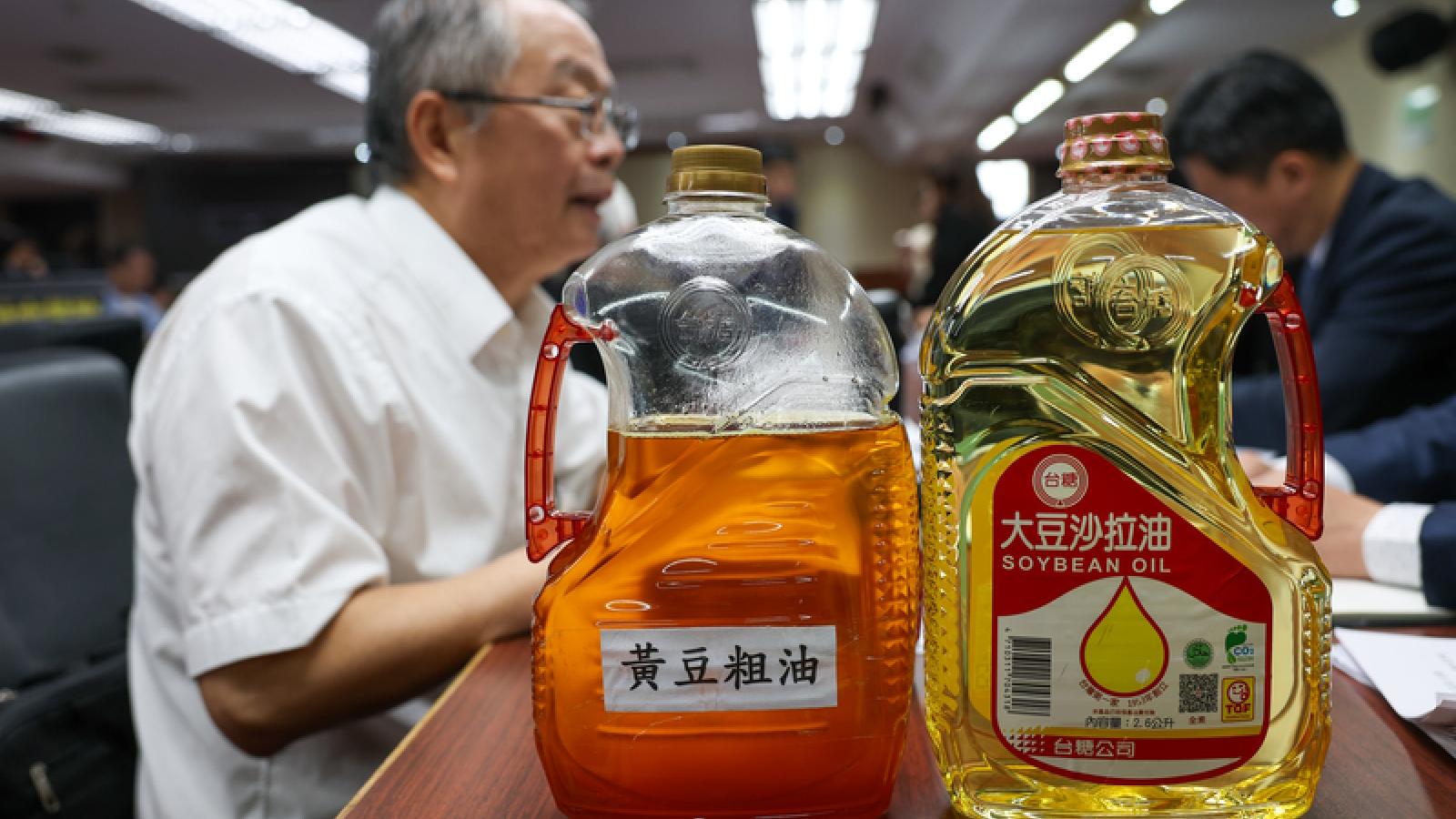
The carcinogenic oil controversy has raged for nearly 40 days. Aside from a single Facebook post by President Lai Qingde, the Lai administration has consistently maintained a stance of no responsibility and no apology. Even though Taiwan Sugar (Taisugar) had previously tested its raw materials and found benzopyrene超标 but failed to report it, the Executive Yuan has instead deployed cabinet ministers in rotation to twist legal interpretations in order to protect Taisugar—effectively elevating the defense of Taisugar into a battle for regime survival. Why? Is it simply because Taisugar’s chairman is a 'close ally of Lai'? Or are there deeper underlying factors?
Reform Equals Regime Collapse? The Reform Paradox Shared by the DPP and the Chinese Communist Party
Around 2012, when mainland China enjoyed relatively greater freedom, then-Chinese Central Commission for Discipline Inspection Secretary Wang Qishan recommended French thinker Alexis de Tocqueville’s classic work The Old Regime and the Revolution to party officials and scholars. This sparked widespread discussion of the 'Tocqueville Paradox' (or 'Tocqueville Trap') in China’s political and academic circles. Why is it called a paradox? Tocqueville, drawing from his firsthand experience of the French Revolution, discovered that revolutions are most likely not to occur during periods of maximum political repression, economic hardship, or public suffering. Instead, revolutions often erupt precisely when a regime begins reform and economic conditions start to improve. Wang Qishan’s intent in highlighting the 'Tocqueville Paradox' was clear: as China’s economy began to take off and public expectations rose, should the political system open up in tandem? According to Tocqueville’s theory, political reform at such a moment could actually trigger revolution and chaos. In other words, the Tocqueville Paradox is also the reform paradox of authoritarian rulers: once reform begins, one must be prepared for total upheaval. Looking at the subsequent political tightening in mainland China, the 'Tocqueville Paradox' clearly served as a warning to top CCP leaders. Since then, political reform has never been lightly discussed, and 'maintaining stability' (weiwen) has become the dominant principle.
In contrast to China, Taiwan currently maintains at least formal democracy. Yet the Lai administration exhibits the same 'reform paradox syndrome' identified by Tocqueville. Whether it’s the opposition party’s proposals for legislative reform, restoring referendums alongside general elections, or domestic transfer voting—any legislation aimed at increasing legislative oversight or expanding civil rights—the Lai administration has refused to yield even an inch, fearing that any concession would lead to total defeat and loss of power. Strangely, most of these were positions the DPP itself advocated during its time as an opposition party. Now, however, it trembles at the mere mention of progress and reform. The DPP deliberately monopolizes the banners of 'Taiwan' and 'local identity,' yet treats progress and reform as if they were floods and ferocious beasts.
This reform paradox is vividly demonstrated in the current carcinogenic oil scandal! After a July 4 expert meeting, the Ministry of Health and Welfare (MOHW) decided that products containing less than 20% of the problematic oil did not need to be fully recalled—a standard widely criticized as too lenient and seen as protecting specific businesses. For such a critical meeting, the MOHW did not release the meeting minutes until a month later, on August 5, allowing public suspicion of a cover-up to fester. It was only at that point that Food and Drug Administration (FDA) Director-General Chiang Chih-kang stepped forward to claim he had made the final decision. Over a month after the food safety crisis began—amid public protests and demonstrations—the Lai administration finally offered a response. But this response came too late, failed to fully disclose the facts, and certainly did not constitute taking political or administrative responsibility. This, too, reflects the DPP’s reform paradox: as long as they don’t concede, they won’t lose.
Taisugar’s Benzopyrene超标 and Failure to Report—Food Safety Law Contradicts Government’s Defense
In this food safety scandal, the most indefensible aspect for the Lai administration is Taisugar’s own detection of benzopyrene超标 as early as May. Did Taisugar have a reporting obligation? If Taisugar had reported to the Tainan City Government (where its headquarters is located) at the time, Taiwanese citizens might not have consumed toxic oil for two additional months, and Chung Lian’s use of substandard soybeans could have been exposed earlier. Whether Taisugar fulfilled its responsibilities as a state-owned enterprise is crucial. Yet, in contrast to the FDA’s earlier demand that the Taipei City Government impose a 3 million fine on Nan Chiao (whose headquarters is in Taipei), the Lai administration deployed both the Minister of Economic Affairs and the Minister of Health and Welfare to defend Taisugar, insisting that raw oil is not equivalent to a final product or food item, and that reporting obligations should not be infinitely expanded. This argument deliberately ignores the provisions of the Food Safety and Sanitation Management Act. Article 3, Paragraph 1 defines 'food' as 'products and their raw materials intended for human consumption or chewing.' Article 7, Paragraph 2 states: 'Food businesses shall have their product raw materials, semi-finished products, or finished products inspected by themselves or by other inspection agencies, legal persons, or organizations.' Article 7, Paragraph 5 states: 'When food businesses discover that their products pose a risk to health and safety, they shall immediately cease manufacturing, processing, and sales, initiate recalls, and report to the competent authority of the municipality, county (city).' In other words, the Food Safety Act does not separate reporting obligations for raw materials, finished products, and goods.
Why is it difficult under the Food Safety Act to separate reporting responsibilities for food, products, and raw materials? The reason is clear: the law aims to enable early warnings and detection of hazardous substances at the front end of the supply chain, preventing food safety crises from erupting later. This carcinogenic oil scandal best illustrates the importance of early reporting and warning. In fact, the government mobilizing all cabinet members to defend Taisugar has disheartened the public, because this concerns people’s food safety. Government agencies and state-owned enterprises should hold themselves to stricter standards. Yet when cabinet ministers repeatedly claim Taisugar is a 'victim,' placing Taisugar on the same side as the public as a rights-bearing party, who then protects the people’s interests? If government entities insist on applying the lowest possible standards and claim it as their right, who will safeguard the public’s welfare?
Did Ma’s Government Lose Because It Took Responsibility for Food Safety? The DPP Misreads Historical Lessons
Taipei Mayor Chiang Wan-an previously proposed a vote of no confidence over the food safety controversy, arguing that despite strong public sentiment, the DPP government refuses to take responsibility. Ignoring political accountability, the Lai administration and Premier Cho’s cabinet have forced the opposition to resort to a no-confidence motion to achieve this end. Even if such a motion succeeds, however, most opposition members pessimistically believe Lai Qingde will not replace Cho Jung-tai. To some extent, this Taisugar defense campaign confirms the opposition’s view: protecting Taisugar is not about Taisugar’s importance, but because for the DPP, if Taisugar becomes a breach, public anger will rise and demand political accountability from the cabinet—an outcome the Lai administration desperately seeks to avoid.
For the DPP, the most recent example of the reform paradox was the Ma administration 12 years ago. At that time, the Jiang cabinet did not shift blame for the tainted oil issue to local governments. Beyond multiple Executive Yuan meetings on source management, Health Minister Chiu Wen-ta resigned to take political responsibility for the food safety incident, and Premier Jiang Yi-huah publicly bowed twice—once outside the Legislative Yuan chamber and again during a policy report—to apologize to the nation. Yet the KMT suffered a major defeat in local elections that year, and Jiang immediately announced his resignation. The Ma administration’s precedent taught the DPP a dangerous lesson: never admit fault, and officials must never resign to take responsibility. However, this is a misreading of history. The reform paradox applies most to authoritarian regimes, which cannot withstand the upheaval of reform. But when people still have the chance to vote, one day they will use their ballots to teach a lesson to parties that refuse to admit fault, refuse to take responsibility, and grow increasingly detached from public opinion.
FACT BOX
- Source: PR Times
- Category: News