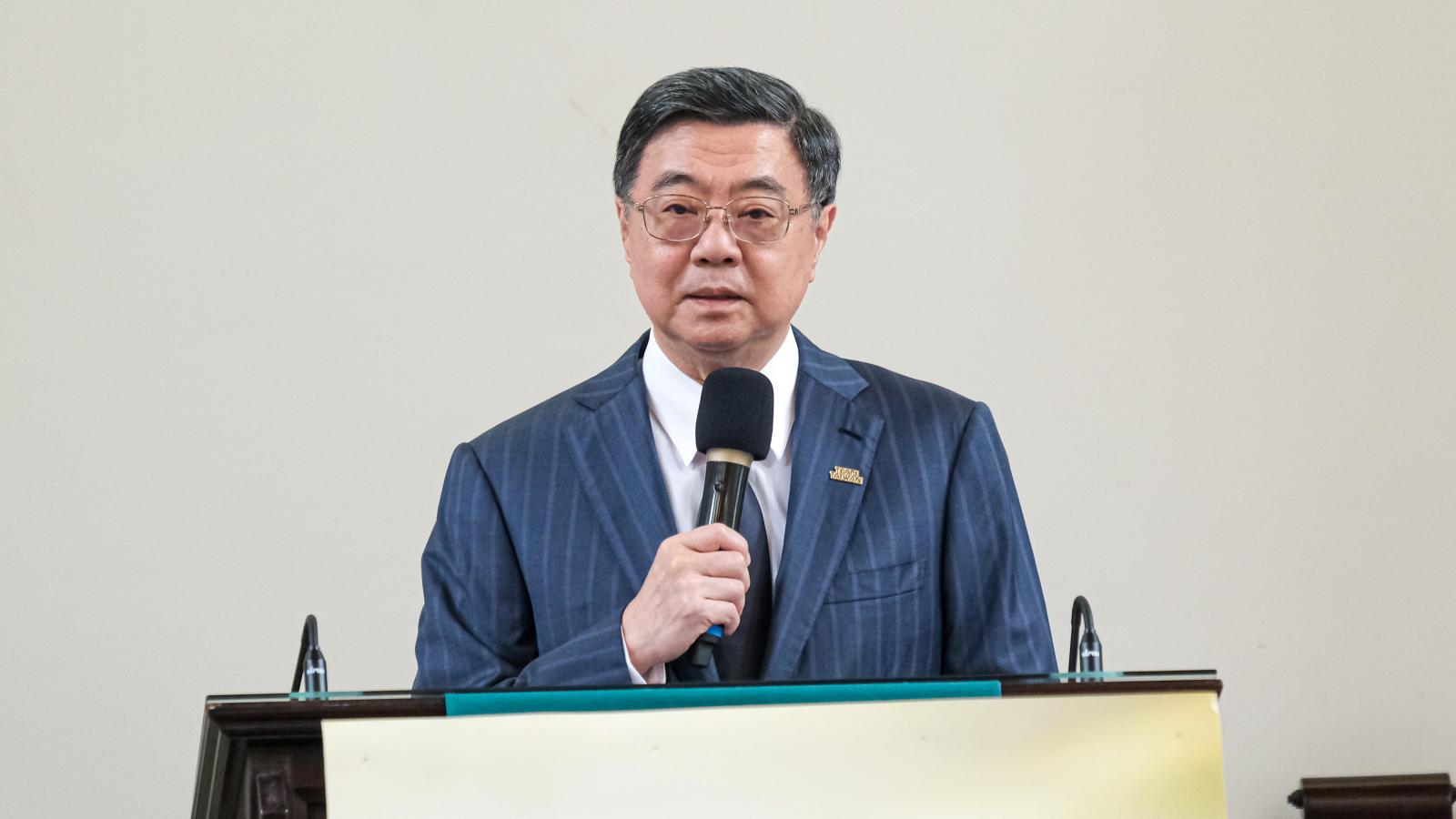
At the end of 2025, the Executive Yuan's refusal to countersign the Legislative Yuan's third-reading passage of the Fiscal Revenue and Expenditure Allocation Act (FREAA) amendment ignited a constitutional controversy. The opposition Kuomintang (KMT) and other parties argued that Premier Cho Jung-tai's refusal to countersign violated the principle of rule of law. In response, KMT legislator Weng Hsiao-ling, along with cross-party lawmakers and civil servant, military, and public safety groups, filed an impeachment petition with the Control Yuan, demanding an investigation into Cho Jung-tai.
On August 4, 2026, Weng announced that after seven months, the Control Yuan had responded, concluding that 'no misconduct or illegality was found' and declining to open an investigation—without providing any reasoning. Weng sharply criticized the decision, calling the Control Yuan 'Lai's imperial guard' and suggesting it should shut down.
The controversy originated on December 15, 2025, when Premier Cho, after the Legislative Yuan rejected his appeal, declared he would not countersign the FREAA amendment under Article 37 of the Constitution and instead filed a petition with the Constitutional Court. The opposition strongly condemned this move, arguing that once a legislative override occurs, the Executive Yuan has no legal basis to refuse execution.
On December 18, the Legislative Yuan's Judiciary and Organic Committee, chaired by KMT convener Weng Hsiao-ling, passed a censure resolution, accusing Cho of 'undermining constitutional order' and voting to refer the case to the Control Yuan for impeachment proceedings. Weng stated at the time that 'democratic governance requires checks on power; the executive must be accountable to the legislature, and Cho's refusal to countersign a passed law violates constitutional principles.'
On December 23, Weng, joined by KMT legislators Wang Hung-wei, Hsu Chiao-hsin, former Taiwan People's Party legislators Chang Chi-kai and Mai Yu-chen, and multiple civil servant, military, police, and firefighter associations, personally delivered an impeachment petition to the Control Yuan. The petition cited four main grounds:
- Refusing to execute a law already in effect - Continuing to withhold countersignature of the FREAA amendment after the legislative override - Illegally cutting general subsidies to local governments - Misusing Article 37 of the Constitution's countersignature mechanism as a tool to veto legislation, thereby undermining separation of powers and the rule of law
However, on August 4, 2026, the Control Yuan responded that after deliberation by its Judicial and Prison Administration Committee, it had decided not to initiate an investigation into allegations that Premier Cho Jung-tai failed to countersign the FREAA amendment and failed to budget in accordance with other passed amendments such as the Military Personnel Treatment Act and Police Personnel Regulations. The letter provided no explanation.
Weng condemned the Control Yuan for ignoring what she called Cho's unconstitutional refusal to countersign and failure to comply with budgetary obligations. She accused the Control Yuan of being a 'toothless institution' that protects the powerful and likened it to an 'imperial guard' serving President Lai Ching-te's administration, suggesting it had lost its legitimacy and should be disbanded.
FACT BOX
- Source: PR Times
- Category: News