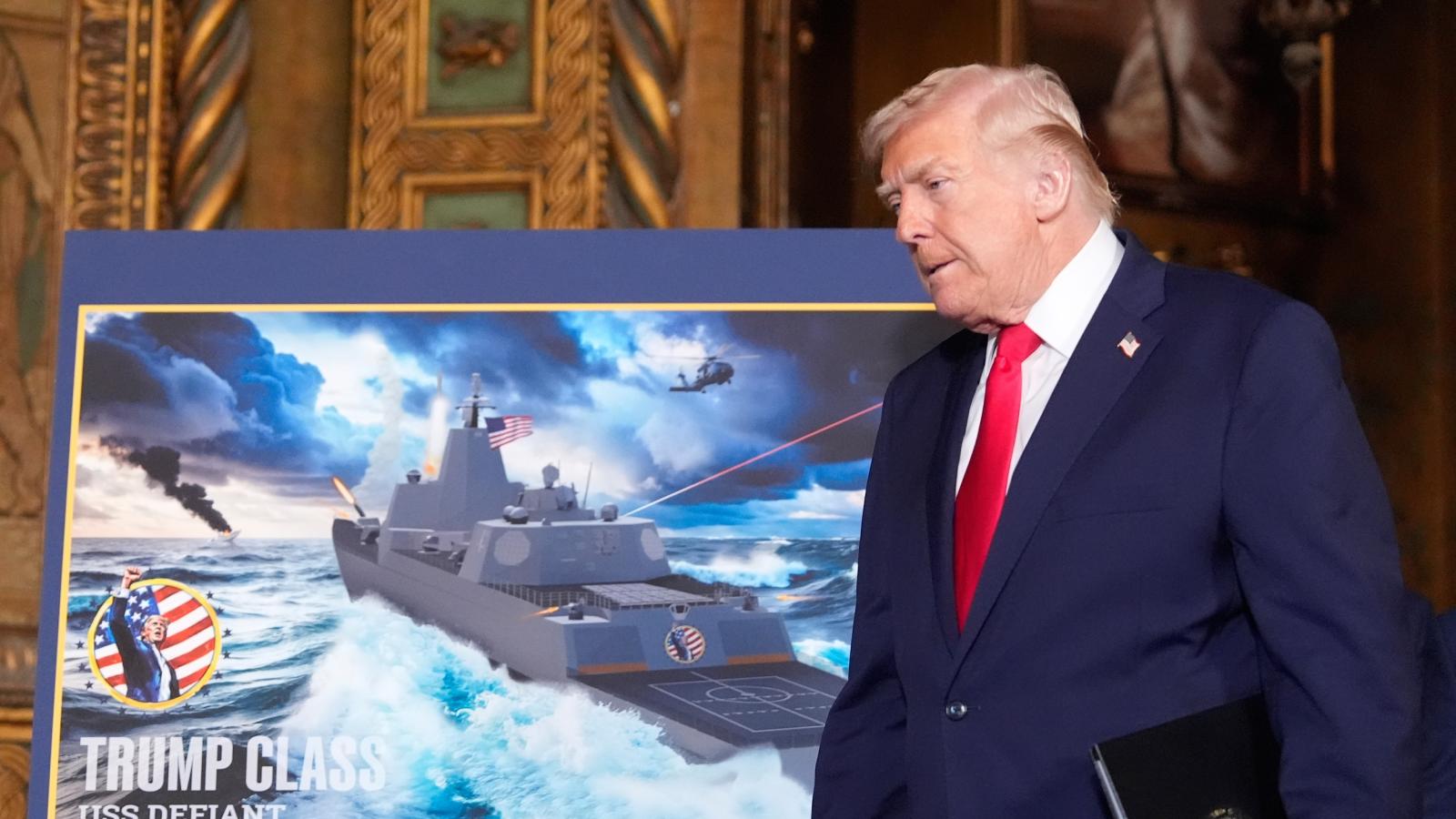
The U.S. Congressional Budget Office (CBO) has issued a new report warning that the 'Trump-class' mega warship program, envisioned by the Donald Trump administration as the largest surface combatant the U.S. Navy has built since World War II, could cost as much as $275 billion (approximately NT$8.8665 trillion). Moreover, existing U.S. shipyard production capacity is fundamentally incapable of supporting such an enormous construction undertaking.
According to CNN’s citation of the congressional report, the plan calls for building 15 nuclear-powered surface warships, each averaging over $18 billion (approximately NT$580.3 billion) in construction cost, with the first vessel projected to reach $23.4 billion (approximately NT$754.4 billion)—a figure rivaling the construction cost of the U.S. Navy’s most expensive current asset, the 'Ford-class' nuclear-powered aircraft carrier.
Dubbed the 'Trump-class' mega warship program, this initiative aims to sharply increase the U.S. Navy’s surface combatant (including destroyers and frigates) procurement budget—from $11 billion (approximately NT$354.6 billion) in fiscal year 2025 to $18 billion (approximately NT$580.3 billion) in fiscal year 2027. The Navy plans to receive these 15 massive warships, each displacing around 35,000 tons, sequentially between 2028 and 2056.
On December 22, 2025, President Trump announced this new weapons program at Mar-a-Lago in Florida alongside Defense Secretary Pete Hegseth. He stated that the series of new warships would be equipped with high-caliber guns, missiles, hypersonic weapons, electromagnetic railguns, cruise missiles, and the world’s most advanced laser weapons. The Navy later confirmed that the Trump-class warships would carry nuclear-armed cruise missiles, making them the most powerful surface vessels in the U.S. arsenal—second only to ballistic missile nuclear submarines (SSBNs) in strategic deterrence.
However, for the Congressional Budget Office, cost is not the only challenge. America’s traditional shipbuilding industry currently lacks the capacity to handle such a massive construction program. Shipyards are already mired in severe delays and cost overruns, making it nearly impossible to take on additional projects like the Trump-class warship, which would be 3.5 times the size of a standard Arleigh Burke-class destroyer.
The CBO report explicitly highlights three critical issues:
• No domestic shipyards capable of nuclear vessel construction: Bath Iron Works and Ingalls Shipbuilding—the two primary contractors for surface combatants—lack both the capability and certification to build nuclear-powered vessels.
• Severe construction backlog: Delivery of the U.S. Navy’s Arleigh Burke-class destroyers is currently delayed by an average of up to five years. Former Navy Secretary John Phelan, who recently stepped down, stated, 'All our shipbuilding programs are in disarray—even the most routine projects face six-month delays and 57% cost overruns.'
• Crowding out aircraft carriers and submarines: If Washington insists on proceeding and shifts construction to Newport News Shipbuilding—the only U.S. shipyard with nuclear-capable facilities—it would inevitably cause severe delays to the Ford-class aircraft carrier and Columbia-class nuclear submarine programs, significantly undermining the Navy’s overall fleet readiness.
Beyond manufacturing hurdles, military experts and retired generals have raised strong doubts about the survivability of 'heavy warships' in modern warfare. Admiral James Stavridis, former Supreme Allied Commander Europe, warned in a Bloomberg column that in a modern battlefield saturated with cheap drone swarms, stealthy submarines, hypersonic missiles, and sea mines, concentrating extremely expensive weapons systems and large crews onto a single, vulnerable platform is highly irrational. 'It’s like putting all your eggs in a few giant baskets—completely contrary to the strategic logic of modern naval warfare,' he said.
FACT BOX
- Source: PR Times
- Category: Survey
- Organizations: Huntington Ingalls Industries / Newport News Shipbuilding / Bath Iron Works