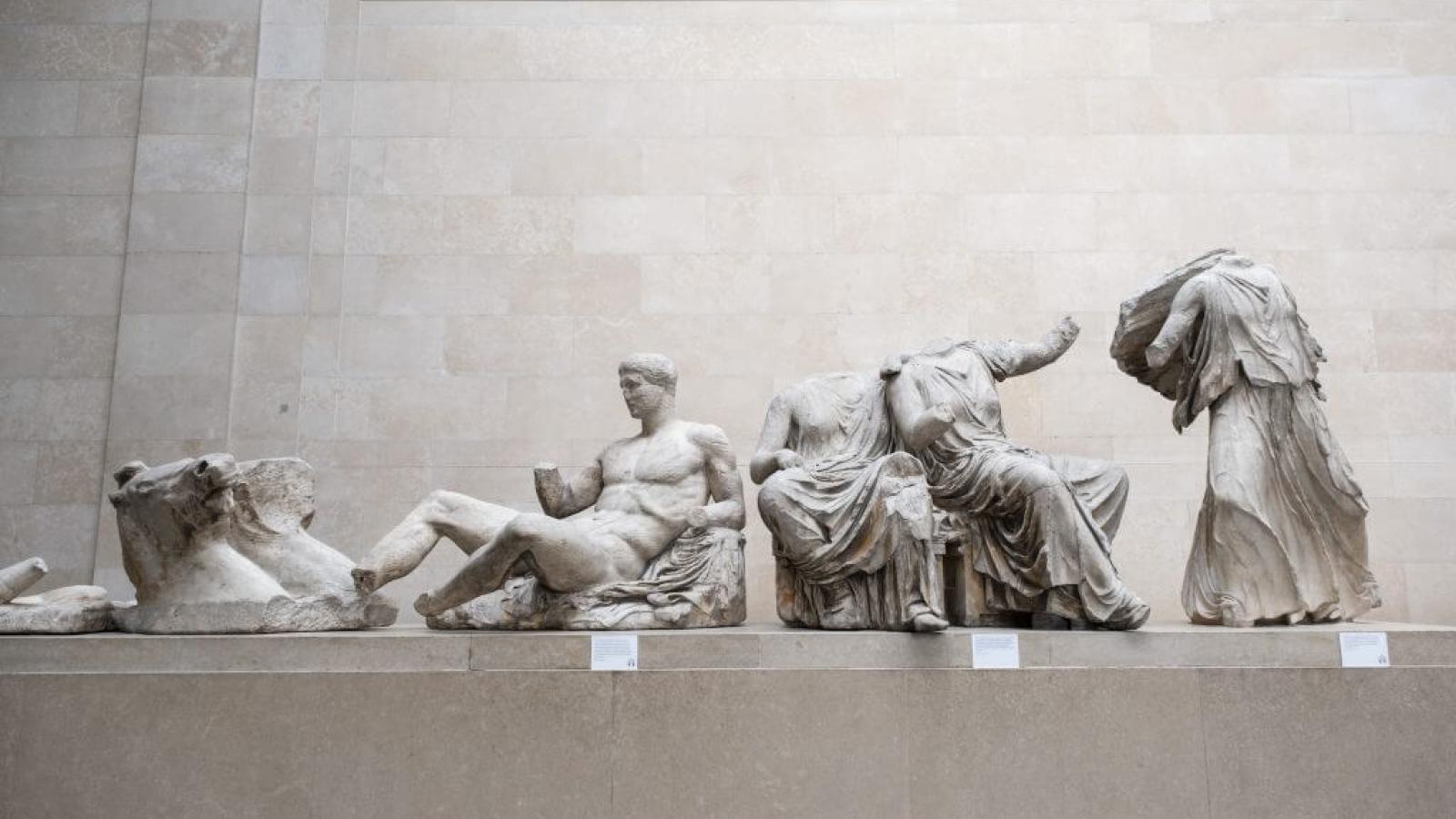
Adonis Georgiadis, Deputy Chairman of the ruling New Democracy party, Minister of Health, and historian, recently told Breitbart News in an exclusive interview that U.S. President Donald Trump currently holds a historic opportunity to help Greek officials negotiate with the UK to return the Parthenon Marbles, thereby establishing his position as a leader of the Western world and leaving a profound mark in history for millennia to come. These sculptures, known to the Greeks as 'Marbles' or 'Parthenon Marbles' rather than 'Elgin Marbles,' are seen as stolen by the 7th Earl of Elgin, Thomas Bruce. They originally belonged to the Parthenon in Athens, created during ancient Greece, and are thousands of years old. Lord Elgin acquired these sculptures during the Ottoman Empire's occupation of Greece, a process fraught with controversy. For centuries, Greeks have been seeking their return, which is not only a matter of national dignity but also has the support of former Ottoman Empire successor states like Turkey. Greek officials believe Trump can pressure the UK government. Georgiadis pointed out that as a natural leader of the Western world, Trump should understand the high regard the American Founding Fathers had for ancient Greece and Rome—the values of democracy and republicanism in the U.S. stem from these classical civilizations. He said, 'I am completely confident that President Trump, as a natural leader of the Western world, can understand the spirit of the American Founding Fathers he represents. They were well-educated and held great respect for ancient Greece and Rome, from which they drew values to build American democracy and republicanism. I am confident he can pressure the UK government to make the right decision.' He further stated, 'Not only in Greece, but all civilized people around the world—especially in the Western world—no educated person would not understand why these marbles should be returned. Even the British do not say 'We will never return them'; they just say 'Let us see if the time is right.' They have not even put forth a real argument of 'We legally own them.' If you trace back the original story, the British once accused Elgin of being a thief. But later, he bequeathed these marbles to the museum in his will. If he had kept them in his own garden, we could have reclaimed them decades ago.' Konstantinos Kyranakis, a current member of the Greek Parliament and Secretary-General of New Democracy, also believes that if Trump facilitates this, his contribution would go beyond diplomacy, becoming a rare moment of political leadership serving civilization itself. 'This would prove that true leadership is not only about shaping the future but also about safeguarding the foundations on which the future depends. The reunification of the Parthenon Marbles will not rewrite history but complete it. We believe President Trump, as the true leader of the West, has the opportunity to leave a legacy that will last for centuries.' Greek-British innovator Andrew A. David stated that Trump's support could be the real key to this historic moment. Endy Zemenides, Executive Director of the Hellenic American Leadership Council, noted that the UK's excuses are becoming increasingly untenable. Zemenides said, 'Now is the time to rectify the greatest theft in history. The reasons the British cannot return the Parthenon Marbles no longer hold. These marbles can now be placed in a world-class museum overlooking the Parthenon. If Trump can facilitate this, it will be an unprecedented contribution to the democratic cultural heritage.' Georgiadis emphasized that the leader who facilitates this will become part of the Parthenon story. The Parthenon has existed for 2500 years and will continue to exist for another 2500 years. He was not exaggerating. On the day of the interview, Georgiadis wore Trump cufflinks and declared himself a loyal Trump supporter, a move also intended for self-protection against the left. Georgiadis said, 'I usually wear them because whenever I see communists, I do similar things to protect myself. I have always believed that the U.S. president is the leader of the entire West, and that is his primary responsibility. I publicly support his actions against Iran because I believe that even though many in the West have not yet realized it, he has protected the West from a great threat. Sometimes politics must make difficult decisions to achieve important things. Trump did important things there. If Iran had had nuclear weapons plus a ballistic missile program at that time, no one would have been safe. Therefore, the U.S. president is the true leader of the Western world.' He believes that the current UK government, showing historical weakness due to Keir Starmer's resignation and Andy Burnham's succession, combined with Trump's strong presidency, is the best time to demand the return and correct historical errors. The Parthenon, built in the 5th century BC, was the greatest symbol of that era and democracy. It stood almost intact for nearly two thousand years, through ancient Greece, the Roman Empire, the Byzantine Empire, the Venetians, and the Ottomans, because all civilizations and authorities that passed through Athens respected it. The greatest destruction occurred in the 17th century when the Turks and Venetians fought, and the Venetians bombarded the Parthenon, which was storing Turkish weapons, causing a massive explosion. This was the first time the Parthenon was attacked in nearly two thousand years, after which it gradually took on its current appearance. In the early 19th century, during the Ottoman Empire, Lord Elgin obtained documents from the Sultan to go to Athens to study the Parthenon. After presenting the documents, he brought workers up to the Acropolis. However, he did not just study; he cut several sculptures of the Parthenon, intending to take them back to Britain. 'He cut the marble, stole the marble, loaded it onto a ship bound for Britain. One of the ships sank, and some of the marble is still at the bottom of the sea today.' The parts that finally arrived in Britain were first placed in Elgin's private garden and later bequeathed to the British Museum in London in his will, where they have been preserved to this day. Georgiadis pointed out that even the Ottoman Empire never recognized this act as legal. The Ottoman authorities stated at the time that Elgin only had a research permit and no authorization to take the marble. The Greek Revolution had already broken out, and Britain consolidated its control over these sculptures in the chaos. The Greek War of Independence, inspired by the American Revolution, saw an event that demonstrated the importance of the Parthenon to the Greeks: when Turkish soldiers were besieged in the Parthenon on the Acropolis and ran out of ammunition, they began dismantling the columns to extract the internal metal cores to make bullets. The Greeks, upon learning this, immediately raised a white flag to cease fire, climbed the hill, and voluntarily provided bullets, saying, 'We will give you as many bullets as you need, just don't touch the Parthenon.' At that time, many Greeks were uneducated and could not even write their own names, yet they knew that this was the core of Greek spirit and national identity. The efforts to reclaim the Parthenon Marbles have never ceased since Greek independence. Britain has repeatedly refused on the grounds that Athens is not suitable for preservation, prompting Greece to build a magnificent museum capable of properly displaying these sculptures. Britain has also argued that returning them would trigger a global wave of artifact claims, but Georgiadis believes this argument does not hold because Elgin's acquisition itself was deceptive in nature, unlike other artifacts in the British Museum. Many British celebrities and politicians, including actors Liam Neeson and George Clooney, as well as many high-ranking British political figures, have supported the return. Georgiadis emphasized that the marble issue is extremely sensitive to Greek culture, and the Greek government (including past governments) has publicly stated that this issue is unique and that Greece will not use it to demand the return of other artifacts or as a bargaining chip. 'For us, the Parthenon sculptures are a symbol of Greek national unity. If you ask anyone what is the greatest symbol of Greece, the answer is the Parthenon. It is a symbol of democracy.'
FACT BOX
- Source: PR Times
- Category: News