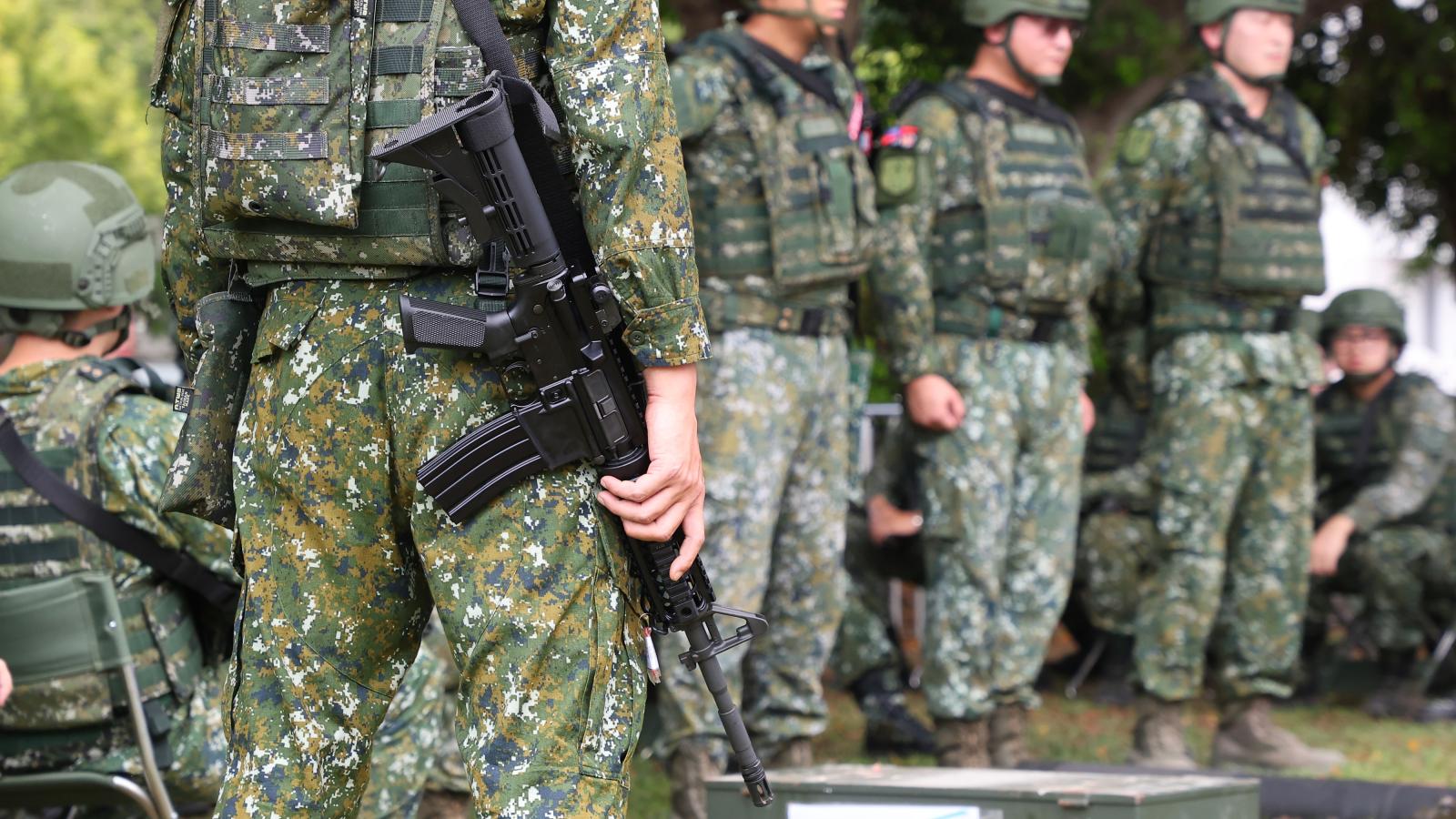
Taiwan's Han Kuang 42 military exercise began yesterday (May 5) and will run for 10 days and nine nights. In addition to testing combat capabilities and weapons systems, the exercise has spotlighted the growing visibility of U.S. personnel—referred to as 'English teachers'—participating in training activities across Taiwan. Meanwhile, The Wall Street Journal recently published an article titled 'Deep U.S. Ties With Taiwan Are Surviving Pressure From China—and Trump,' highlighting increasingly open military and coast guard cooperation between the U.S. and Taiwan, marking a shift from past low-key practices. In response, U.S.-based scholar Lu-Chung Weng posted an analysis on Facebook today (May 6), titled 'The closer U.S.-Taiwan relations become under Trump, the more Taiwan must calculate the potential costs.' Weng emphasized that while closer U.S.-Taiwan ties are not inherently negative, each public move comes at a price—and the key question is 'what are we exchanging, and what are we gaining in return?'
Has U.S.-Taiwan military engagement become more visible? What did Taiwan's Defense Minister Koo Ji-hong say? The Wall Street Journal reported that past U.S.-Taiwan military cooperation was typically conducted discreetly and privately to avoid provoking Beijing. However, recent developments—including public photos of joint Taiwan-U.S. coast guard drills, officials openly discussing security collaboration, and continued deployment of retired or active U.S. personnel to assist training—indicate a deliberate push toward greater transparency. The report also noted that the Taiwanese government does not assume direct U.S. military intervention in the event of war.
Defense Minister Koo Ji-hong, in a pre-exercise interview, stated that long-standing U.S.-Taiwan military exchanges are 'more extensive than most people imagine.' The 'English teachers' the public sees may only represent a fraction of the support, as U.S. Indo-Pacific Command assists Taiwan across multiple domains to enhance its defensive capabilities.
Is U.S.-Taiwan security cooperation becoming more overt? What did The Wall Street Journal report? Citing the report, Weng noted that the Taiwanese government is now openly discussing security cooperation with the U.S. Defense officials told the Journal that military exchanges include reserve force reforms, logistics, command and communications, and training. Additionally, the American Institute in Taiwan (AIT) recently released photos showing Taiwan Coast Guard and U.S. Coast Guard vessels sailing side by side. On the economic front, Weng pointed out that rising demand for AI and high-end chips continues to drive Taiwan's exports and economic growth, further elevating its strategic importance in global supply chains. However, a potential second Trump administration may demand expanded Taiwanese investment or a review of U.S.-Taiwan trade terms. Taiwan's economy still faces structural risks, including wage stagnation, challenges in traditional industries, and demographic issues.
Does higher-profile cooperation with the U.S. carry greater risks? Is Trump focused on reciprocity? Weng analyzed that while Taiwan should not be overly pessimistic about U.S.-Taiwan relations, it must realistically acknowledge that 'security will come at a higher cost' under Trump. If the U.S. provides market access, technology, and security, allies must reciprocate—through arms purchases, energy procurement, investment, tariffs, and potentially semiconductor capacity and talent. Taiwan's public display of coast guard and military cooperation sends a strong message to China about the solidity of U.S.-Taiwan ties and boosts domestic confidence. However, Weng warned, 'the more transparent the security cooperation, the easier it becomes for Washington to demand more from Taiwan.' In fact, U.S.-Taiwan security cooperation has long existed, but was previously unacknowledged. The issue now is: 'How much has the cost increased due to this visibility?' From Trump's perspective, U.S. support for Taiwan may not just signal solidarity—it could also imply, 'We’re providing this level of security service—how much is Taiwan prepared to pay?'
How should Taiwan respond to the risks of high-profile cooperation? Weng stressed the need to clearly understand Taiwan's leverage and the costs involved. He clarified that he is not opposing U.S.-Taiwan cooperation, nor is he pessimistic about Taiwan. But the more significant the cooperation, the less it needs to be publicized—because greater visibility may not provoke Beijing, but 'Trump will definitely pull out his calculator.' Taiwan’s leverage lies in U.S. dependence on its semiconductor industry, supply chains, and geopolitical position. Conversely, Taiwan relies on U.S. markets and security cooperation. Therefore, Taiwan must not treat U.S. assistance as a 'one-sided favor' or view 'U.S. support for Taiwan' as a free guarantee. The key is whether Taiwan can convert its strategic value into better terms: increased defense spending should yield equipment that meets actual needs; expanded investment should secure market access, technology, and talent collaboration; and semiconductor strategies must protect core R&D and industrial advantages. In conclusion, a mature U.S.-Taiwan relationship is not about treating U.S. support as 'political fireworks,' but about clearly understanding what has been paid in return.
FACT BOX
- Source: PR Times
- Category: Event