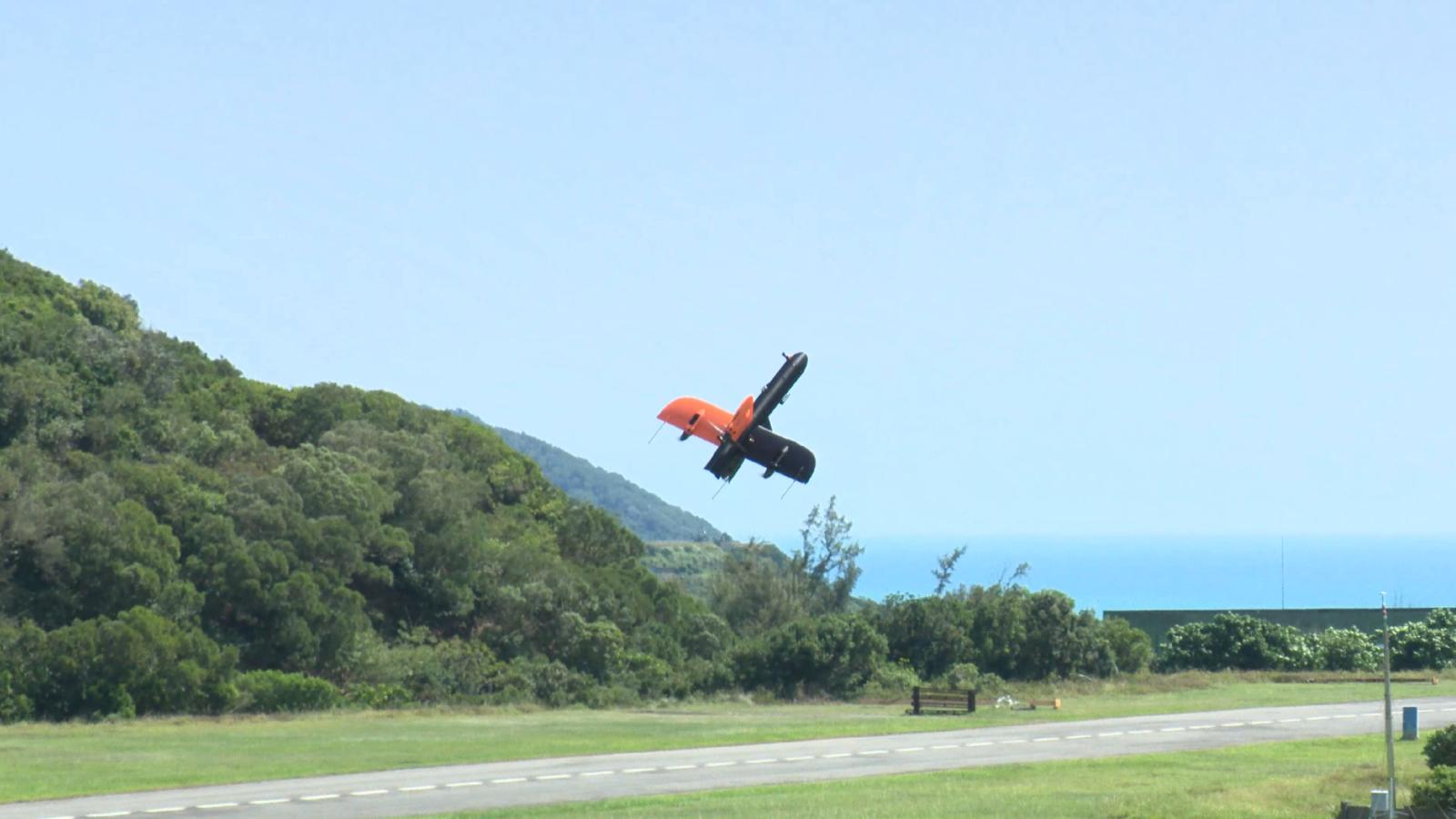
U.S. defense technology company Shield AI and Taiwan's National Chung-Shan Institute of Science and Technology (NCSIST) jointly announced on the 6th that they have successfully completed a real-world demonstration of a multi-drone collaborative autonomous search mission. A total of three 'Mighty Hornet III' drones, developed by NCSIST, were deployed in the mission. This achievement has also led to an expanded partnership, with both parties continuing to integrate Shield AI's Hivemind autonomous system into NCSIST's various R&D programs.
Within just three months, with technical support from Shield AI, NCSIST's engineering team independently developed multiple AI Pilot unmanned systems and successfully integrated them into three Mighty Hornet III drones. During the demonstration, the Hivemind platform autonomously managed drone takeoff and coordinated multi-drone operations to execute a wide-area search mission while avoiding designated no-fly zones. Each of the three drones searched assigned areas while maintaining communication with one another, with one drone operating near the perimeter of a restricted zone. Upon mission completion, Hivemind also autonomously executed the landing procedures for the Mighty Hornet III drones.
Brandon Tseng, President and Co-Founder of Shield AI, emphasized that autonomy is the key to unlocking true combat effectiveness for drones. 'You can mass-produce 10 million drones, but you cannot train 10 million drone operators,' he said, highlighting that Hivemind's multi-drone collaborative autonomy makes it a 'force multiplier' in modern defense. Enabling Taiwan to independently develop AI-powered autonomous flight capabilities will significantly enhance its national defense capacity, and Shield AI expressed its commitment to continuing collaboration with NCSIST and other partners to build mission-autonomous capabilities essential for deterrence.
Shield AI first signed a cooperation agreement with NCSIST in February this year, integrating Hivemind into NCSIST's intelligent unmanned systems, covering software development and field deployment. Throughout the contract period, NCSIST engineers worked closely with Shield AI's on-site engineers, learning through hands-on training how to independently operate and utilize the autonomous capabilities supported by Hivemind. This successful demonstration marks the smooth completion of NCSIST's original contract and has led to a significant expansion of the partnership's scope.
NCSIST Director General Li Shih-Chiang noted that with Shield AI's support, his team mastered Hivemind operations in less than three months. He emphasized that beyond the impressive performance of the AI flight control system, he was particularly grateful for Shield AI's full support throughout the collaboration—through practical training, technical expertise, and on-site guidance—which enabled Taiwan's engineers to independently operate the technology within a short timeframe, building strong confidence in Hivemind.
Hivemind's AI-powered autonomous flight control grants vehicles the ability to perceive, decide, and act independently, enabling mission execution without human intervention. Hivemind has already been successfully integrated into over 30 different platforms, including F-16 fighter jets, jet-powered drones, helicopters, unmanned surface vessels, and ground vehicles.
The Mighty Hornet III, independently developed by NCSIST, is Taiwan's first X-wing high-mobility drone, classified as a Group 2 unmanned aircraft. The airframe features a modular 3D-printed design, offering advantages in rapid, low-cost mass production. The Mighty Hornet III combines the vertical takeoff and landing (VTOL) capabilities of a multirotor platform with the high-speed cruise performance of a fixed-wing aircraft, requiring no ground support equipment during takeoff or landing.
FACT BOX
- Source: PR Times
- Category: Partnership
- Organizations: Shield AI