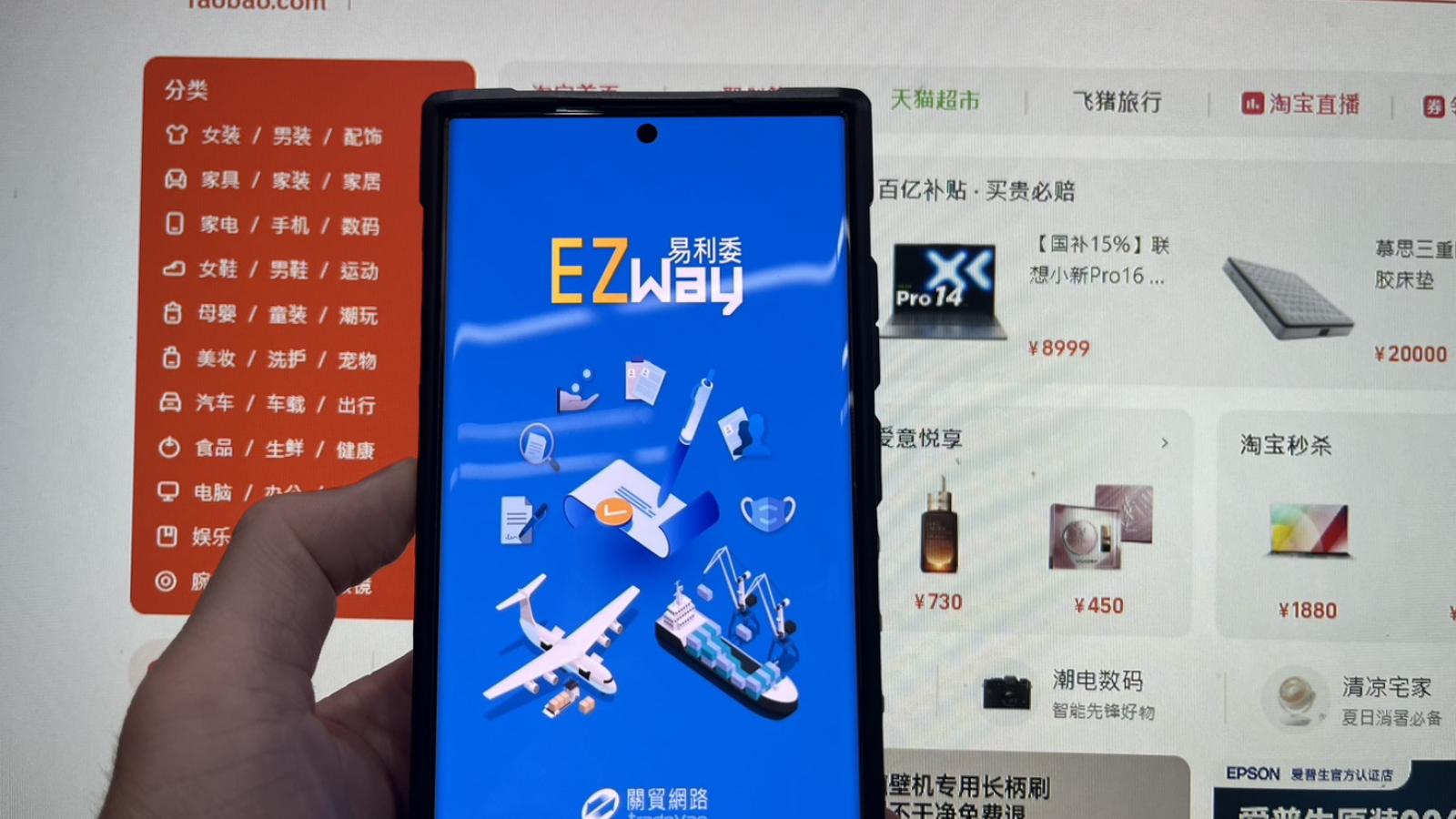
Recently, EZ WAY (Yi Li Wei) has once again become a focal point of social discussion. Following the Ministry of Finance's announcement to fully implement 'pre-confirmation of authorization' starting this March, individuals who have not completed EZ WAY verification will be unable to clear customs for their express shipments—and may even face return of goods—leading to rising public complaints. Some question whether EZ WAY merely adds inconvenience, while others suspect that the government is outsourcing public services to specific private companies. In response to these controversies, the Directorate General of Customs under the Ministry of Finance issued three clarifications, emphasizing that EZ WAY aims to prevent unauthorized declarations, protect personal data, and improve customs efficiency—not to benefit any particular company.
However, the more important issue may not be whether EZ WAY should exist, but whether the government remains stuck in a decade-old mindset regarding customs management.
First, we must acknowledge that EZ WAY serves a necessary purpose. Before EZ WAY was established, personal imports were primarily handled through paper-based authorization, where consumers had to provide identification documents for customs brokers to file declarations on their behalf. This system long carried risks of personal data leakage and fraudulent filings, including cases where unscrupulous operators used others’ identities to import goods. The core reform of EZ WAY’s real-name authentication system lies in replacing paper authorization with electronic consent, ensuring that each customs declaration is confirmed by the individual themselves, thus reducing the risk of identity misuse. From this perspective, the initiative aligns with the direction of digital advancement.
Yet, a well-intentioned system does not automatically mean its current design is optimal. The existing EZ WAY employs a per-transaction authorization model: every cross-border purchase requires users to wait for a notification and manually confirm each transaction. As cross-border e-commerce becomes increasingly frequent—with small-value, high-frequency, multi-batch transactions becoming the norm—this model reveals numerous shortcomings, including notification fatigue, missed messages, cumbersome operations, and customs delays. These have become common experiences among many consumers. For frequent cross-border shoppers, repeating the same procedure every time results in administrative costs that may actually exceed expectations.
Moreover, EZ WAY may not have fully resolved the very problems it aimed to address. There continue to be reports of individuals receiving notifications for goods they never purchased, or even being falsely declared as recipients. This indicates that the system ultimately relies on the accuracy of data entered by customs brokers. In essence, EZ WAY places the final line of defense on the consumer, rather than preventing errors at the source. When the system depends on recipients detecting anomalies and rejecting authorization to avoid harm, such protection remains reactive—'post-incident remediation'—rather than true risk prevention.
Furthermore, another critical concern is the vast amount of administrative resources the government invests in maintaining this per-transaction confirmation system—including customer service, account issues, phone number verification, operational inquiries, and handling of abnormal cases. These human resources could otherwise be allocated to high-risk cargo inspections and border risk management. The current system appears to keep regulatory authorities overwhelmed with routine administrative tasks, which contradicts principles of administrative efficiency.
Examining practices in major countries worldwide, the international trend shows logistics providers, e-commerce platforms, or customs agents submitting electronic data in advance, allowing customs authorities to conduct risk analysis and determine inspection needs—without requiring every consumer to participate individually in customs clearance. In Japan and the United States, authorization is often completed when consumers place orders and accept logistics services. In South Korea, a Personal Customs Clearance Code (PCCC), combined with name, phone number, and address, enables cross-verification, real-time alerts, and anomaly monitoring to prevent false declarations—consumers are not required to confirm each individual parcel.
By contrast, Taiwan mandates direct consumer involvement in every customs procedure—a uniquely designed system. While differing from major global approaches doesn’t necessarily mean EZ WAY is fundamentally flawed, it does indicate that the system has failed to evolve alongside genuine digital governance models.
EZ WAY requires a 'true' reform. Future improvements should not merely focus on enhancing the app interface, but involve rethinking the entire institutional design. EZ WAY exists because the government seeks to balance border security, personal data protection, and customs efficiency—a goal that is valid. However, a truly mature system should not turn every consumer into part of the customs process. Instead, through data integration, intelligent risk management, and technological verification, the majority of people should barely perceive the system’s existence. This is the direction Taiwan’s next phase of cross-border customs reform should genuinely pursue!
*Author: Chen Meng-jun, Distinguished Research Fellow, Center for International Economic and Trade Policy, Chung-Hua Institution for Economic Research
FACT BOX
- Source: PR Times
- Category: News