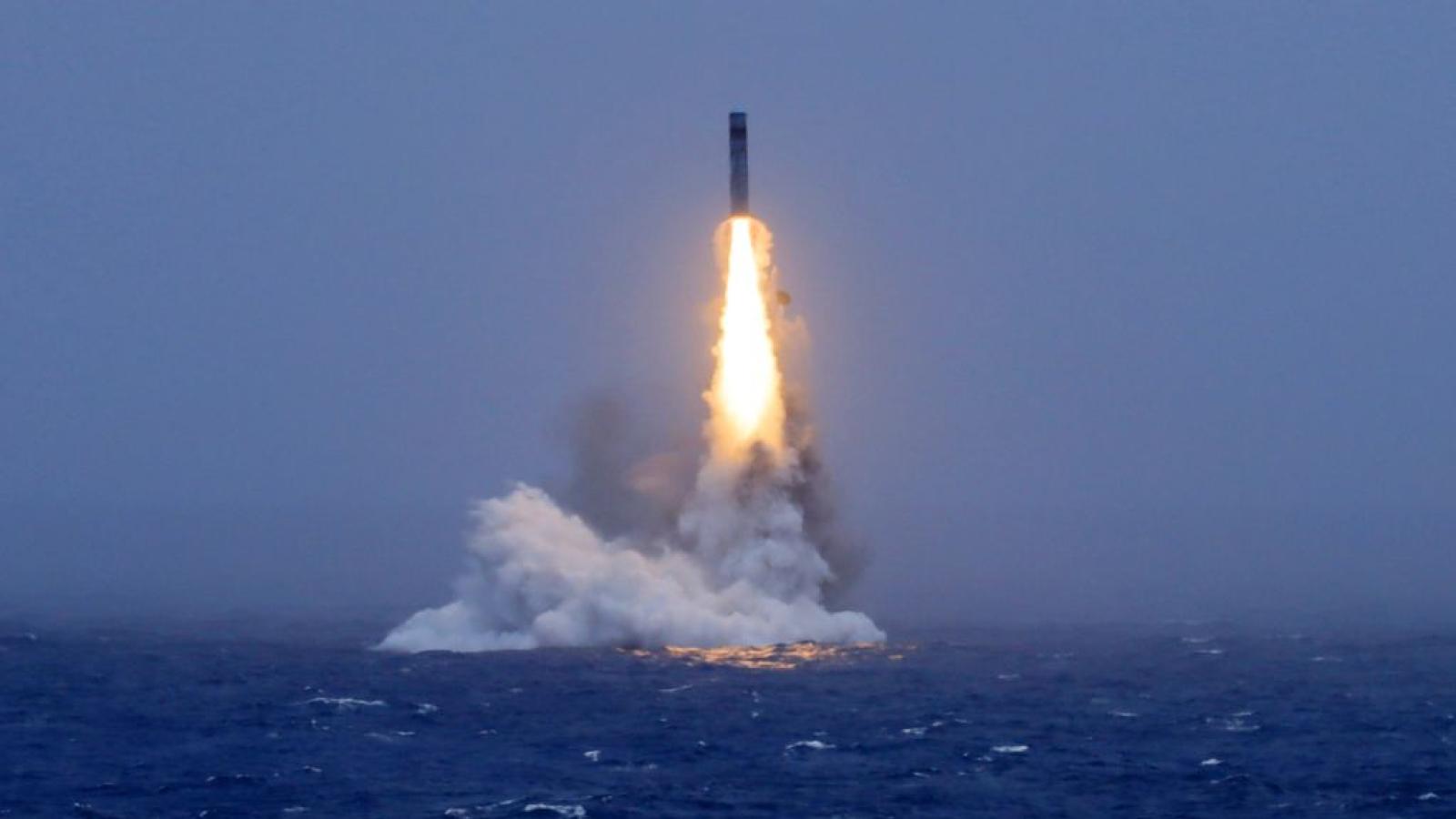
At 13:01 on July 6, 2026, Xinhua News Agency reported: 'At 12:01, a strategic nuclear submarine of the PLA Navy successfully launched a submarine-launched strategic missile carrying a training mock warhead into the relevant public sea area of the Pacific Ocean, accurately hitting the predetermined sea area.' According to open-source intelligence, the submarine-launched ballistic missile's training mock warhead successfully landed in the target sea area in the South Pacific, east of the Solomon Islands and west of Samoa. After the PLA successfully launched the missile, various parties discussed it extensively, with diverse opinions emerging. The author sorted out the discussion focuses from various parties and compiled them into the following outline for this article: 1. Purpose of the missile launch; 2. Purpose of setting up two restricted sea areas; 3. Process of submarine-launched missile launch; 4. Eight stages of submarine-launched missile launch; 5. Launch of the Giant Wave missile and submarine model; 6. Seizing the opportunity to demonstrate 'three-in-one' nuclear strike capability; 7. Seizing the opportunity to verify and demonstrate joint operational capability.
1. Purpose of the missile launch After the PLA successfully launched the missile, some commentators believed that the CCP was targeting Japan, deliberately choosing the eve of the 89th anniversary of the 'July 7th Incident,' aiming to warn Japan. Of course, the commentators' statements were based on the 'Eight Years' Anti-Japanese War' perspective of the Republic of China. In fact, the CCP, in order to seize the narrative rights of the Anti-Japanese War, has changed the Eight Years' Anti-Japanese War to the Fourteen Years' Anti-Japanese War. What the Nationalist Army regards as the first battle of the Anti-Japanese War, the 'Lugou Bridge Incident (July 7, 1937),' the CCP only regards as one battle during the Anti-Japanese War. The CCP unilaterally changed the first conflict of the Anti-Japanese War to the 'September 18th Incident (September 18, 1931).' In other words, the purpose of the PLA's missile launch is not closely related to the 'Lugou Bridge Incident.'
The author's assessment is that the purpose of the PLA's missile launch is part of the annual military training route arrangement, which is a routine plan. However, the plan did not set a specific time and place. The final decision to complete the launch between 'July 6th and 8th' was made by Xi Ping, the commander of the Central Military Commission Joint Operations Command Center. The author's assessment is that, in addition to the annual training route arrangement, the possible reasons for Xi Jinping, the commander of the Central Military Commission Joint Operations Command Center, to make the decision include the following geopolitical changes:
(1) Aimed at Japan: Japan passed the 'Three Security Bills,' raising the Self-Defense Forces' budget from 1% to 2%, and shifting its defense policy from 'exclusive defense' to 'counterattack capability.' Japan's strengthening of its defense capabilities is interpreted by the CCP as a dangerous signal of the resurgence of 'militarism.' Additionally, the CCP is concerned that Japan might abandon the 'Japanese Nuclear Non-Proliferation Principle (not possessing, not producing, not introducing nuclear weapons).' Japan has purchased 400 Tomahawk cruise missiles from the US and simultaneously expanded the amphibious landing forces of the water-land mobile brigade. The southwestern islands have fully expanded ammunition depots and dual-use airports, pre-positioned US ammunition and equipment, and built frontline operational support points in the first island chain. Therefore, the CCP's attention to Japan has increased, leading to the decision to conduct the missile launch at this time.
(2) Joint military exercises: 1. From June 20 to 30, 2026, the Japan Self-Defense Forces and the US military conducted the 'Firm Dragon 26' joint exercise in Kyushu, Okinawa, Miyako, and Ishigaki Islands in the southwestern islands (adjacent to the eastern side of the Taiwan Strait), with a total of 9,600 troops. The exercise subjects included island seizure, near-sea blockade, shore-based anti-ship, and amphibious landing. 2. From June 23 to July 1, 2026, the Japan Self-Defense Forces and the US military conducted the 'Brave Shield 26' joint exercise in Japan's mainland and from Guam to the western Pacific. The exercise subjects included long-range anti-ship by strategic bombers, submarine anti-submarine cooperation, and live-fire sinking of target ships. 3. From June 24 to July 31, 2026, 31 countries conducted the 'RIMPAC 26' joint military exercise in the Hawaiian Islands and Pearl Harbor, with exercise subjects including joint anti-submarine, island amphibious seizure, multi-service saturation anti-ship sinking of target ships, unmanned vessel group operations, and targeted blockade of key maritime routes in the western Pacific.
(3) South China Sea dispute: The Philippines deployed patrol vessels and coast guard ships, and the US Coast Guard patrol ships cooperated in conducting large-scale maritime and aerial joint reconnaissance around the Scarborough Shoal. In June 2026, the US delivered four underwater unmanned reconnaissance vessels to the Philippines in Subic Bay, which can stay submerged for 7 days underwater and can also be used to quickly transport ammunition and equipment to the Philippines.
2. Purpose of setting up two restricted sea areas On July 5, 2026, the Dalian Maritime Safety Administration issued the 'Liao Navigation Warning 289/26,' stating, 'From 0800 on July 6 to 1500 on July 8, in the four-point connected area, there is a risk of rocket debris falling, and entry is prohibited.' On the same day, the Guangdong Maritime Safety Administration issued the 'Guang Navigation Warning 433/26,' stating, 'From 0000 on July 6 to 0700 on July 8, in the four-point connected area, there is a risk of rocket debris falling, and entry is prohibited.' This shows that the PLA prepared two launch units for this submarine-launched missile, aiming to ensure that if the first launch unit fails, the other launch unit can immediately take over and launch, ensuring that the launch work is foolproof.
On May 18, 1980, the PLA Second Artillery Corps carried out the '580 Mission,' successfully launching a self-designed and manufactured long-range carrier rocket into the predetermined sea area 700 kilometers northwest of Fiji in the South Pacific, with a radius of 70 nautical miles, accurately hitting the target. In fact, at that time, at the 'Jiuquan Missile Test Base' 2nd launch site, two intercontinental missiles were respectively erected on two launch pads 400 meters apart in the south and north positions. Finally, only one intercontinental missile was launched. In other words, the other one was a backup missile, which would complete the launch and test work if the first launch failed.
According to the CCP's routine of preparing two options, it is inferred that when launching the 'DF-31AG Intercontinental Missile' on September 25, 2024, two launch teams were also prepared. Therefore, the issuance of two navigation warning sea areas this time is to prepare two options, not to launch two submarine-launched missiles simultaneously. However, it is currently not possible to understand which of the nuclear submarines in the Bohai Sea and the South China Sea is the main launch unit and which is the backup launch unit. Of course, it is also not possible to judge whether the PLA's submarine launch this time was a first launch success or a backup unit took over and succeeded.
3. Process of submarine-launched missile launch The purpose of this submarine-launched missile launch process is to completely verify the entire process of deep-sea stealth maneuvering, underwater cold launch, underwater navigation, water exit ignition, mid-course flight, warhead separation, terminal penetration, and precise hit of the strategic nuclear submarine, as well as far-sea measurement and control, and long-range guidance. After comprehensively analyzing open-source intelligence, the launch process of this submarine-launched missile is summarized as follows:
(1) The provincial maritime safety administration of China issued navigation warnings in advance, delineated maritime restricted areas, and notified surrounding countries in advance to avoid the risk of ships and aircraft mistakenly entering the area.
(2) The nuclear submarine responsible for the submarine launch mission performed underwater stealth positioning, completed the calculation of ballistic elements, and completed the self-check of the entire system.
(3) The underwater cold launch pushed the missile out of the launch tube, and the first-stage engine ignited and ascended after exiting the water.
(4) Each stage of the rocket separated in sequence, and the mock warhead flew across the ocean and accurately fell into the predetermined sea area in the South Pacific.
(5) Simultaneously collected the entire set of real combat data for underwater launch and long-distance flight, and verified the reliability of the coordination between the submarine, missile, and command link.
4. Eight stages of submarine-launched missile launch The launch of land-based missiles is simply the ignition of the engine and the launch of the missile. However, this logic is completely inapplicable in a deep-sea submarine. Underwater launch must overcome multiple extreme environments such as water pressure, currents, and submarine sway, with extremely high technical difficulty. If the missile engine is directly ignited inside the submarine's launch tube, the instantaneous high temperature of several thousand degrees and ultra-high pressure will directly penetrate the launch tube, burn the submarine's equipment, and even the entire submarine will be severely damaged by the shock wave. Therefore, submarine-launched intercontinental missiles mostly adopt the 'cold launch mode,' that is, 'first launch, then ignite, the missile exits the tube and the water, and then activates its own engine.' The submarine is only responsible for 'pushing' the missile out of the deep sea, and the missile flies up by itself and heads to the target. According to the analysis of the launch mode, the submarine-launched missile undergoes the following eight stages from launch, entry into orbit, to landing in the sea.
(1) Launch preparation Launch cannot be carried out at any time. The strategic nuclear submarine will arrive at the predetermined sea area in advance, stabilize at a safe depth of 30 to 60 meters underwater, maintain low-speed stable navigation, and avoid interference from surface waves and currents. The submarine maintains silence throughout the process, maintains a stable attitude, the navigation system completes accurate positioning, and completes the preparation work such as water injection into the launch tube, launch system inspection, and ballistic element setting.
(2) Maintaining pressure balance inside and outside the submarine If the launch tube is directly connected to seawater, high-pressure seawater will directly crush the tube body and flood the equipment. If the internal and external pressures are unbalanced, the hatch cover will not open or will be destroyed by the seawater when opened. Therefore, the first step is to maintain the pressure balance inside the tube: the control system fills the sealed launch tube with high-pressure nitrogen gas, precisely adjusts the gas pressure inside the tube, and makes it completely balanced with the external deep-sea water pressure. After the pressure is balanced, the outer metal hatch cover can be safely opened, and the inner waterproof diaphragm is still intact, firmly isolating seawater and protecting the internal missile from corrosion, which is also the core key to preventing launch failures.
(3) Gas-steam ejection and missile exit from water The gas generator at the bottom of the launch tube ignites instantaneously, generating a large amount of high-temperature and high-pressure gas, which quickly mixes with the water in the tube to form a super-strong thrust gas and steam mixed pressure field. In an extremely short time, the huge pressure pushes the missile weighing dozens of tons upward along the vertical launch tube, breaks through the inner waterproof diaphragm, and smoothly pushes it out of the submarine and into the water. The entire process does not produce any fire or high temperature in the submarine, and is fully safe and controllable.
(4) Continuously correcting attitude and maintaining stable navigation After the missile enters the water, it does not immediately ignite the engine, but relies on the initial speed obtained from the ejection to continue sliding underwater.
FACT BOX
- Source: PR Times
- Category: 其他