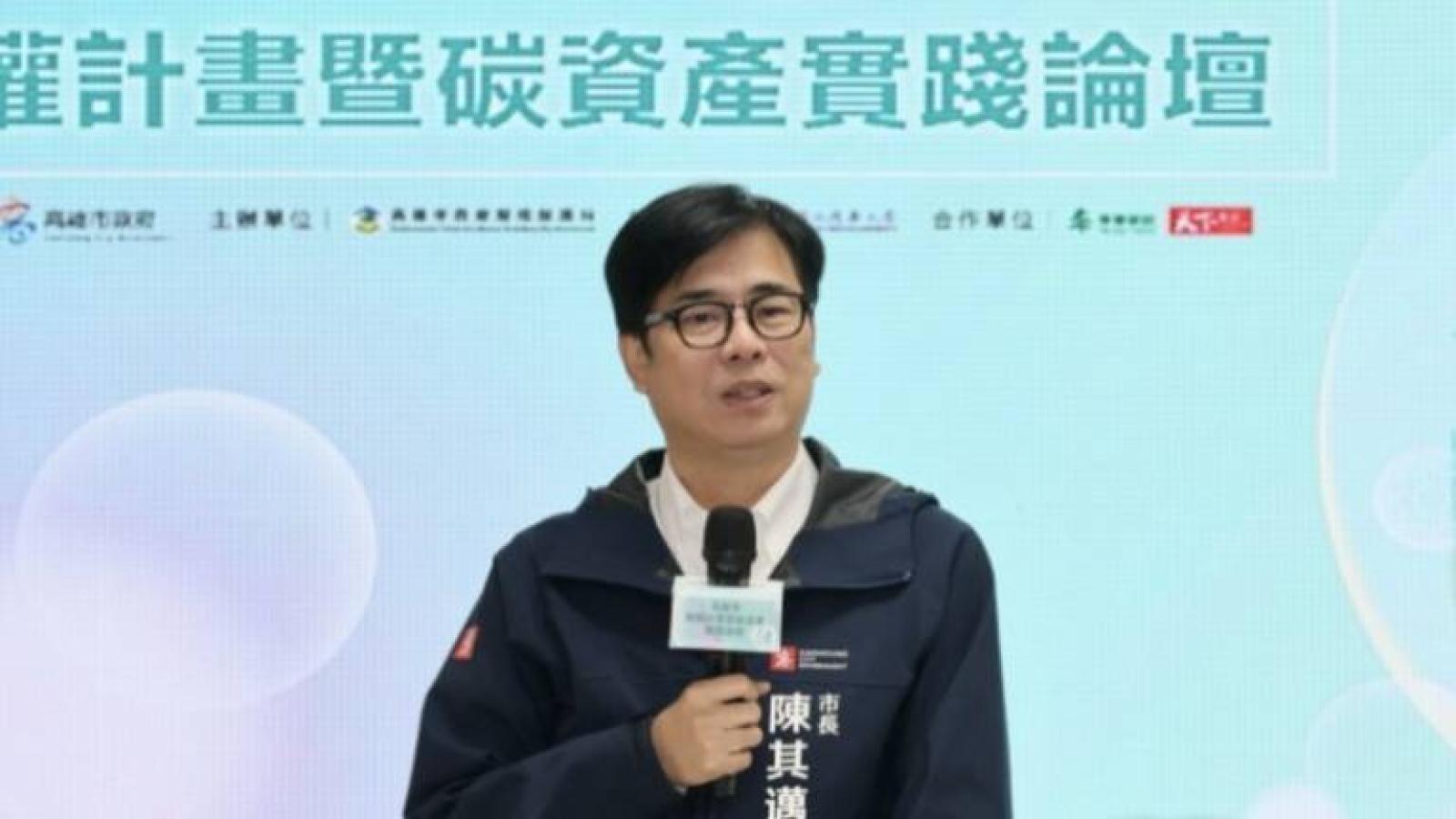
Recent food safety incidents have continued to escalate, and with the opposition persistently launching political offensives, the selection of the next Premier has once again become a focal point in Taiwan’s political arena. Kaohsiung Mayor Chen Chi-mai, praised for his consistent administrative performance, extensive local governance experience, and ability to mediate across party factions, has repeatedly been cited in public discourse as a potential candidate for cabinet leadership. However, a comprehensive analysis of recent political developments, the evolution of power dynamics within the Democratic Progressive Party (DPP), and Chen’s own public statements reveals political signals far more nuanced than the simplistic narrative of a 'popular Premier candidate.'
1. The Nature of Factional Alliances: 'Vertical and Horizontal Alliances' in Party Power Structures
The DPP, in both its institutional framework and operational practices, is fundamentally a political alliance composed of diverse factions. Key decisions and personnel appointments—including Premier nominations and party congress elections—have always been outcomes of shifting factional power balances and negotiated compromises. Under the 'strong presidential' system where Lai Qingde serves as both President and DPP Chairperson, the New Tide faction continues to wield significant influence as the largest intra-party group. However, the movements of non-New Tide factions remain the critical lever determining whether intra-party power remains balanced.
In the recent party congress and the re-election of core party leadership bodies (Central Committee and Central Standing Committee), the Yongyan Association faced a critical bottleneck in retaining its Central Standing Committee seat after failing to secure expected numbers in the Central Committee. Chen Chi-mai’s political network played a decisive role by providing crucial support, enabling Yongyan to successfully preserve one Central Standing Committee seat. This pivotal move fully demonstrates the dynamic nature of factional alignments within the DPP: Chen does not position himself as a 'factional leader,' but rather functions as a highly skilled 'factional mediator.' By integrating forces such as Yongyan and other local, non-New Tide groups, Chen has not only maintained stability in Kaohsiung and southern Taiwan—the DPP’s stronghold—but also fostered unprecedented cooperation among non-New Tide factions.
2. The Political Language Behind Public Statements: From 'Commitment' to 'Flexibility'
Chen Chi-mai has consistently maintained a clear public stance on the cabinet appointment issue. As early as after the 2024 presidential election, when rumors began circulating, he explicitly stated his intention to 'serve until the last day of my term,' emphasizing this as a promise to Kaohsiung citizens and reiterating that Premier appointments fall under presidential authority. Recently, amid renewed food safety concerns and cabinet speculation, he reiterated that his top priority at present is to focus on municipal affairs and food safety.
What deserves close attention is the political flexibility embedded in his statements. He repeatedly emphasizes 'fulfilling his term-long commitment,' neither declaring an absolute refusal to return to central government nor denying the possibility of assuming high-level responsibilities after his term ends. This signal is clear: he will not leave Kaohsiung prematurely due to political calculations, but he has not closed the door to future strategic opportunities in central governance.
3. Strategic Deconstruction of Opposition Endorsements: 'Exposure Equals Death' and Agenda Shifting
Taipei Mayor Chiang Wan-an publicly named Chen Chi-mai as a suitable Premier candidate, sparking widespread discussion. From the perspective of partisan strategy, the opposition’s public endorsement of a strong potential candidate from the ruling party carries multiple strategic implications: First, it shifts political attacks from 'pushing for a vote of no confidence' to 'naming alternative cabinet candidates,' thereby projecting an image of offering constructive alternatives. Second, prematurely spotlighting the opponent’s strategic card triggers a 'see-the-light-and-die' (Jian Guang Si) effect, prompting early positioning and defensive reactions from various DPP factions, thereby reducing the likelihood of the candidate emerging in the short term. Third, if Chen Chi-mai—a powerful southern political figure—can be tied down in the administrative quagmire of central government, it could indirectly disrupt the DPP’s future regional election strategies.
Of course, without concrete evidence, this should be viewed as a potential strategic side effect rather than a secret conspiracy by a single individual. Notably, as a local executive, Chiang Wan-an first proposed abolishing the Control Yuan, then advocated for a no-confidence motion, and now suggests Chen Chi-mai for Premier—each move overreaching constitutional boundaries regarding the five-power system, political trust between the party leadership and caucus, and presidential authority. Yet, given his current electoral prospects and public standing, such 'political effect spillover' is a confident and natural expression.
4. Restructuring the Factional Landscape: Beyond a Single Faction, the 'Key Common Denominator'
More significant than external endorsements is the evolving power structure within the DPP. Chen Chi-mai has traditionally been categorized as a key figure in the 'Ying faction'—a close ally during Tsai Ing-wen’s presidency. In terms of factional lineage, Chen may have originated from the Hsieh faction and later developed a long-term, close partnership with the Ying faction. His political roots are neither part of the 'Zhengguohui' nor the traditional core of the New Tide faction. In the post-Tsai era, Chen has gradually shed the label of a single faction by delivering stable local governance results and demonstrating flexible coordination skills.
The concrete outcome of his support for Yongyan in the recent Central Standing Committee election further confirms that he has become a 'key common denominator' recognized across factions. Rather than being hailed as the 'common leader of the non-New Tide,' it is more accurate to describe him as one of the few heavyweight political figures in the party who can transcend factional divides and maintain trust and communication with both Lai Qingde’s central leadership and various factions.
5. Differences in Governance Style: A 'Litmus Test' in Crisis Management
In the recent food safety crisis, Chen Chi-mai’s actions—'no cover-up,' 'delayed product launches,' and 'let the unscrupulous merchants go bankrupt'—clearly contrast with the governance rhythm of the central executive team under President Lai’s administration. Chen favors a local government approach of 'information transparency, swift action, and strict accountability,' whereas the Executive Yuan and ministries tend to prioritize strict legal interpretations and inter-ministerial coordination.
Does this difference constitute a barrier to cabinet appointment? The answer depends on the leader’s strategic needs. If the President seeks to maintain the current pace and stability of governance, candidates with divergent governance philosophies may not be the top choice. However, if the ruling authorities aim to rebuild public trust by changing crisis response models, a local executive with hands-on experience and a decisive decision-making style becomes a key option for breaking through deadlock.
6. Political Cost-Benefit Analysis: Chen Chi-mai’s Strategic Dilemma
From a personal political calculus, the incentives for Chen to assume the premiership now are low. Under the 'ruling minority legislature' structure, the Premier faces extremely high political attrition. If the upcoming 'nine-in-one' local elections are seen as a midterm evaluation of governance, the Premier will bear the most direct political responsibility. In contrast, Chen currently enjoys a solid governance foundation in Kaohsiung and high public approval ratings, steadily accumulating cross-factional influence and steadily increasing his political capital. Leaving office prematurely would not only violate his promise to 'serve fully and completely' but could also dissipate the political capital he has built over years in short-term political battles.
7. From 'Cabinet Appointment' to 'Integration': A Strategic Positioning Highly Aligned with Central Leadership
Notably, Chen’s choice to 'serve fully and completely' does not mean disengagement from central politics. On the contrary, it represents a strategic decision to deeply integrate his influence into the broader governance framework:
Policy Integration: He has positioned Kaohsiung as a 'showcase' for central industrial transformation and local governance, using local decisive execution to enhance central policy effectiveness, creating a symbiotic relationship of 'central policy, Kaohsiung implementation, party-wide benefit.'
Party Power Integration: By playing a 'key supporter' role in party leadership elections, he facilitated consensus with factions like Yongyan. Leveraging his cross-factional trust, he acts as a 'key stabilizing point' supporting the top leadership in maintaining party unity, functioning as a stabilizing force on the periphery rather than rushing into the central power core.
Election Timing Integration: By preserving the full strength of his Kaohsiung mayoralty, he can provide the strongest southern defense line for the upcoming 'nine-in-one' local elections while accumulating the highest political legitimacy as a 'flawlessly departing mayor.'
This positioning—'physically in the locality, functionally integrated into the center'—not only avoids the short-term political attrition of a ruling minority legislature but also allows him to steadily layer his personal capital into the DPP’s overall governance strategy.
8. Conclusion: Lai Qingde’s Ultimate Strategic Consideration
In summary, three cautious judgments can be drawn from the current situation:
First, Chen Chi-mai’s personal inclination is clearly toward completing his term as Kaohsiung mayor, with the current 'serve fully and completely' stance firmly established.
Second, his precise demonstration of integration capability and consensus-building with factions like Yongyan during party leadership elections has significantly enhanced his cross-factional reputation and strategic value. However, this represents long-term asset accumulation and does not imply an urgent push for immediate cabinet appointment.
Third, the selection of the Premier cannot be determined by a single event or factional maneuver alone but depends on President Lai Qingde’s comprehensive assessment of governance stability, legislative confrontation, factional balance, and future electoral planning.
In conclusion, Chen Chi-mai remains a highly watched senior potential candidate within the DPP. However, given strategic cost considerations and the current political landscape, he is more inclined to stay in Kaohsiung to accumulate capital. Any future political shift will ultimately depend on the top leadership’s final decision on how to resolve the overall political impasse.
※The author is a writer.
FACT BOX
- Source: PR Times
- Category: News