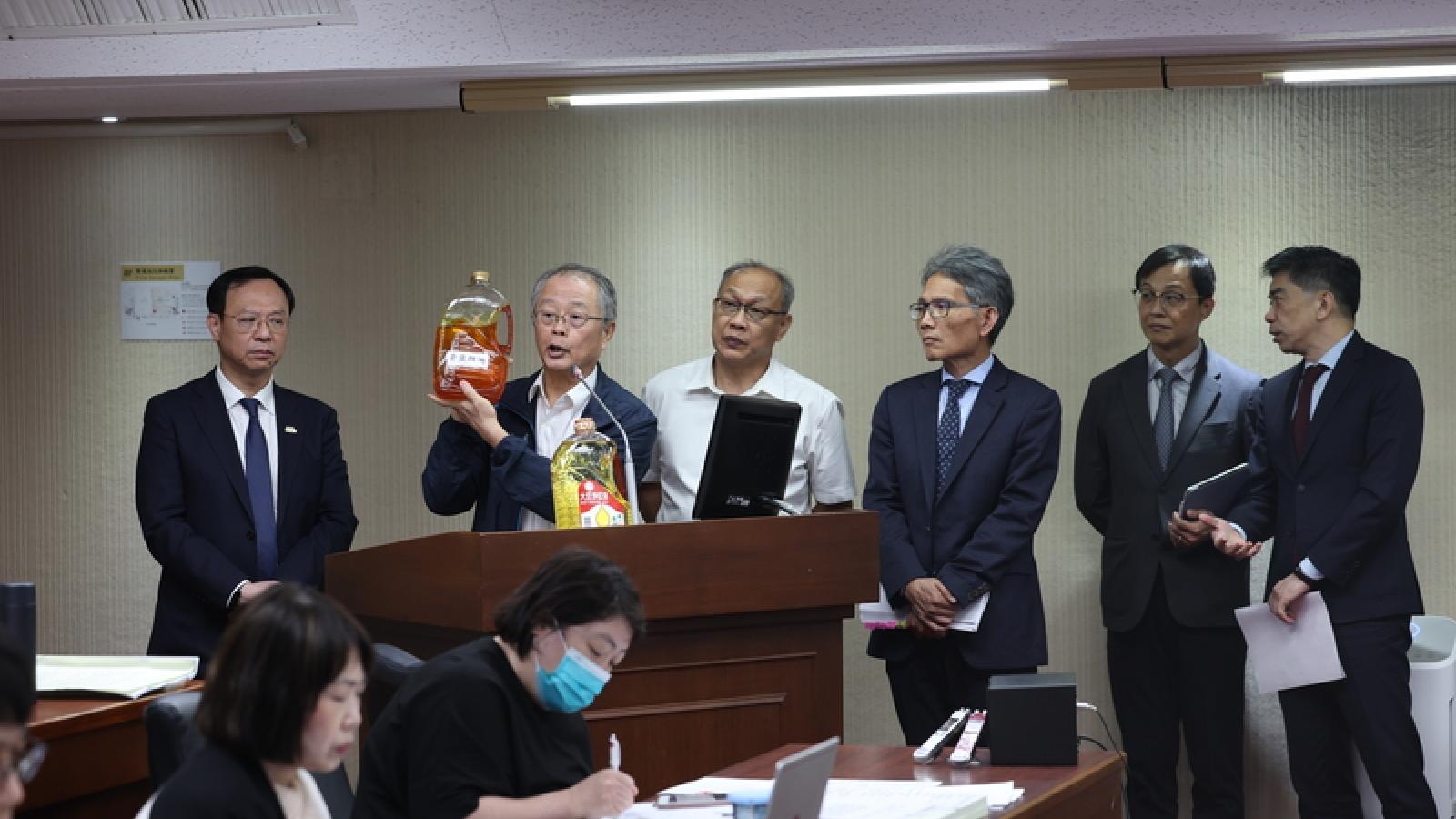
The 2013 black-heart oil incident left a deep impression on Taiwanese society. Thirteen years later, we thought that the system had been established and the food safety defense line had been reinforced. However, the Zhonglian Oil event told the people that a truly terrifying food safety crisis may not start from the factory but could come from the government. Because a government that knows the risk but does not immediately activate the warning mechanism is more unsettling than a bottle of problematic oil. What was truly shocking about this incident was not just the excessive benzo[a]pyrene, nor was it whether a single company was violating the law, but the governance capabilities and attitude of the entire government when facing the crisis. Since the incident broke out, what society has heard the most is not the truth, but various mutual blame-shifting. Some officials said there was no property right, so there was no responsibility; some officials said the oil did not enter the factory, so there was no obligation; some officials said it was a raw material, not a food product; some officials said the law did not clearly stipulate, so there was no need to report; even more absurd was a local official who compared 'food business operators' to 'consumers', believing that if a customer buys expired instant noodles at a convenience store and returns them, there is no need to report. They heavily criticized those who spoke the truth and provided professional opinions, even labeling them politically, and the sidelined net army launched a barrage of attacks, which was unbelievable. However, what the people really want to know is: since there were food business operators who knew about the high-risk health hazards, why was there not a single government agency that could immediately activate the food safety protection mechanism? This is a serious failure of government governance. There is an Arabic proverb: 'If you don't want to do something, you will always find an excuse; if you want to do something, you will always find a way.' The meaning of this is that when a person truly decides to accomplish something, difficulties and obstacles will not be reasons, and in the end, a solution will always be found. Government governance is not about starting to act only when every word in the law is clearly written; true mature governance is to take effective protective measures immediately upon discovering food safety risks. For administrative agencies, the law is the bottom line, not the ceiling. If the competent authority always speculates whether the law has clear regulations, or even if there are regulations but they are lightly interpreted in a restrictive manner to nullify the law, and do not care at all whether the people will be harmed as a result, then it is not rule by law, but the formalism of lazy bureaucrats. A modern and capable government should first establish risk governance (Risk Governance), not blame governance (Blame Governance). More worrying is that this case exposed another deeper crisis—the government seems to have gradually lost the ability of 'proactive governance.' After the food safety incident was exposed, various agencies were busy proving that they had no responsibility, rather than showing what they had done. Many officials were busy explaining how to shirk responsibility, but there was no leader who first explained to the people: what to do next? How to prevent the food safety storm from happening again? How to make up for the shortcomings of the system? What needs to be done is crisis management, not crisis public relations. In particular, the greatest responsibility of the government is not to criticize opponents in public and convince the people that they are not wrong, but to make the people believe in the system that the next time it will not happen again. In recent years, almost every major food safety incident in Taiwan has revealed a surprising common pattern: 1. Incident occurs. 2. Information is fragmented and confusing. 3. Central and local governments blame each other. 4. Legal interpretations diverge, and officials say different things. 5. Experts' opinions are not unanimous. 6. Finally, there is only the way of amending the law. 7. Then wait for the next untimed bomb, and so on in a cycle. What the public really cares about is not which party or which local government, which central ministry won the political offensive, but that the entire government has not established a governance system that can quickly identify risks, report information in a timely manner, coordinate and handle across ministries, and make transparent and open decisions. The many controversies surrounding the reporting obligations, the decision-making process of the expert meetings, and the direction of legal amendments in this incident also highlight that the design and operation of food safety systems still need to be clarified and strengthened. A truly responsible government is not afraid to admit that there are loopholes in the system; a truly dangerous government will only repeatedly use the fact that the law is not clearly stipulated to cover up governance incompetence. The people's eyes are sharp. Food safety governance is not just about reporting problems or food management; it tests whether the government has risk awareness; whether it has the ability to coordinate and integrate across ministries, central and local agencies; whether it is willing to be transparent and open; whether it truly puts people's health issues before politics. What the people really want is not for officials to shirk responsibility, not political rhetoric, not legal word games, but a government that is willing to step forward to protect the people the first time a food safety risk occurs. The biggest victims of this food safety incident may not just be consumers; what is truly eroded is the serious blow to the people's trust in the government's governance capabilities. Cancer-causing oil can be recalled; defective products can be taken off the shelves; companies can be held accountable. However, once the people begin to believe that the government's first thought when facing a governance crisis is how to clear itself of responsibility rather than how to reduce the people's food safety risks, then what is lost is not just a trust crisis, but the most important governance legitimacy of the entire democratic politics. History will record this food safety storm. What should be left is not just a few government agency penalty notices and meeting minutes, nor just a series of political figure attacks and verbal battles. What should be left is the lesson: food safety problems have never been just about raw material problems, process problems, or reporting problems, but about government governance problems; the real poison that harms the people is not just carcinogenic toxic oil, but absurd and seriously dysfunctional national governance. *The author is the Chief Prosecutor of the High Prosecutors Office.
FACT BOX
- Source: PR Times
- Category: News