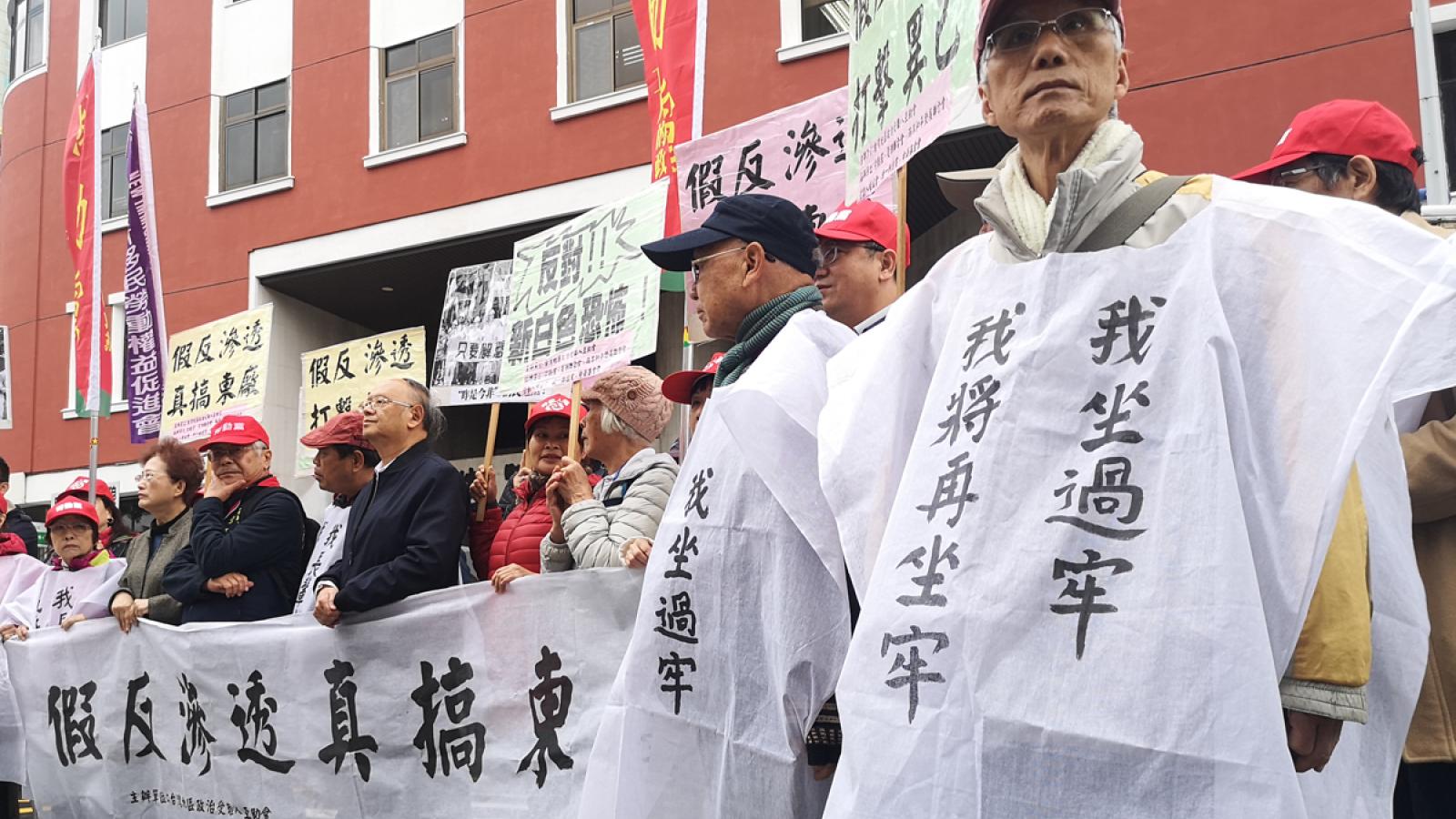
Seeing the achievements of Northern Europe, the construction of a social democratic welfare system requires political democratization to mature, political leaders with social democratic ideas to promote, and strong labor unions to support. The close cooperation between the Swedish Social Democratic Party and labor unions is a key factor in their success, and the strong labor force is the main force in influencing politics. The KMT government, which is vigilant against labor movements, is the biggest obstacle to the development of social democracy. The February 28th Incident and the White Terror in Taiwan were aimed at eliminating local intellectual elites and left-wing elements who were pro-communist, preventing campus and social unrest. Martial law was imposed, depriving people of freedom of speech, assembly, and association. For 38 years of martial law, Taiwan was like an 'anti-communist pure land'. Universities could not read socialist books, and even the Department of Sociology and Political Science at National Taiwan University could not open such 'ideological poison' courses. The Chinese Communist Party defeated the KMT through class struggle, so the KMT regarded labor movements as poisonous snakes and beasts, closely monitoring and prohibiting the development of labor movements. It was not until 1950, based on the 'Taiwan Province Labor Insurance Regulations', that labor insurance was established, initially providing benefits for injury, disability, childbirth, death, and old age; hospital medical benefits were implemented in 1956, and outpatient medical benefits were implemented in 1970. This was the earliest social insurance system implemented, but in my opinion, this approach of partially imitating public insurance to win over laborers still follows the German Bismarckian institutional thinking of controlling laborers through insurance benefits. Facing the suppression of labor movements by the KMT, in 1984, the democratic movement outside the party challenged its edge, and on Labor Day, together with Qiu Yiren, He Duannan, Yan Yingying, Su Qingli, Wang Lixia, Zhang Fuzhong, Fan Xunlv, Guo Jiren, and I, we jointly initiated and established the 'Taiwan Labor Legal Support Association'. Avoiding the words 'labor movement' and 'solidarity', it was named a 'service-oriented association' to avoid attracting the attention of the security forces. At that time, the United States used the 'Section 301 of the Trade Act' to pressure Taiwan with 'unfair labor dumping', and the government passed the 'Labor Standards Act', which coincidentally gave 'labor legal services' legitimacy. In 1988, it was renamed the 'Taiwan Labor Movement Support Association', and in 1992, it was renamed the 'Taiwan Labor Front', shouldering the mission of the labor movement. In 1985, the chairman of New Glass, Ren Hejun, fled with the money, and the employees tried to go to the Provincial Government to petition Governor Lee Teng-hui, but the tour bus was stopped halfway by the security forces. The Labor Support Association took on this thorny case, suggesting that they should petition to the Executive Yuan, take the train directly, and then go to the Executive Yuan in groups. In the martial law period, group protests were a taboo, and more than 600 New Glass employees made a sudden petition, shocking the security forces. Emergency troops and police were called in, and the banners were snatched away. They immediately took out small national flags from their backpacks and shook them in fear, repeatedly emphasizing that they were patriotic workers. Trying to protect themselves with a small national flag, how humble the workers in front of them were, but they had broken through the intimidation of the martial law period. The petition letter from New Glass employees was accepted by Zhao Shoubo, the then director of the Social Affairs Department of the Provincial Government. The general manager of New Glass could not bear the pressure and, under Zhao's witness, signed to agree that the employees would take over the factory, although it was a short-term self-rescue operation, it still created the first example of industrial democracy operated by workers. Taiwan has more than 1.6 million small and medium-sized enterprises, accounting for 80% of the employed population, but only less than 10% employ more than 30 employees, and most do not meet the conditions for organizing enterprise unions. Therefore, the unionization rate of enterprises is only about 6%. In a resource-poor environment, it is difficult for unions to survive. Unlike European unions with tens of thousands or even hundreds of thousands of members, and professional unions with broader links, most 'professional unions' in Taiwan are established only for labor insurance and are pseudo-unions that do not fight for rights. I advocate that the main force of the labor movement should be in 'public enterprise unions' and 'unions in large private enterprises', as the locomotive of the labor movement, to drive overall labor vitality. Although criticized by other labor movement groups for 'currying favor with 'aristocratic unions' and ignoring the more vulnerable small and medium-sized enterprise unions', they say that compared to public enterprise unions, wages and benefits are better, and they should not be the focus of the labor movement. But I believe that large unions have a large number of members, and through ideological education, creating issues and missions can promote national issues, even change policies, and drive small unions to follow up and achieve unity. In recent years, we have actively trained unions, strengthened ideological concepts, created issues, learned to analyze problems, formulate strategies, and implement action plans. We also helped cadres use union elections to defeat the KMT's control and regain union autonomy. CPC, CSC, TSM, telecommunications, postal services, Taipower, Taiwan Shipbuilding and Engineering, China Airlines, and the National Bank Employees' Professional Union have all become autonomous unions. At the initial stage of the implementation of the Labor Standards Act, it was common for overtime pay not to be paid according to the law. Many public enterprises also did so. According to Article 126 of the Civil Code, overtime pay belongs to 'periodic payment', and the statute of limitations for the right to request is five years. That is to say, overtime pay not received five years ago has expired and can no longer be claimed. The TSM Union was the first to take the lead, claiming five years of unpaid overtime pay, and the Labor Front cooperated to link public enterprise unions to resist and fight for it, successfully claiming it. This demonstrated the power of linkage and inspired various unions to follow suit. At the beginning, the scope of application of the Labor Standards Act was only limited to manufacturing workers. Service industry, defense industry, tourism, information industry, banking and insurance, environmental protection, gas stations, and medical care, about 2 million workers were excluded, and their labor rights were sacrificed. We assisted the bank employees in establishing a union and organizing training for the cadres, hoping that they could become the main force in expanding the scope of application of the Labor Standards Act. In 1995, the KMT, in order to win the presidential election, urgently wanted to win the labor vote. The process of including bank employees in the Labor Standards Act went through multiple rounds of cross-party negotiations and delays in the announcement by the Council of Labor Affairs. It was only thanks to the continuous resistance and lobbying of the bank employees that this case became a focus of cross-party negotiations. In the end, the KMT could not resist, and the banking industry finally officially applied the Labor Standards Act on May 1, 1997. This event was an important battle in Taiwan's labor history, benefiting a total of 550,000 employees nationwide. In 2010, to protest Israel's opening fire on a humanitarian aid ship, the Swedish port workers' union initiated a boycott of ships and goods from Israel, not helping to load and unload goods. Swedish unions not only fight for workers' rights but also often demonstrate political power to uphold justice. So far, Taiwan's labor movement is still limited to pursuing better working conditions. In fact, looking at the international situation and expanding the vision, unions should, as citizens, demonstrate altruistic spirit to contribute to the country and society, and influence the social system. Therefore, the training courses developed by the Labor Front are intensively carried out in unions across the country to establish social democratic ideas, so that various unions can lead the movement with ideology. The Labor Front is the most successful group in education and training in all social movements. Even the DPP, teachers, the Disabled Alliance, Cilin, URM (Urban Rural Mission City and Country Mission), and university clubs have all invited them to assist in training, increasing the energy of social movement linkage. In the 1995 legislative elections, the Labor Front initiated the 'anti-endorsement movement' for conglomerate legislators, inviting members of the Taiwan University Labor Society, Lin Zonghong, Zheng Lixuan, Wei Xisheng, and He Mingxiu, to judge based on the speeches and voting records of legislators, whether they spoke for the public interest and the rights of the weak, or were spokesmen for capitalists. They selected the 'conglomerate legislators' based on the 'Act for the Promotion of Industry', the 'Act for the Promotion of Participation in Elections', the 'Securities Transaction Tax Act', the 'Act for the Service of Employment', the 'Inheritance and Gift Tax Act', the 'National Health Insurance Act', the 'amendment of the Labor Standards Act', and so on. They printed 300,000 copies of a small booklet and distributed it to various unions, and held propaganda and lectures based on this, causing heated discussions and support. At that time, several legislators were named as conglomerate legislators, including one independent, one from the DPP, and the rest from the KMT. The named conglomerate legislators felt pressured, and several did not dare to run for election, and several also lost the election as a result. In addition, they actively linked the Disabled Alliance, Teachers' Association, Elderly Welfare Promotion Alliance, Parents' Association of People with Intellectual Disabilities, Women's New Knowledge Foundation, Eden Social Welfare Foundation, Taiwan Labor Front, Taiwan Bank Employees' Union, Taiwan Peace Promotion Foundation, and jointly established the 'Pan-Green Alliance'. They focused on the social safety net, the legislation of the National Pension, the prevention of tax cuts for the rich, and the establishment of a fair tax system. This strengthened the loopholes in the social safety net, promoted the rapid legislation of the National Pension, ended the convenient path for the rich to reduce taxes through the Act for the Promotion of Industry, and passed the legislation of the minimum tax threshold. Learning from Sweden's 'social service' system, young people can choose social service, environmental protection, education, firefighting, medical care, agriculture, and aboriginal village service according to their interests and specialties. The diverse military service can develop the potential of young people, which is beneficial to the construction of social democracy. It can also solve the dilemma of Jehovah's Witnesses who refuse to take up arms. In 2000, Taiwan officially implemented the 'Implementation Regulations of Alternative Service' (including social service and other categories), becoming the first country in Asia to establish a complete alternative service system. Leaders with non-violent and altruistic cultivation are an important cornerstone for consolidating social democracy and peaceful dialogue, and then establishing a social democratic system. Socialism advocates the dictatorship of the proletariat, which uses hatred of capitalists as motivation and uses violence to seize power, often degenerating into authoritarian politics. Sweden, on the other hand, establishes a social democratic welfare state with the spirit of 'people's home' and altruism, which is worth Taiwan's labor movement to learn from. Looking back, I was also fortunate to be recommended by the Canadian URM to go abroad for training.
FACT BOX
- Source: PR Times
- Category: News