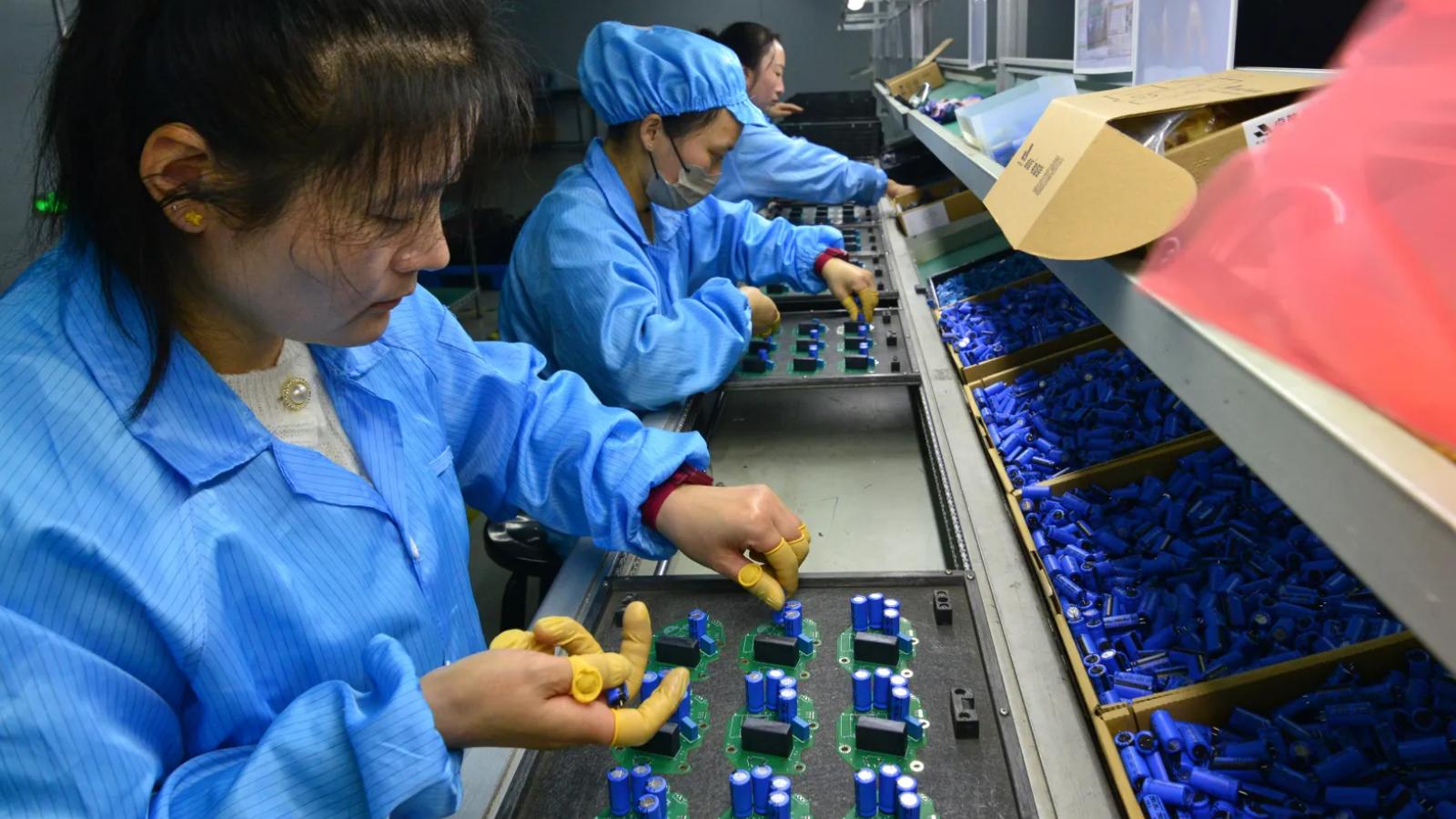
Dongguan, a city in Guangdong Province adjacent to Hong Kong, was known decades ago for manufacturing cheap toys, shoes, apparel, and electronics, propelling China into the role of the 'world's factory.' Today, Dongguan sits at the heart of a new industrial transformation: China is evolving into a 'factory for factories.' The Wall Street Journal reported on the 6th that China is no longer just a producer of low-value consumer goods, but is accelerating exports of high-value intermediate and capital goods that power global manufacturing operations, including chips, precision machinery, and industrial robot arms. Frank Jiang (Jiang Liming), Vice President of International Business at Topstar, a major Chinese industrial robot and machinery manufacturer, told The Wall Street Journal: 'Advanced manufacturing used to be dominated by Germany and Japan. But we believe our technology has caught up, and in many product areas, we've even surpassed them.' This growing control over a larger share of the global supply chain has made China's export machinery more robust and highly resilient to tariffs imposed on final consumer goods. According to McKinsey Global Institute's analysis of China's official customs data, in the first five months of 2026, China's exports of intermediate and capital goods surged 25% and 12% year-on-year respectively, while consumer goods exports grew only 4%. The 'China Shock 2.0' Threat The Wall Street Journal points out that China's industrial transformation is now threatening the 'economic moats' of advanced manufacturing economies such as the European Union, Japan, and South Korea. Companies in these countries that once produced chemicals, machinery, and batteries viewed Chinese factories as key customers. Now, Chinese firms are not only fierce competitors in global markets but are also entering their domestic markets. For the first time in decades, Germany's imports of advanced capital goods from China have exceeded its exports to China. This shift has triggered global alarm, with European leaders considering new protective measures against the so-called 'China Shock 2.0' threat. Although South Korea and Japan have benefited this year from a surge in AI-related exports, behind the AI boom, broad foundational industrial supply chains are steadily losing global market share. At Topstar's headquarters in Dongguan, screens display logos of its global client base: including U.S. manufacturing giant Jabil, South Korea's Samsung, Taiwan's Foxconn, and Chinese leaders Huawei and CATL. Topstar says it serves over 15,000 clients from more than 50 countries. Topstar's business is booming. Driven by strong demand from Mexico, Brazil, and Vietnam, its overseas sales last year grew nearly 10% to about $92 million. In the first quarter of 2026, Topstar's industrial robot business revenue surged 81% year-on-year, while its CNC machine tool business jumped 63%, with profits expected to more than double year-on-year in the first half. Moving Up the Value Chain The Wall Street Journal notes that China's journey from a global consumer goods assembly line to an advanced manufacturing powerhouse has been years in the making. Chinese policy encourages higher domestic content, promoting local component production. Under the 'Little Giants' program, the Chinese government provides subsidies, tax incentives, and low-interest loans to thousands of small and medium-sized enterprises specializing in high-tech manufacturing. A vast domestic market and fierce competition have accelerated industrial upgrading, supported by a well-developed supply chain network and infrastructure, enabling extremely high production efficiency. The experience of Henry Wang, General Manager of Dongguan's ICT Technology, epitomizes China's rise. When China joined the World Trade Organization (WTO) in 2001, 18-year-old Mr. Wang had just graduated from middle school and arrived in Dongguan from Heilongjiang Province in northern China with nothing. He lived in a cramped dormitory with 11 others, working on the assembly line at BBK Electronics—the predecessor of Chinese smartphone giants Oppo and Vivo. By 2012, Mr. Wang co-founded Dongguan ICT Technology, an 80-employee company specializing in exporting automated robotic systems used to assemble circuit boards for nearly all modern electronic products. He says the company sells equipment to global manufacturers—including U.S. giants IBM, Honeywell, and L3Harris—and relies almost entirely on China's domestic supply chain. Mr. Wang expects ICT Technology's revenue to grow by at least 50% this year, and the company is moving to a new headquarters twice the size of its current one. He emphasizes that tariffs have no impact on his company—so long as there is global demand for electronics, his employees will stay busy: 'The era of China simply being the world's factory is over. Now, China is helping the rest of the world build their factories. China cannot forever only export final consumer goods.' Tariffs Accelerate Industrial Shift, Benefiting Chinese Intermediate Goods McKinsey Global Institute's analysis of Chinese customs data shows that when the U.S. imposed new tariffs in 2025, China's consumer goods exports saw their first decline since 2019. However, exports of intermediate and capital goods increased by over $175 billion compared to the previous year, pushing China's trade surplus to a record $1.2 trillion. Jeongmin Seong, a partner at McKinsey Global Institute, noted: 'For advanced manufacturing economies, China is increasingly shifting from customer to competitor.' According to South Korea's national broadcaster KBS, battery electrolyte manufacturer Dongwha Electrolyte has incurred losses for several consecutive years due to intensified competition from Chinese rivals. Dongwha's CEO, Kim Jong-hun, told KBS: 'This is an extremely difficult situation—we must beat Chinese competitors in an unfair competitive environment.' Cherry Lee, a salesperson at Dongguan's Lituo Electronics, says customers have switched from Western brands to their components for Nescafé coffee machines and other appliances to cut costs. Since 2020, the company's sales have grown about 10% annually, with Mexico and Vietnam becoming its main export markets. Many companies have moved production lines out of China to avoid U.S. tariffs, but this has instead accelerated industrialization in Southeast Asia and Latin America, creating further business opportunities for Chinese factories producing intermediate and capital goods. In São Paulo, Brazil, Poliana Lanari, Managing Director for Latin America at German heavy industrial connector manufacturer Harting, says Chinese competitors offer up to 30% discounts on mass-market products with continuously improving quality, 'which is already severely affecting our growth rate.' In Germany, Jungheinrich's CEO Lars Brzoska estimates that Chinese manufacturers' market share in Europe's industrial forklift market has surged from 11% in 2019 to 30% today. Initially targeting the mid-tier 'good enough' market at half the price of Western peers, Chinese firms are now establishing R&D centers and production bases locally. In response to this pressure, Jungheinrich formed a strategic partnership last year with Chinese forklift maker EP Equipment and lowered its profit forecast for the year. Samson Shi, General Manager of Dongguan's Tortai Technologies, which specializes in PCB manufacturing and electronic manufacturing services (EMS), expects the company's sales to grow about 30% this year. Regarding European complaints about China's strong export performance, he says: 'China doesn't force anyone to buy our products. Our success comes not just from price advantages, but from providing comprehensive customized services like engineering design.'
FACT BOX
- Source: PR Times
- Category: Survey
- Organizations: Jabil / Samsung / Foxconn