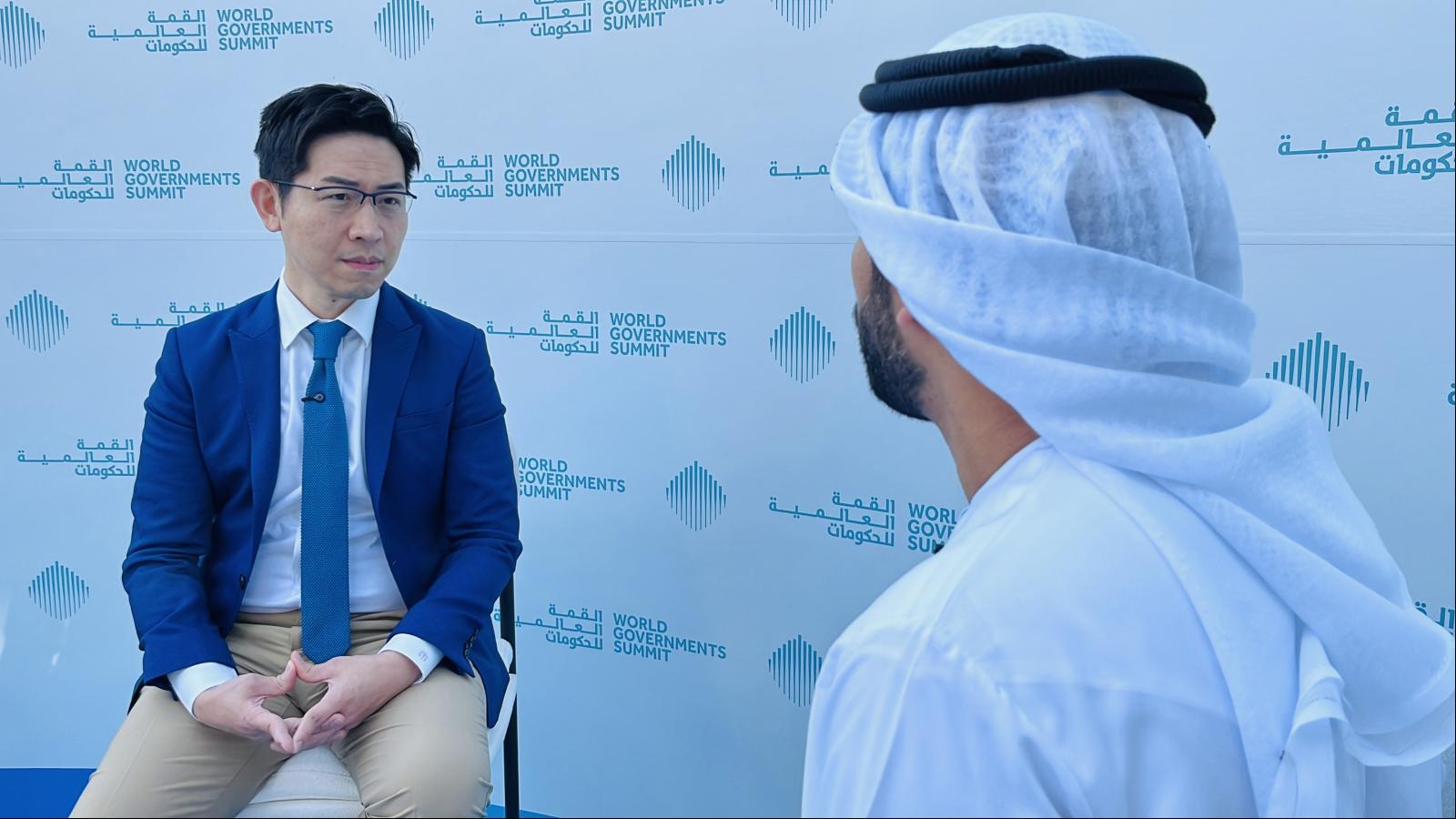
Zhang Jingyi, a Taiwanese journalist who covered the White House for 15 years, relocated to Abu Dhabi in the United Arab Emirates in early 2025 and experienced the entire US-Israel-Iran war that began on February 28, 2026. He compiled his observations and thoughts into a new book, "Windows of War: A White House Reporter's Frontline Coverage of the US-Israel-Iran Conflict, and a Look at the Global Shifts," which was published on July 31. A week later, on August 7, I had a video call with Zhang, who was 6,700 kilometers away in Taipei, to discuss his firsthand experiences of the war and the global situation.
Is Taiwan in a parallel universe? Tang Xianglong has mentioned more than once on his radio show that he knows two people with the surname Zhang, both from Yunlin, who are "eccentric." One is Zhang Jingyi, and the other is me. Comparing me with Zhang Jingyi makes me feel embarrassed. Zhang Jingyi has always been someone I respect and admire. I can't remember when I started becoming a loyal viewer of his show "Yi Jian" and learning from his observations, analysis, and broad-mindedness.
I still remember his "farewell special" before he decided to leave the US and go to the Middle East. His deep disappointment with the current state of American politics and his compassion for the American underclass were very moving. Zhang Jingyi's farewell was a testament to the decline of the US and the great changes in the world. The outbreak of the US-Israel-Iran war proved his keen sense of smell and declared to the world that no one can stay out of this transformation.
Just before I interviewed Zhang Jingyi, American media reported that the US military was facing a dire situation of running out of ammunition, while Iran was negotiating the reopening conditions of the Strait of Hormuz with Oman. The situation was full of uncertainty, and it was clear that this war was full of deception and change. However, Taiwan's media seemed to be in another parallel universe. Talk show hosts and guests discussed the war with excited and joyful attitudes, "predicting" that "China will collapse" under the squeeze of the Ukraine war and the Iraq war. Meanwhile, the highest point of power in Taipei, the Presidential Office, was receiving groups of American legislators one after another, under the name of "democratic alliance," secretly plotting to introduce military procurement of weapons.
Hidden Western Hatred and Prejudice? I asked Zhang Jingyi, as the first Chinese-language media member in the 100-year history of the White House Correspondents' Association, and someone who has studied and worked in the US for many years, what prompted him to decide to leave in 2025. Our conversation was interspersed with his deep thoughts, pauses, choking, and furrowed brows, and it was clear that his emotions were genuine. He said that when he personally witnessed students supporting Palestine being violently suppressed, he saw an unbelievable double standard, but the White House press corps could wear formal evening wear and raise their glasses, completely ignoring "human rights" and "press freedom."
One of the roots of this lies in the increasing white supremacy in the US. Zhang Jingyi pointed to his own face and said that Chinese people here not only suffer from discrimination but also face life-threatening dangers. In New York, 1 in 5 Chinese people have experienced direct violence. The history of the abolition of slavery has almost made people forget that the cultural foundation of the US has always been white supremacy. "I don't want my children to be seen as an inferior race, to be treated as second-class citizens. I want them to grow up in a diverse and equal environment, and only after making the right judgment can they truly embrace this world," Zhang Jingyi said frankly.
The interview with Zhang Jingyi was a conversation full of warmth. In addition to the analysis of geopolitics, it was more about the display of humanity and morality. I was moved and excited because the person in the camera represented the "our path is not lonely" that still exists in the media industry. In the busy interview work, Zhang Jingyi still found time to complete a 130,000-word work, which is really admirable. One of the motivations was that he hoped to break away from and break through Western prejudices and lead readers to understand the real context behind the war.
"Misunderstandings caused by hatred and hostility are rampant in Western media reports, but the historical background that led to such results is often omitted. If we directly translate Western reports without understanding the historical causes, we are directly accepting Western perspectives and judgments." The fierce anti-American sentiment of the Iranian people made people forget that before 1979, Iran had a very pro-American Pahlavi dynasty. Its dictatorial and corrupt rule eventually led to the rise of a theocratic regime. Zhang Jingyi reminded that when people follow the Western context to blame Iranian leaders as "anti-American religious fanatics," they have completely decontextualized religious conflicts, historical entanglements, and oil interests.
Why did the Iranian people "run back"? Therefore, when the US and Israel invaded Iran, the Iranian people did not choose to "run out" like in other wars, but "run back," uniting under the banner of the nation. This scene was very shocking to Zhang Jingyi. Based on his long-term experience of reporting in the US, Zhang Jingyi mentioned that Israel's control over US politics and media was beyond imagination, and even the US mainstream media's reports involving Israel and Palestine, in addition to self-censorship, had to be sent to Jerusalem for review. When prejudice dominates everything, the US naturally underestimated Iran's national character and resistance will, and thus launched a war that was doomed to fail from the beginning.
The book's introduction reads: "When the war is still far away, we talk about the situation, analyze hegemony, and compete for the right to speak; when the war has come to the window, you only have one thing left─can you protect your loved ones?" One of the motivations for Zhang Jingyi's writing was to let readers see the cruelty of war. When those in power decide to ignite the war, the sacrifices are always the unarmed civilians.
I asked him, after seeing the ruthlessness of the Middle East war, what would you like to say to your Taiwanese relatives and family? Zhang Jingyi did not give an answer right away, but talked about the reality that the US has never protected its allies, only taking care of its own military bases, which has caused great disasters for its allies. He also mentioned the fact that Oman, a country that does not allow the US to set up bases and maintains friendly relations with its neighbor Iran, has thus avoided the impact of the war. Finally, he distilled it into 8 words: "Be good to your neighbors, make friends with your opponents."
"Do not easily entrust your fate to distant forces, ultimately you have to take control of it yourself." This is the "secret trick" and "journalist's benevolence" given by Zhang Jingyi, who calls himself an "international journalist."
Zhang Jingyi published his new book "Windows of War," reporting firsthand information about the Middle East to the audience in front of the window of war, analyzing the political factors behind the conflict, and looking at this international major change. (Provided by the publisher)
*The author is a veteran media person and the executive director of the Yuanxiangren Cultural Workshop.
FACT BOX
- Source: PR Times
- Category: 其他