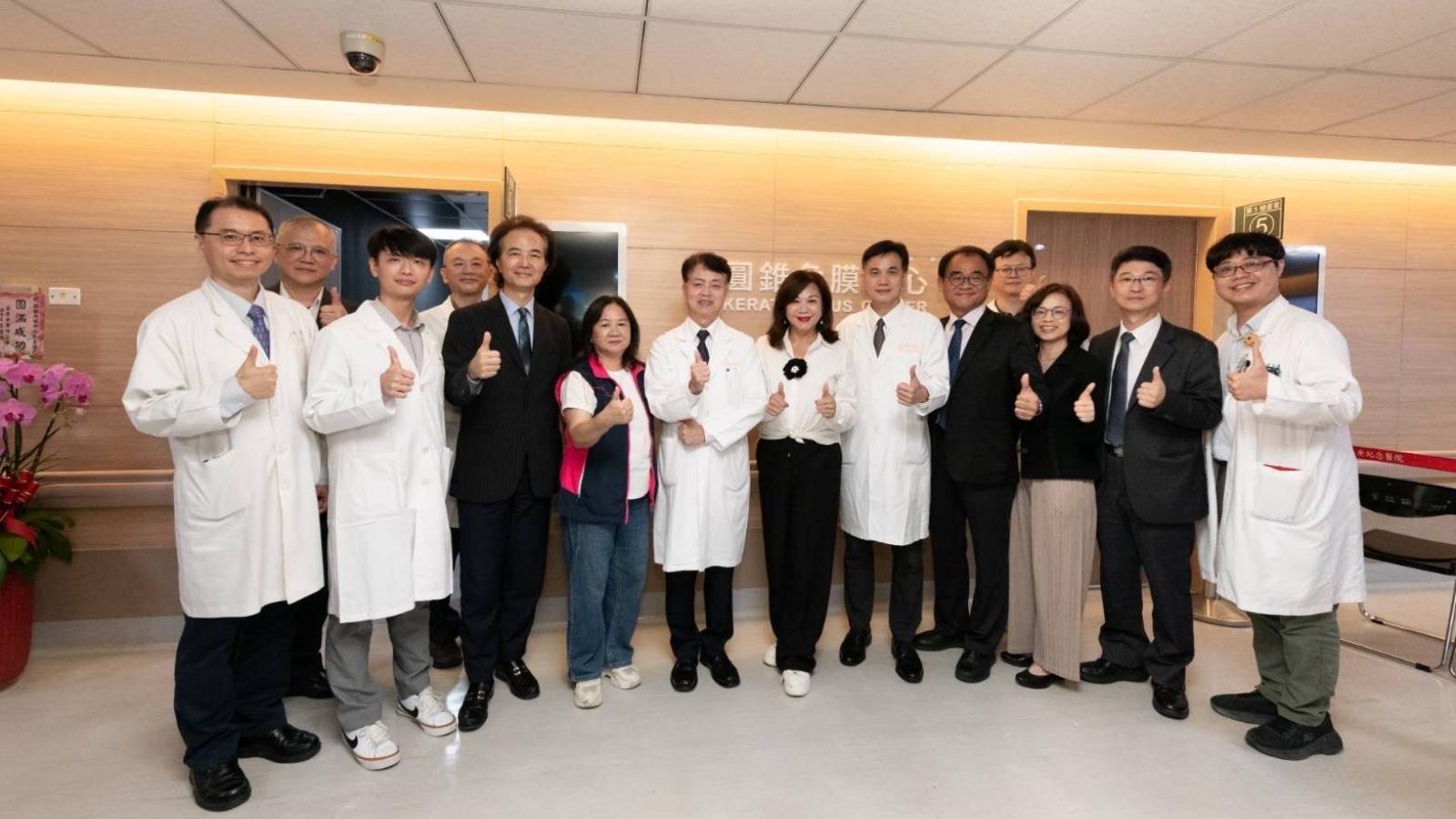
A sudden surge in astigmatism, coupled with persistent blurry vision despite frequent eyeglass changes, may signal more than just worsening myopia. Keelung Chang Gung Memorial Hospital has officially launched its Keratoconus Center, with Vice President Sun Chi-Chin, Keelung City Deputy Mayor Chiu Pei-Lin, and Hospital Director Dr. Wu Chun-Te jointly unveiling the center to initiate integrated cross-departmental care. The initiative targets adolescents, allergy sufferers, and individuals with chronic eye-rubbing habits, aiming to detect abnormalities before significant corneal deformation occurs.
The inauguration ceremony was witnessed by Keelung City Health Bureau Deputy Director Kuo Hsiang-Lan, Keelung City Medical Association President Wang Chun-Chieh, and the hospital’s medical team. The hospital estimates that approximately 40,000 people in Taiwan suffer from keratoconus, yet many remain undiagnosed due to subtle early symptoms, only discovering the condition after severe vision deterioration.
Blurry Vision Despite New Glasses – Chronic Eye-Rubbing May Worsen Corneal Deformation
Keratoconus is a condition where the cornea progressively thins and bulges forward into a cone-like shape, commonly affecting individuals from adolescence to around age 30. Early symptoms often include rapid progression of myopia or astigmatism, double or distorted images, night-time glare, and poor vision correction even with glasses.
Dr. Chan Yuan-Hsi, Director of the Keelung Chang Gung Keratoconus Center, emphasized that chronic eye-rubbing is a major risk factor accelerating disease progression. Patients with allergic rhinitis, atopic dermatitis, asthma, or autoimmune diseases often experience itchy eyes and repeatedly rub them, increasing their risk of corneal changes. If left untreated, the condition may lead to corneal scarring, and in severe cases, corneal transplantation may be required.
Four Departments Unite to Target High-Risk Groups – Advanced Screening for Early Detection
The Keratoconus Center integrates ophthalmology, dermatology, rheumatology, and pediatrics to establish referral and screening pathways for high-risk patients. The ophthalmology team uses corneal topography, optical coherence tomography (OCT), and corneal biomechanical analysis to assess corneal shape, thickness, and structural changes, tailoring follow-up and treatment plans accordingly.
Dr. Chan noted that the center has established a dedicated clinical space on the fifth floor of the ophthalmology outpatient department, consolidating diagnostic equipment, image analysis, and clinical workflows in one location. This allows patients to complete evaluations, tests, and follow-ups efficiently, minimizing inter-departmental transfers and wait times.
Don’t Ignore Sudden Astigmatism Increase – Doctors Urge Early Evaluation for Warning Signs
Dr. Chan warned that adolescents experiencing rapid increases in myopia or astigmatism, persistent blurry vision despite new glasses, frequent image distortion or night-time glare, or those with severe allergies and chronic eye-rubbing habits, should seek ophthalmic evaluation promptly. Treatments such as corneal collagen cross-linking must be individually assessed by physicians based on corneal condition and disease progression.
Dr. Wu Chun-Te stated that the establishment of the Keratoconus Center aims to provide comprehensive local care for residents in Keelung and the northeastern region. The hospital plans to build a clinical database and standardized care protocols, continuing efforts in high-risk population screening and corneal disease research.
FACT BOX
- Source: PR Times
- Category: Event