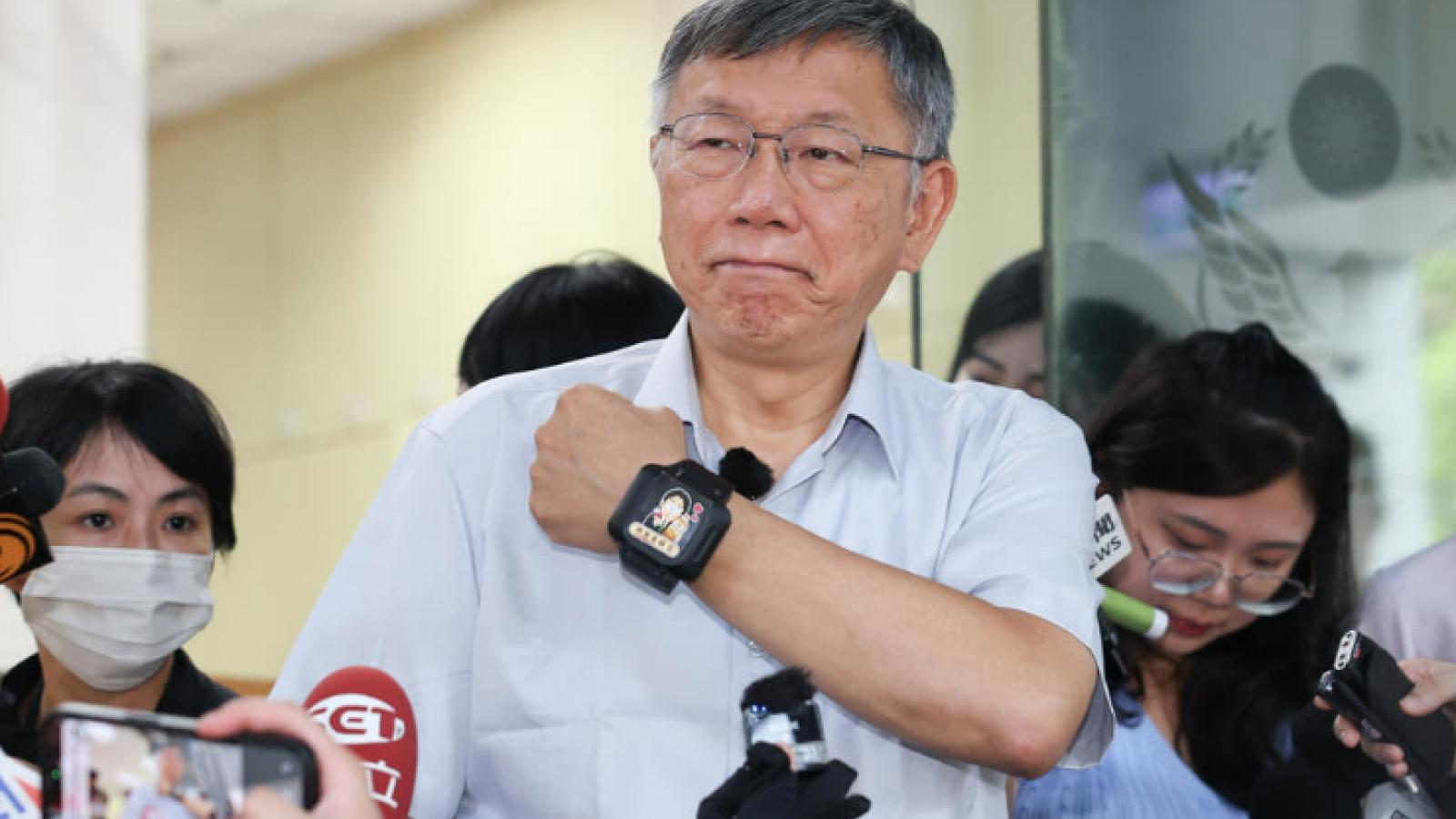
On the morning of August 5, 2026, Ko Wen-je appeared at the Ren'ai Road Police Station of Taipei's Zhongzheng First Precinct, leaning on a cane, to replace his long-worn electronic ankle monitor with an electronic wristband. After the switch, he proudly displayed the wristband—adorned with a 'Lai Er Xiao Zhang' (Principal Lai) cartoon sticker and the handwritten words 'I am Benzopyrene'—joking, 'This will become fashionable from now on' and 'It'll spark a watch-wearing trend.' At the same time, news continued to spread about Wu Nai-jen, a senior figure in the Green Camp, who had failed to repay NT$170 million to Taiwan Sugar and was caught being chauffeured to a gym during the gap between court-ordered detention attempts. These two incidents, occurring within a week of each other, jointly exposed the most delicate fissure in Taiwan's judicial enforcement landscape: the visibility of technological surveillance and the selectivity of enforcement are simultaneously eroding public trust in the rule of law.
The Semiotics of a Wristband: From Humiliation to Parody
The legal facts of Ko Wen-je's case are not complicated. In the first instance of the Jinghua City case, he was sentenced to 17 years in prison and six years of civil rights deprivation; the appeal has been transferred to the Taiwan High Court. Since his release on bail on September 8, 2025, Ko has been restricted from leaving the country or island and has worn an electronic ankle monitor. This restriction was extended for another eight months starting May 15, 2026. The official reason for switching to a wristband is the frequent malfunction of the original ankle monitor's alert system—media reports indicate over 3,800 false alarms—leading the High Court to rule that from August 5, 2026, to January 14, 2027, he would be monitored with a less intensive electronic wristband.
Ko Wen-je himself is unimpressed. He quipped, 'Maybe the Ministry of Justice wants to showcase all the restraints? First the ankle monitor, then the wristband—next, will there be an electronic collar?' His wife, Chen Pei-chi, earlier revealed on Facebook that Ko believes 'switching from an ankle monitor to a wristband carries the same monitoring function but greater humiliation.'
It is within this context that the appearance of the 'Lai Er Xiao Zhang / I am Benzopyrene' sticker instantly elevated a net meme into a political symbol. 'Benzopyrene' is a keyword from Taiwan's recent tainted oil scandal. A Blue Camp 'net staffer,' Wei Chun-yu, created a short film titled 'Oil Cannot Deceive You' under the name 'Father of Principal Lai,' opening with 'I am Benzopyrene' in a voice strikingly similar to Lai Qing-de, sparking deepfake controversy. The Taipei District Prosecutors Office has opened a separate investigation to determine possible forgery of private documents.
By turning the wristband into a vessel for this meme, Ko Wen-je executed a precise 'soft resistance.' He did not deny being under technological surveillance but used humor to 'de-threaten' the monitoring device—the wristband is no longer a restraint but a fashion accessory; 'Benzopyrene' is no longer a carcinogenic chemical but a metaphorical target aimed at those in power.
In terms of communication impact, this move clearly succeeded. Ko posted three photos on social media showing him wearing the electronic wristband, and public reaction was polarized: some praised him as 'cool' and 'unyielding,' while others criticized him as 'shameless' and 'a corruption whirlwind.' Regardless of praise or criticism, attention was successfully captured. This illustrates precisely that in Ko Wen-je's media strategy, judicial humiliation can be transformed into political capital—as long as the subject is willing to perform.
The 'Parkinson’s Disease' at the Gym: Another Judicial Narrative
In stark contrast to Ko Wen-je's active 'showing' of the wristband is Wu Nai-jen's passive 'exposure' at the gym.
Wu Nai-jen was ordered to repay NT$170 million in principal and interest due to the Taiwan Sugar land sale case, but he delayed payment for years. On June 3, 2026, Taichung District Court commissioned Taipei District Court to execute an arrest, but prosecutors and police arrived to find him absent. Wu only turned himself in on June 11 and was detained for just 12 days before Taiwan Sugar withdrew its detention request, leading to his release. During this period, court press releases stated that Wu suffered from severe Parkinson’s disease, was unable to care for himself, and lived with his children.
But eyewitness accounts shattered this narrative: on June 4 and 8, Wu was twice driven by a chauffeur in a luxury car to a gym co-owned by his son, Wu Yi-han, in Taipei’s Da’an District, then driven back to his home in Sanxia, even stopping to buy ice cream. Taipei City Councilor Chang Szu-kang questioned why Wu went out 'almost without disguise, not even wearing a mask, as if he had nothing to fear.' Wang Hung-wei bluntly stated that in the footage, Wu 'clearly does not appear to have Parkinson’s or be unable to care for himself.'
In an interview after switching the wristband on August 5, Ko Wen-je directly attacked this issue: 'Wu Nai-jen is someone Lai Qing-de guaranteed with his political life. He’s Lai’s godfather. How can I compare?' The power of this statement lies not in factual claims but in its precise exposure of two coexisting judicial standards: one for Ko Wen-je, involving electronic ankle monitors, wristbands, travel bans, and weekly High Court monitoring; the other for Wu Nai-jen, involving failed arrests, 12-day detention, and Taiwan Sugar’s voluntary withdrawal of the case.
The Real Issue Behind the Contrast: The 'Visual Fairness' of Rule of Law
Placing these two incidents side by side, what truly deserves the attention of think tanks and society is not whether Ko Wen-je has a sense of humor or whether Wu Nai-jen actually has Parkinson’s disease, but the gap in Taiwan’s judicial enforcement system across 'visual' and 'substantive' levels.
First, the 'performative' nature of technological surveillance is too strong. The ankle monitor’s 3,800+ false alarms reveal serious flaws in the technical system; imposing it on defendants before fixing these flaws carries a 'do first, explain later' performative tone. Ko Wen-je’s 'Lai Er Xiao Zhang' sticker, in a way, uses parody to expose this performance—when monitoring devices become stages for political symbols, their substantive function is undermined.
Second, the 'selectivity' of enforcement is too obvious. In Wu Nai-jen’s case, the court claimed 'could not locate,' Taiwan Sugar voluntarily withdrew the case, and detention lasted only 12 days—each step may pass legal scrutiny, but together they paint a picture of 'the wealthy and powerful can navigate the judicial system.' Former legislator Kuo Cheng-liang bluntly said: 'Wu Nai-jen is like Lord Mengchang, extremely wealthy. I don’t believe he has no money.' When the legitimacy of judicial procedures depends on whether the party 'cooperates' rather than the system’s inherent strength, the authority of the rule of law is eroded.
Third, the contrast effect in public opinion is reshaping the political landscape. Media commentator Yao Hui-zhen asserted that the contrast of Wu Nai-jen 'not repaying debt, not going to jail, yet being chauffeured to the gym' will ignite public anger, 'and the bill will likely be paid by the DPP in year-end elections.' Ko Wen-je’s camp clearly realizes that juxtaposing images of his 'technologically monitored' self with Wu Nai-jen’s 'gym visits during detention' is the cheapest and most effective political narrative material.
When the Judiciary Becomes a Meme Battlefield
Returning to the electronic wristband labeled 'I am Benzopyrene,' it is both Ko Wen-je’s reactive gesture and a microcosm of Taiwan’s current political-judicial ecology: when the solemnity of the judiciary cannot suppress public ridicule, and when selective enforcement fails to uphold institutional dignity, parties have both motive and space to turn wristbands into stickers and courtrooms into stages.
The real question may be: Why is it Ko Wen-je turning the wristband into a meme, rather than the judicial system itself offering a convincing explanation? Why are citizens filming Wu Nai-jen entering the gym, rather than prosecutors locating him during detention? When the rule of law depends on the 'self-awareness' and 'cooperation' of individuals to function, and when technological surveillance becomes a fashion accessory with stickers, what we see is not the victory of one side, but the chronic erosion of the entire system’s credibility.
The wristband will be removed on January 14, 2027; the gym footage will fade with the news cycle. But the label 'Benzopyrene' will likely remain firmly stuck to the judicial credibility of this era—impossible to wash off, impossible to peel away.
*Author is a freelance writer
FACT BOX
- Source: PR Times
- Category: News