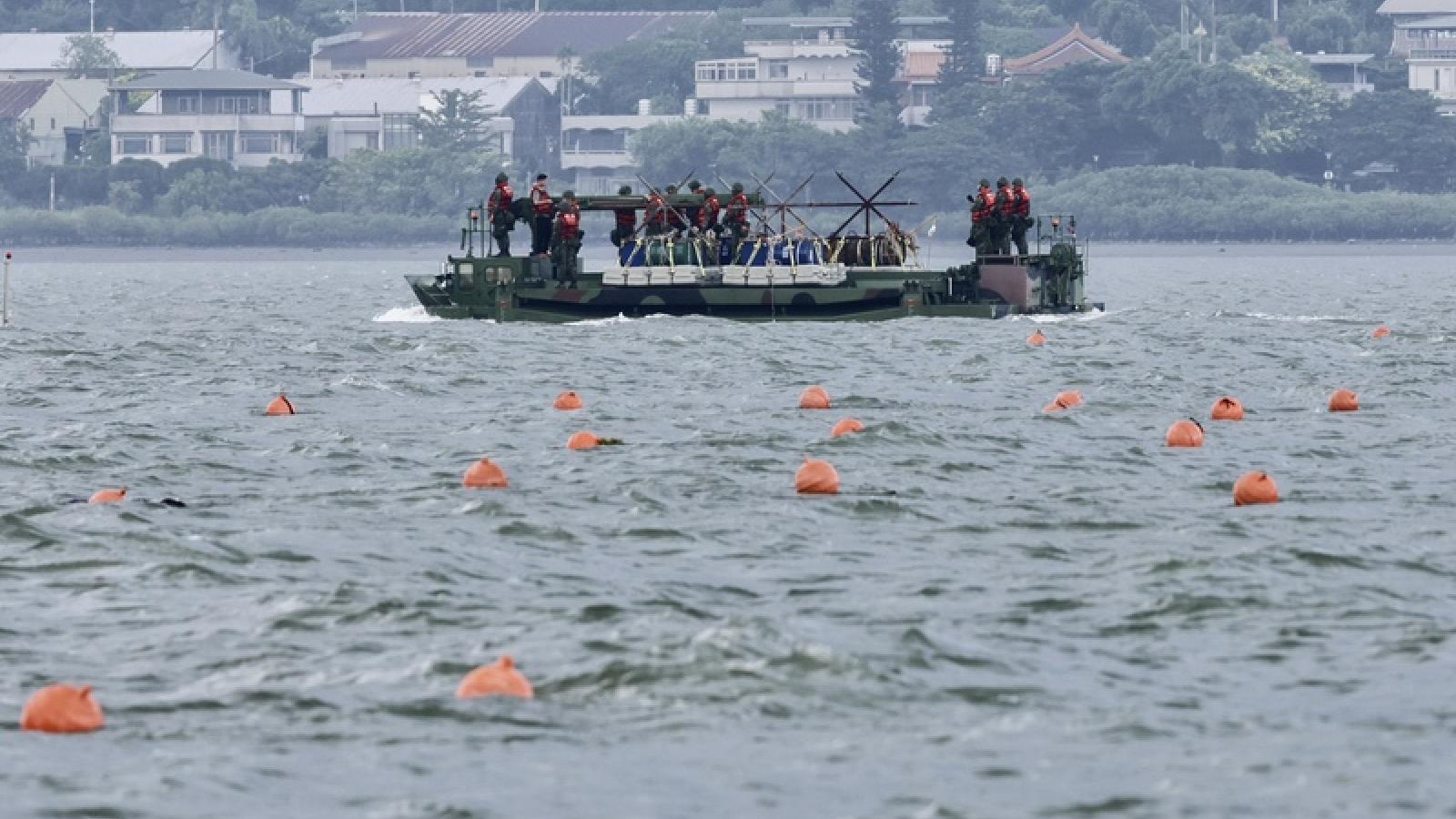
The Republic of China Armed Forces' 'Han Kuang 42' live-fire exercises have commenced, with the Matsu Defense Command simulating a scenario in which critical infrastructure is sabotaged by unidentified individuals. The exercise deployed CM21 armored personnel carriers, drones, and reserve forces to conduct drills on search operations, engagement, crowd evacuation, and facility reinforcement.
Frankly speaking, such drills are not meaningless. Consider the scenario where the enemy dispatches small special operations units, armed infiltrators, or uses internal collaborators to sabotage key facilities such as power plants, communication stations, bridges, and ports. Whether defending forces can rapidly reach the site, seal off the area, search for enemy presence, evacuate civilians, and regain control is indeed fundamental to defensive operations. Especially in Matsu, which lies on the frontline, the enemy may not initially aim to completely destroy all facilities but might instead attempt to paralyze, occupy, or even preserve certain nodes for future operations.
From this perspective, armored vehicles and infantry rushing to the target zone are not mere theater. However, the crux of the issue lies in the fact that the seven words 'critical infrastructure is sabotaged' encompass a far more complex battlefield than a scenario involving a few hypothetical infiltrators awaiting reinforcements.
The starting point of modern warfare is not 'arrival.' True modern warfare does not wait for troops to arrive before combat begins. A more realistic script is this: at the outbreak of war, undersea cables are severed, network backbones are paralyzed, base stations and radar sites are precisely destroyed by missiles, cruise missiles, or drone swarms; key substations, power nodes, bridges, interchanges, and transportation hubs are simultaneously struck in multiple waves. At the same time, cyberattacks, electronic jamming, and cognitive warfare unfold on a massive scale.
At this stage, the question is no longer 'can the troops send personnel to the site,' but rather—'even if personnel arrive, what can they actually do?'
Armored vehicles can transport troops to damaged facilities, but they cannot reconnect severed undersea cables; infantry can cordon off the site, but they cannot instantly restore power to a destroyed substation; drones can search for enemy activity nearby, but they cannot restore operation to a disabled base station. If the facility itself has been destroyed by attack, what troops can do upon arrival is often limited to maintaining security, conducting rescue operations, clearing unexploded ordnance, preventing secondary disasters, or assisting repair crews in entering the site.
What truly determines whether a nation can continue to function has never been 'who arrives first at the scene,' but whether there is subsequent engineering repair capability, backup communications, alternative power supplies, and cross-departmental command and coordination resilience.
In other words, what media cameras capture primarily verifies 'arrival capability' and 'engagement capability'; but what modern warfare urgently needs to verify is 'whether the nation can continue operating after system failure.' The gap between the two is worlds apart.
Defending critical infrastructure cannot be accomplished by a single armored unit alone. A complete critical infrastructure defense system should encompass at least five layers:
First, military alertness and anti-infiltration. When facilities are occupied or sabotaged by enemy special forces, can military and police quickly seal off, search, and retake them?
Second, engineering repair capacity. Can Taipower, Chunghwa Telecom, transportation agencies, local governments, and private contractors rapidly enter the site and conduct repairs under wartime conditions?
Third, alternative systems and backup mechanisms. When the primary system fails, can satellite communications, microwave communications, military independent networks, mobile base stations, generators, energy storage devices, and backup command centers immediately take over?
Fourth, cross-regional dispatch and rerouting capability. If a region suffers power outages, network disruptions, or severed roads, can neighboring regions provide power, communication, and transportation support?
Fifth, information order and social resilience. When people's mobile phones lose connectivity, TV signals are cut off, and social media is flooded with disinformation, through what channels can the government issue credible commands? How should the public discern the truth?
If exercises only verify the first layer and never comprehensively test the latter four, then what we see is ultimately just a group of brave soldiers arriving at a non-functional ruin, not truly meaningful national defense.
Even more dangerous is the second wave of attacks. It is worth noting that the enemy will not conduct just one strike. The first wave destroys facilities; the second wave is likely to target repair personnel and engineering convoys. Drones can continuously monitor the site, and once repair activities are detected, launch another attack. This means Taiwan cannot merely prepare a single repair team but must establish a decentralized, concealed, rotating, and second-echelon support mechanism. Otherwise, repair once, destroy once—the system will ultimately fail to sustain.
If the enemy uses force against Taiwan, it may not solely rely on missile bombardment but is more likely to adopt a hybrid warfare model: first using cyberattacks to paralyze systems, then electromagnetic interference to suppress communications, followed by cutting undersea cables, destroying radars and base stations, simultaneously dispatching special forces to attack backup nodes, and finally creating panic and chaos through cognitive warfare.
The real target may not be to completely flatten all of Taiwan's facilities at once, but to thoroughly disrupt Taiwan's social nervous system—when the central government cannot communicate with local governments, local governments cannot coordinate with police and fire departments, hospitals don't know where to send the injured, the military cannot verify the authenticity of orders, and the public cannot distinguish credible information. Even if physical facilities are not entirely destroyed, national operations will already be paralyzed.
What Han Kuang exercises should truly simulate is 'after the nation goes offline.' Deploying armored vehicles, infantry, and drones to damaged facilities to confront infiltrators and armed saboteurs is certainly necessary. But this only answers 'can troops reach the site,' not 'can the nation continue operating after infrastructure fails.'
What truly needs to be verified is not just whether troops can search, engage, and evacuate crowds, but whether, when undersea cables are severed, base stations and radars destroyed, power nodes disabled, and bridges and transportation hubs severed, the government can still maintain basic command, issue credible information, coordinate repair resources, and enable the military, police, fire, medical, and local governments to continue operating in coordination.
A more realistic question is: when the first wave of repair personnel arrives and is then targeted by drones and a second wave of attacks, does Taiwan have alternative communications, decentralized power, rerouted networks, backup command centers, and second-echelon repair capabilities?
What Han Kuang exercises should truly verify has never been merely 'can personnel be dispatched to the site,' but whether, even if networks are severed, communications fail, and power is damaged, this nation can still issue commands, transmit information, maintain order, and continue fighting.
Therefore, the Ministry of National Defense and the central government must clearly explain to the public: if a war in the Taiwan Strait breaks out and Taiwan's networks, communications, and power are simultaneously severely damaged at the outset, how will command orders be issued? Where will the public obtain credible information? How will local governments communicate with the central government? How will police, fire, and repair units continue to operate under conditions of severed networks, power outages, and blocked roads?
Are these backup mechanisms concrete, feasible action plans, or merely paper exercises? Have they ever undergone comprehensive stress testing under harsh conditions close to real combat?
The answers to these questions are the true core of the Han Kuang exercises—and the truth the public truly needs to know.
*Author is an asset management expert
FACT BOX
- Source: PR Times
- Category: News